
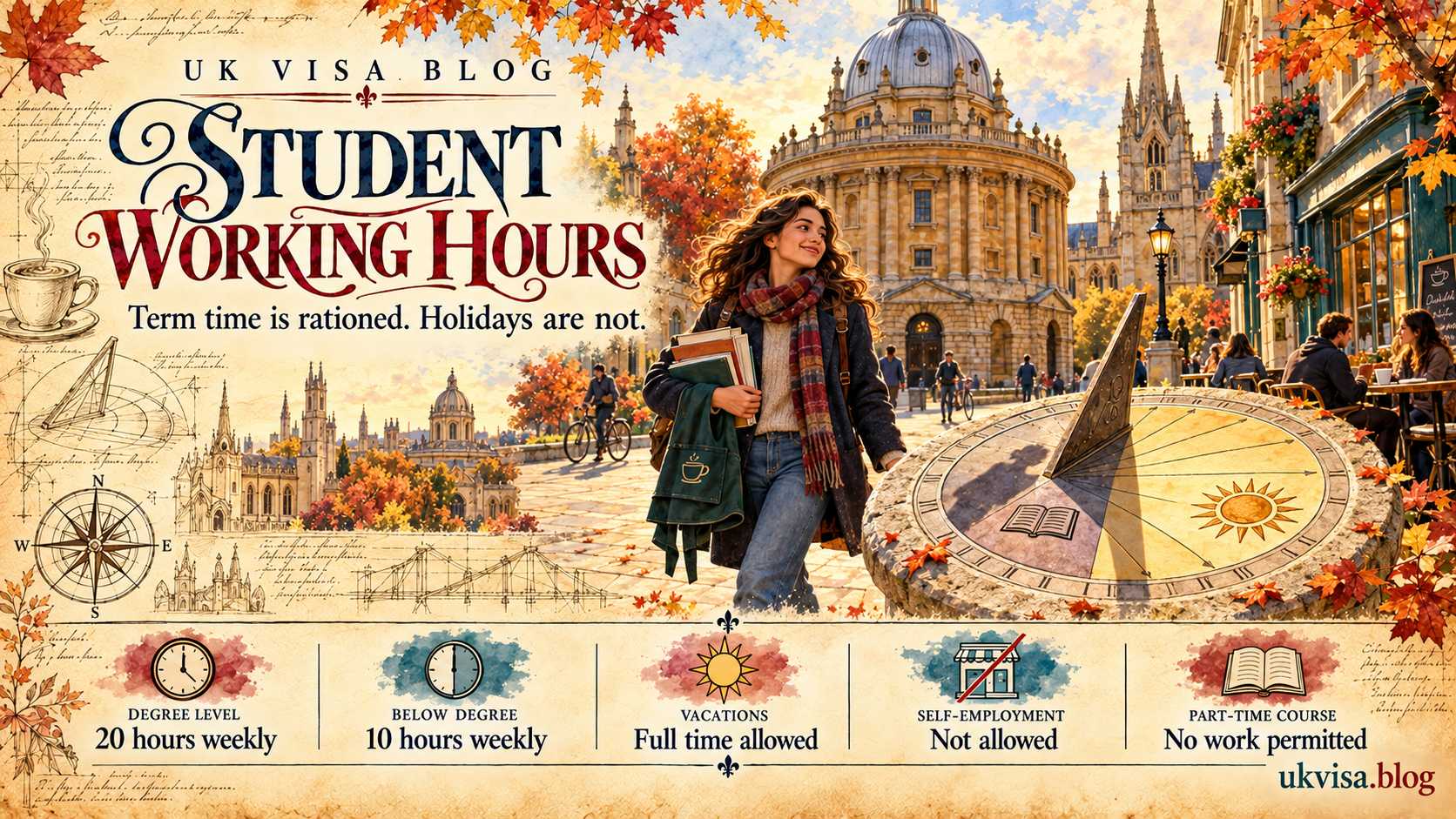
Most degree-level students may work 20 hours a week in term time and full time in vacations. But the right depends on your sponsor as much as your course, and a large group of students has no work rights at all. Breaching the condition risks cancellation and a re-entry ban, and costs the employer up to £60,000 per worker.
UK Student Visas
UK Student Visa Working Hours 2026: Limits, Restrictions and What Comes Next
What a Student Visa Actually Allows
Twenty hours a week in term time on a full-time degree-level course sponsored by a higher education provider with a track record of compliance, and full time outside term time. Ten hours for a below-degree course at the same kind of provider. Everything else — part-time courses, further education colleges, private providers, sponsors without a track record — carries no permission to work at all.
Work rights sit at ST 26 of Appendix Student and are a condition of your permission, not a benefit of enrolment. Your digital immigration status records the condition that applies to you, and it is the condition, not your university’s careers advice, that an employer’s right-to-work check relies on.
The eligibility framework behind the permission — the 70 points, the CAS and the sponsor’s licence status — is set out in our Student visa requirements guide. Language levels sit in our guide to how English is proved for UK visas, at CEFR B2 for degree-level study and B1 below it.
What the Visa Costs in 2026
| Charge | Amount |
|---|---|
| Application fee, inside or outside the UK | £558 |
| Immigration Health Surcharge, per year | £776 |
| Priority service, where offered | £500 |
| Super Priority service, where offered | £1,000 |
Source: Home Office immigration and nationality fees, 8 April 2026. Priority services are not available at every application centre.
You cannot use future earnings to satisfy the money test at application stage — that has to be evidenced before you arrive, as our student maintenance funds guide explains. Working is how you live once you are here, not how you qualify. Full pricing across every route is in our breakdown of current UK visa charges.
UK Student Visa Working Hours Explained
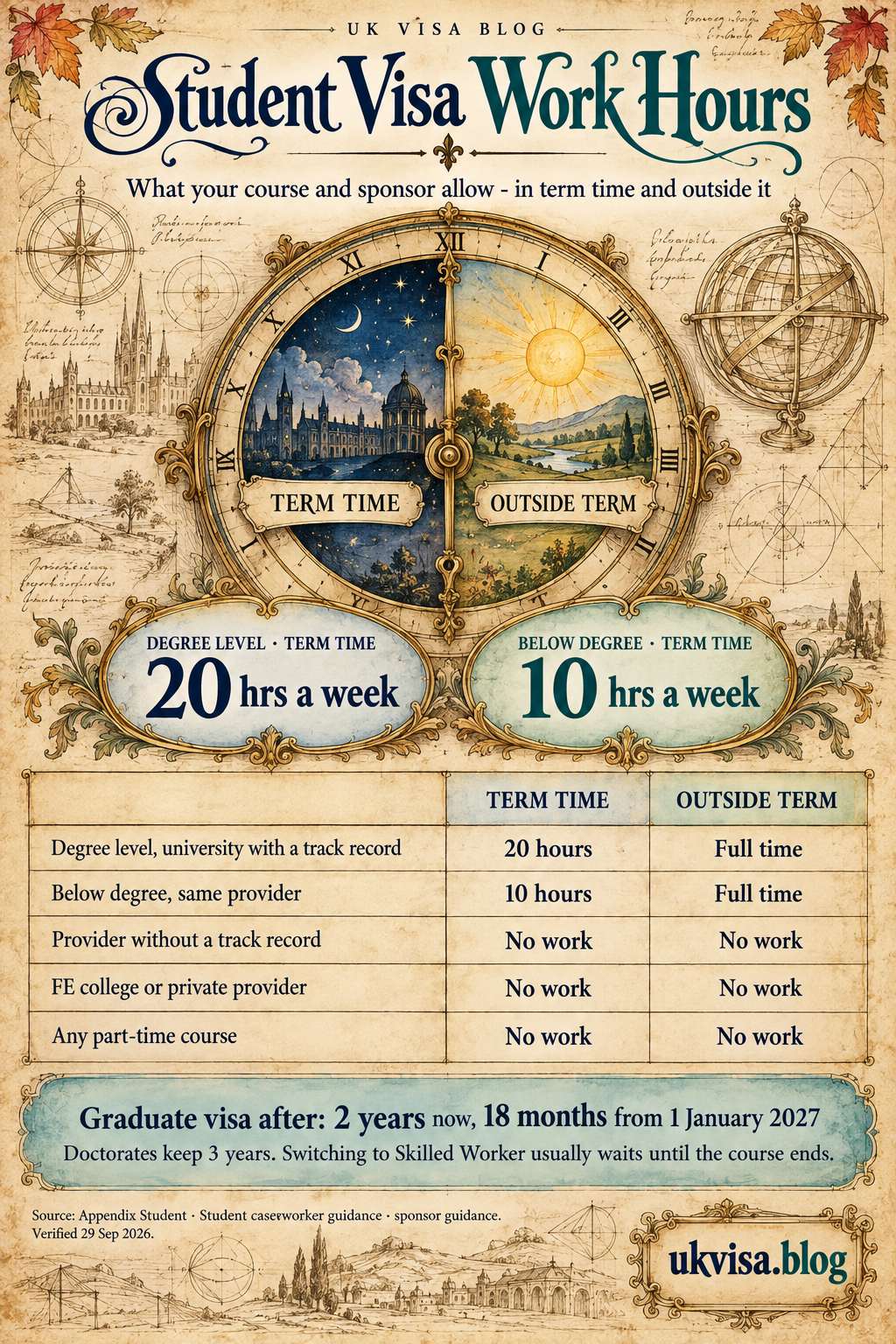
Two variables decide your limit: the level of the course, and what kind of sponsor is teaching it. Getting the second one wrong is what turns an honest part-time job into a breach.
Working Hours by Course and Sponsor
| Course and sponsor | Term time | Outside term time |
|---|---|---|
| Full-time, degree level or above, at a higher education provider with a track record of compliance | 20 hours a week | Full time |
| Short-term study abroad programme in the UK at an overseas higher education institution | 20 hours a week | Full time |
| Full-time, below degree level, at a higher education provider with a track record of compliance | 10 hours a week | Full time |
| Any course at a provider without a track record of compliance | No work | No work |
| Any course at a publicly funded further education college or a private provider | No work | No work |
| Any part-time course | No work | No work |
Source: Appendix Student ST 26.1; Student Sponsor Guidance Document 2, paragraph 6.4.
The bottom three rows account for a great many students who believe they may work ten hours a week. They may not work at all, and no employer’s willingness changes that.
If your sponsor is a further education college, a private provider, or a higher education provider without a track record of compliance, your permission carries no work rights whatever your course level. The same applies to every part-time course, including part-time postgraduate study. Working in breach is not a paperwork slip: it can end your permission, follow you into every future application, and expose the employer to a civil penalty of up to £60,000 for each illegal worker — or, where they knew, five years’ imprisonment and an unlimited fine. Check the condition on your digital status before you accept a job.
What Counts as Term Time
There is no Home Office definition. Your sponsor sets and publishes term and vacation dates, and it is under a duty to make sure you know them so you can keep within your limit. On a one-year taught master’s this matters more than anywhere else: sponsors generally treat the dissertation period as term time rather than summer vacation, so the 20-hour cap continues through it. Ask your sponsor in writing rather than assuming.
When You Can Work Full Time
Outside term time, and in two periods people often miss. The sponsor guidance states that students may work full time in the period before the course starts and at the end of the course, provided their conditions permit term-time work and their permission is valid. It goes further and settles the argument outright: the period at the end of the course is a vacation period for this purpose.
How the Limit Is Counted
The cap is expressed per week, not per term, so hours cannot be averaged: 30 in one week and 10 in the next is a breach in the first week regardless of the second. Hours combine across every employer. Assessed work placements that form part of the course are separate and do not eat into the allowance.
Work Placements and the Percentage Caps
A placement must be an integral, assessed part of the course, and must not exceed 33 per cent of the course length in the UK. The cap rises to 50 per cent where the course is at degree level or above with a compliant higher education provider, or forms part of a study abroad programme, or where a UK statutory requirement demands longer. Probationary sponsors cannot offer below-degree courses containing a placement at all.
Volunteering Is Not Voluntary Work
Genuine volunteering for a charity, with no contract, no fixed obligations and no benefits in kind, sits outside the hours limit. Voluntary work with contractual duties, set hours, or a role that would otherwise be filled by an employee counts towards it even when unpaid. The test is whether the arrangement has the features of employment, not whether money changes hands.
Work Restrictions and the Exceptions
Four categories of work are closed to Students however many hours are left in the week — and three of them now carry a written exception that is worth knowing about.
- Self-employment or business activity: including freelancing and remote work for overseas clients, since the work happens where you are.
- Professional sport: playing or coaching at professional or semi-professional level, paid or unpaid.
- Entertainment: employment as an entertainer.
- Permanent full-time vacancies: filling a post that is both permanent and full time.
- Public funds: benefits and pensions are not available on this route.
The Sabbatical Officer Exception
An elected Student Union sabbatical officer post — full time, salaried, elected — is permitted for up to two years, provided the CAS was assigned for that purpose. It is also the one case where a Student may lawfully fill a full-time permanent vacancy. The maximum is two years at the same institution; a third year is only possible at a different institution or in a national NUS position.
Sabbatical time does not count towards the placement percentage cap. An officer holding a second job may work part-time in term and full time in vacations, so long as they are not also working full time for the union during those vacations.
The Innovator Founder Exception
Self-employment becomes lawful at one precise moment: once you have applied on the Innovator Founder route with an endorsement from an endorsing body, having applied while holding Student permission, and while that application or any administrative review of a refusal remains undecided. Not before the endorsement, and not on a hope. Our guide to starting a business on a Student visa works through the sequence.
How Widely “Professional Sportsperson” Reaches
The definition is far broader than people expect. It catches anyone playing or coaching at professional or semi-professional level, paid or unpaid; anyone registered to such a team within the previous four years, academy and development squads included; anyone who has represented a national, state or regional team in the previous two years from under-17s upwards; anyone with an established international reputation; and anyone who has engaged a sporting agent in the last twelve months.
What a Breach Costs
Permission can be cancelled and you can be required to leave. Adverse immigration history follows you into every later application, and a re-entry ban may apply depending on how you leave and what happened. Applicants with a compliance question in their file are also likelier to face a credibility interview next time.
Switching from Student to Skilled Worker
You can switch inside the UK, and you do not have to finish the degree first. What you do need is a licensed sponsor, a job at the right skill level, and a salary that clears the threshold — the route tightened considerably on 22 July 2025.
- Certificate of Sponsorship: from a licensed sponsor, for a specific role.
- Skill level: the job must sit at RQF Level 6 or above since 22 July 2025.
- Salary: £41,700 or the going rate, whichever is higher, with lower options for new entrants and qualifying PhDs.
- Timing: apply while your Student permission is still valid.
- English: normally already satisfied by a UK degree taught in English.
You Can Start the Job Before the Decision
This is the provision most students never hear about. Where you are on a full-time degree-level course with a compliant higher education provider and you apply for the Skilled Worker route, you may start a full-time permanent vacancy up to three months before your course completion date while the application is pending — and after successful completion where you have applied on the Graduate route. The permission runs until a decision, or until any administrative review of a refusal is finally determined.
The salary options, going rates and the new-entrant discount are set out in our Skilled Worker route guide, which also covers what survives to settlement and what does not. Note that no salary discount carries through to indefinite leave to remain.
The Graduate Route After Your Studies
The Graduate route removes every restriction on this page. No sponsor, no hours limit, no prohibited categories, and self-employment is permitted. It cannot be extended, and it is a bridge rather than a destination.
Graduate Route Duration
| Date of application | Bachelor’s or master’s | Doctorate |
|---|---|---|
| On or before 31 December 2026 | 2 years | 3 years |
| On or after 1 January 2027 | 18 months | 3 years |
Source: GOV.UK Graduate visa guidance. Fee £937; health surcharge at the standard £1,035 a year.
Graduating in 2026 makes the timing decision worth six months of permission. Eligibility, the application itself and the dependant rules are covered in our Graduate route guide.
If Your Dependants Are Here
A Student’s partner and children may work without an hours limit, but not as a professional sportsperson. Two situations remove the right: where the Student’s new course is under nine months having previously been six months or longer, and where the new course is below degree level. Our Student dependant guide sets out who may come in the first place.
Courses of six months or less do not use this route at all — see our Short-term study guide, which carries no work rights whatsoever.
Sources: Appendix Student ST 17 and ST 26; Student Sponsor Guidance Document 2, Sponsorship Duties, version 04/2026; Student and Child Student caseworker guidance, version 14.0, published for Home Office staff on 3 August 2026; the register of licensed student sponsors; GOV.UK penalties for employing illegal workers. Figures verified 22 August 2026.
Frequently Asked
Questions about Student Visa Work Rights
Twenty a week in term time on a full-time degree-level course sponsored by a higher education provider with a track record of compliance, and full time outside term time. Ten a week in term time if the course is below degree level at the same kind of provider. If your sponsor is a further education college, a private provider or a provider without a track record, or your course is part time, you have no permission to work at all.
No. Self-employment and business activity are prohibited, and that includes remote freelancing for clients abroad — the work is treated as happening where you are. The single exception is once you have applied on the Innovator Founder route with an endorsement, having applied while holding Student permission, and while that application or an administrative review of its refusal is still undecided.
Yes, if your conditions permit term-time work and your permission is still valid. The sponsor guidance treats the period at the end of the course as a vacation period, so the term-time cap no longer applies. The same is true of the period after your permission starts but before the course begins. The prohibitions on self-employment and professional sport continue throughout.
Your sponsor decides, because it sets and publishes the term and vacation dates and must tell you what they are. On a one-year taught master’s, sponsors generally treat the dissertation period as term time, which keeps you at 20 hours a week until submission. This catches people out every year. Get your sponsor’s answer in writing before you take on more hours.
No. The limit is stated per week, so each week stands alone: 30 hours in one week is a breach even if you work 10 the next. Hours from every employer add together. Assessed work placements that form an integral part of your course are separate and do not count against the weekly allowance, but they are capped as a percentage of the course itself.
Your permission can be cancelled and you can be required to leave, with a re-entry ban depending on the circumstances and how you depart. The breach becomes adverse immigration history in every later application. The employer faces a civil penalty of up to £60,000 for each illegal worker, and where they knew or had reasonable cause to believe, up to five years’ imprisonment and an unlimited fine.
Yes. You can apply from inside the UK without completing the degree, provided you apply while your Student permission is valid. Since 22 July 2025 the role must sit at RQF Level 6 or above and pay £41,700 or the going rate, whichever is higher, with reduced options for new entrants and qualifying PhDs. You may also start a permanent full-time job up to three months before your course completion date while the application is pending.
Two years for a bachelor’s or master’s where you apply on or before 31 December 2026, and 18 months where you apply on or after 1 January 2027. A doctorate attracts three years either way. The fee is £937 and the health surcharge reverts to the standard £1,035 a year. There is no sponsor, no hours limit and no bar on self-employment, but it cannot be extended.
Genuine volunteering does not: no contract, no fixed obligations, no benefits in kind, for a charity. Voluntary work does, even unpaid, where you have contractual duties, set hours, or hold a role that would otherwise be an employee’s. The question is whether the arrangement looks like employment, not whether you are paid for it. If in doubt, treat it as counting.