
The UK Ancestry visa gives Commonwealth citizens with a UK-born grandparent five years of unsponsored permission to work, at £726. There is no salary threshold, no employer and no English test. Two rules do the damage: you must intend to work, and you cannot switch into it from inside the UK.
UK Work Visas
UK Ancestry Visa 2026: Eligibility, Fees and the Route to Settlement
What the Ancestry Visa Is
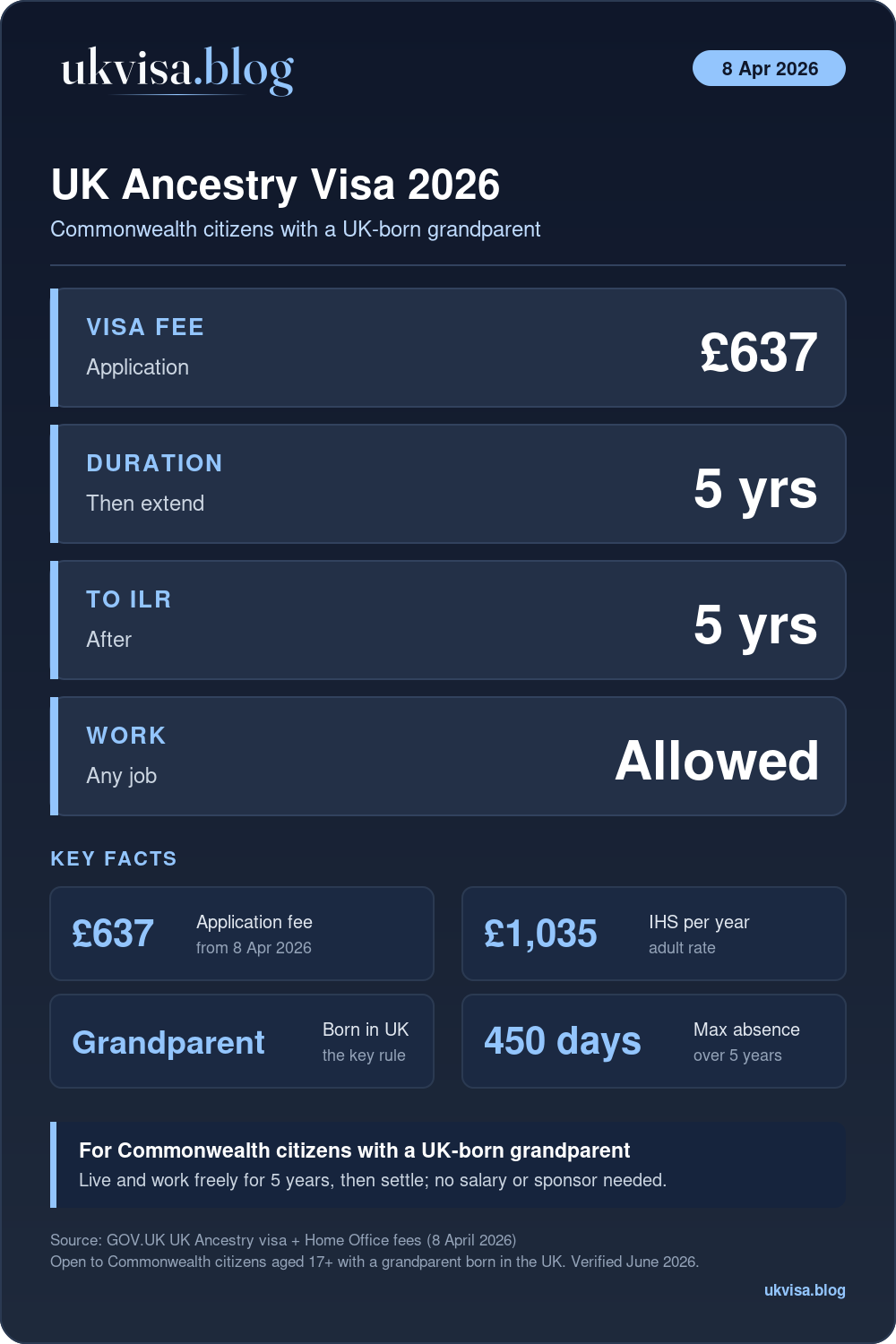
A five-year work route for Commonwealth citizens, British overseas citizens, British overseas territories citizens, British nationals (overseas) and citizens of Zimbabwe who have a grandparent born in the UK, the Channel Islands or the Isle of Man. It costs £726, needs no sponsor and no job offer, and permits employment, self-employment, voluntary work and study. After five years you can extend for another five or apply to settle.
It is the most permissive work route the UK operates. There is no occupation code, no salary threshold, no certificate of sponsorship and no employer tied to the permission. What replaces all of that is a nationality condition and a family connection — and the requirement that you can and plan to work here.
Eligibility
Nationality comes first: Commonwealth citizen, British overseas citizen, British overseas territories citizen, British national (overseas), or a citizen of Zimbabwe. Then the ancestry, then the personal conditions.
- Nationality: one of the qualifying categories above.
- Grandparent: born in the UK, the Channel Islands or the Isle of Man; or before 31 March 1922 in what is now Ireland; or on a ship or aircraft registered in the UK or belonging to the UK government.
- Age: 17 or over.
- Money: enough to support and house yourself and any dependants without public funds.
- Work intention: you must be able to work and plan to do so in the UK.
- No switching: you cannot change into this visa from another visa while in the UK.
GOV.UK states it plainly: you cannot change into the Ancestry visa if you came to the UK on a different visa. Someone already here as a visitor, student or worker who discovers a qualifying grandparent has to leave and apply for entry clearance from abroad — there is no in-country route in. That makes the discovery of eligibility a travel decision as much as a legal one, and it is worth checking the family history before committing to another UK application rather than afterwards.
Proving the Ancestry
The evidential chain is the part that takes time. You are proving an unbroken line from you to the UK-born grandparent, which usually means your own birth certificate, the birth certificate of the parent who connects you, and the grandparent's UK birth certificate — plus marriage certificates wherever a name changed along the way.
Adoption, name changes and certificates issued in countries with different registration practices are the common complications, and reordering a missing certificate from a foreign registry can take months. Start the document work before the application, not alongside it — the general approach is in our document checklist.
The Documents in Order
Work backwards from the grandparent. Their UK birth certificate is the anchor; then the birth certificate of your parent showing that grandparent as their parent; then your own birth certificate showing that parent. Every change of name between those documents needs its own certificate — a marriage certificate, a deed poll, or an adoption order.
Where a document is missing, the replacement usually has to come from the registry that issued it, which is why timelines run in months rather than weeks. Certificates not in English or Welsh need certified translations, and photocopies or family records are not substitutes for official certificates.
How to Apply
Apply online from outside the UK, no earlier than three months before you travel. You should get a decision within three weeks, and a paid faster service may be available. What happens between biometrics and decision is covered in our processing guide, and a refusal is normally challenged through administrative review.
What You Can Do Once You Are Here
You can work in any job at any level, be self-employed, run a business, do voluntary work, work part-time or full-time, and study. You can change employer, sector or working pattern without any application. What you cannot do is claim public funds, which is also why the application asks you to show you can support and house yourself and any dependants.
The work condition is not merely a formality at entry. The route exists for people coming to work, and the ability and intention to do so is part of what is assessed — which is why an application built around retirement or extended family visits sits uneasily on this route even where the ancestry is beyond doubt.
Fees
£726 for the application. The health surcharge may also be payable as part of the application — see our surcharge guide for how it is calculated across the length of the grant. The wider schedule sits in our fee guide and our Home Office fees reference.
Ancestry Against the Sponsored Routes
For anyone who qualifies, this route beats sponsored work on almost every measure: five years rather than three, no employer tie, no salary floor, no skills charge and a lower fee. The trade is that eligibility is fixed at birth. You either have the grandparent and the nationality or you do not, and no amount of qualification or salary substitutes for them.
Extending After Five Years
If you have lived in the UK for five years on this visa you can either extend for a further five years or apply to settle. The extension is made on the in-country forms described in our leave to remain forms guide, and is the sensible route where the absence record or the work history will not yet support a settlement application.
Absences Are the Thing to Track
Because the route runs for five years with no employer reporting on you, nobody else is keeping a record of your time out of the country. Settlement is assessed against the absence limits, so the log you keep — dates, destinations, boarding passes — is the only evidence that will exist when the question is asked. Build it as you go.
Long single trips are the usual problem, particularly for people with family and business interests in the country they came from. A pattern of six-week visits home is very different from one nine-month absence, even where the total days are similar, and the second can break continuity outright.
Settlement
Five years on the route opens indefinite leave to remain. The usual settlement conditions apply: absences within the 180-day limit, a pass in the Life in the UK test, and English at the settlement standard — which rises to B2 for applications made on or after 26 March 2027 under HC 1691, as set out in our English requirements guide.
The application forms are covered in our settlement forms guide, and timescales in our settlement processing guide. The current settlement fee is £3,226 per person.
Extend or Settle?
At the five-year point the two options are not equivalent. Settlement removes the time limit and the conditions, but is assessed on absences, English and knowledge of life. An extension buys another five years on the same terms and keeps the position intact where one of those tests is not yet met. Applying for settlement and being refused is a worse outcome than extending and applying a year later.
Citizenship
Settlement is not the end of the road. Naturalisation follows on the ordinary timetable, with its own residence, absence and good character requirements set out in our citizenship guide. For many ancestry visa holders the whole sequence — five years, settlement, then citizenship — is the plan from the outset, which makes the absence record worth tracking from the first year rather than the fourth.
Sources: GOV.UK UK Ancestry route page on GOV.UK; Appendix UK Ancestry; and types of British nationality. Figures verified 22 August 2026.
Frequently Asked
Questions about the UK Ancestry Visa
Commonwealth citizens, British overseas citizens, British overseas territories citizens, British nationals (overseas) and citizens of Zimbabwe, provided they have a qualifying grandparent and are 17 or over. Nationality is checked first: without one of those statuses the ancestry itself does not open the route, however well documented the family line is.
A grandparent born in the UK, the Channel Islands or the Isle of Man; born before 31 March 1922 in what is now Ireland; or born on a ship or aircraft registered in the UK or belonging to the UK government. Great-grandparents do not qualify, and neither does a grandparent born elsewhere to British parents.
No. GOV.UK states you cannot change into the Ancestry visa if you came to the UK on a different visa. Anyone already here who discovers a qualifying grandparent has to leave and apply for entry clearance from outside the UK, which makes it worth checking eligibility before making any other UK application.
No. There is no sponsor, no certificate of sponsorship and no salary threshold. What you do need is to show you can work and plan to work in the UK. Employment, self-employment, part-time work and voluntary work all count, and you can change what you do without telling the Home Office.
£726 for the application. The health surcharge may also be payable as part of the application, calculated on the length of permission. Settlement later costs £3,226 per person. There are no sponsor-side costs at all on this route, because there is no sponsor — one of the reasons it is cheaper overall than the sponsored alternatives.
Five years. After five years in the UK on this visa you can either extend for a further five years or apply to settle. Extending is the sensible choice where absences or documentation will not yet support a settlement application, since it preserves the position rather than risking a refusal.
Yes — a partner and children can come with you, and you must be able to support and house them without public funds. Their permission runs alongside yours, and they build their own residence towards settlement in parallel, which is one of the practical advantages of a five-year grant over shorter work routes.
Nothing at the application stage. English appears at settlement, where the standard applies in the ordinary way — and rises to B2 in all four components for settlement applications made on or after 26 March 2027 under HC 1691. Anyone whose five-year point falls near that date should work out which side of it they land on.