
The Government Authorised Exchange visa — formally known as the Temporary Work — Government Authorised Exchange route, and still widely called the T5 Tier 5 GAE visa after the legacy nomenclature — is the UK's dedicated immigration route for participants in approved exchange schemes administered by government agencies, professional bodies, and higher education institutions. The route distinguishes itself from all other Temporary Worker sub-routes by being scheme-mediated: applicants apply first to an approved exchange scheme administered by an authorised "overarching body", then apply to the Home Office for the visa using the sponsorship reference number issued by that scheme. This structure ensures placements are genuine knowledge exchanges, training, research, or fellowships — not vacancy-filling labour migration. From 8 April 2026, the application fee rose from £319 to £340; the sponsor licence fee rose from £574 to £611 (Temporary Worker category, flat across all sponsor sizes). No other substantive changes affect this route in 2026.
The GAE visa is the right route for structured exchange programmes: graduate internships (AIESEC, BUNAC, GTI, Mountbatten Institute), research and academic fellowships (Chevening, Fulbright, UKRI, Chatham House), medical training (Medical Training Initiative for NHS postgraduate doctors), legal training (Bar Council, Law Society), language teaching (Foreign Language Assistants, China-UK Mandarin), and government/diplomatic exchange (Finance Ministries and Central Banks). Maximum 12 months for work experience and internships; 24 months for research, training, and language programmes. Sponsored researchers in approved schemes can switch in-country to the Global Talent visa — a unique structural advantage of this route. No English language test, no minimum salary threshold, no Immigration Skills Charge, no settlement pathway. NO age limit on the GAE route itself (unlike the Youth Mobility Scheme).

- What is the Government Authorised Exchange Visa?
- 30+ Approved Exchange Schemes
- Overarching Body Structure
- Eligibility Requirements
- Duration: 12 vs 24 Months
- Fees and Costs from 8 April 2026
- How to Apply
- What You Can and Cannot Do
- Bringing Your Partner and Children
- Switching to Global Talent or Other Routes
- Frequently Asked Questions
Government Authorised Exchange Visa UK 2026: T5/Tier 5 GAE Route Explained
The Government Authorised Exchange visa sits within the UK Temporary Worker (T5) framework as one of six sub-routes alongside Religious Worker, Charity Worker, International Agreement, Creative Worker, and Seasonal Worker. The GAE route is structurally unique within the T5 family by operating through approved exchange schemes rather than direct employer sponsorship. The sponsor on a GAE visa is the "overarching body" — typically a government agency, university, or professional body that administers the scheme — not the host employer or institution where the actual work or research is performed. This scheme-mediated structure is the legal mechanism that distinguishes the route from regular sponsored work routes like Skilled Worker.
What is the Government Authorised Exchange Visa?
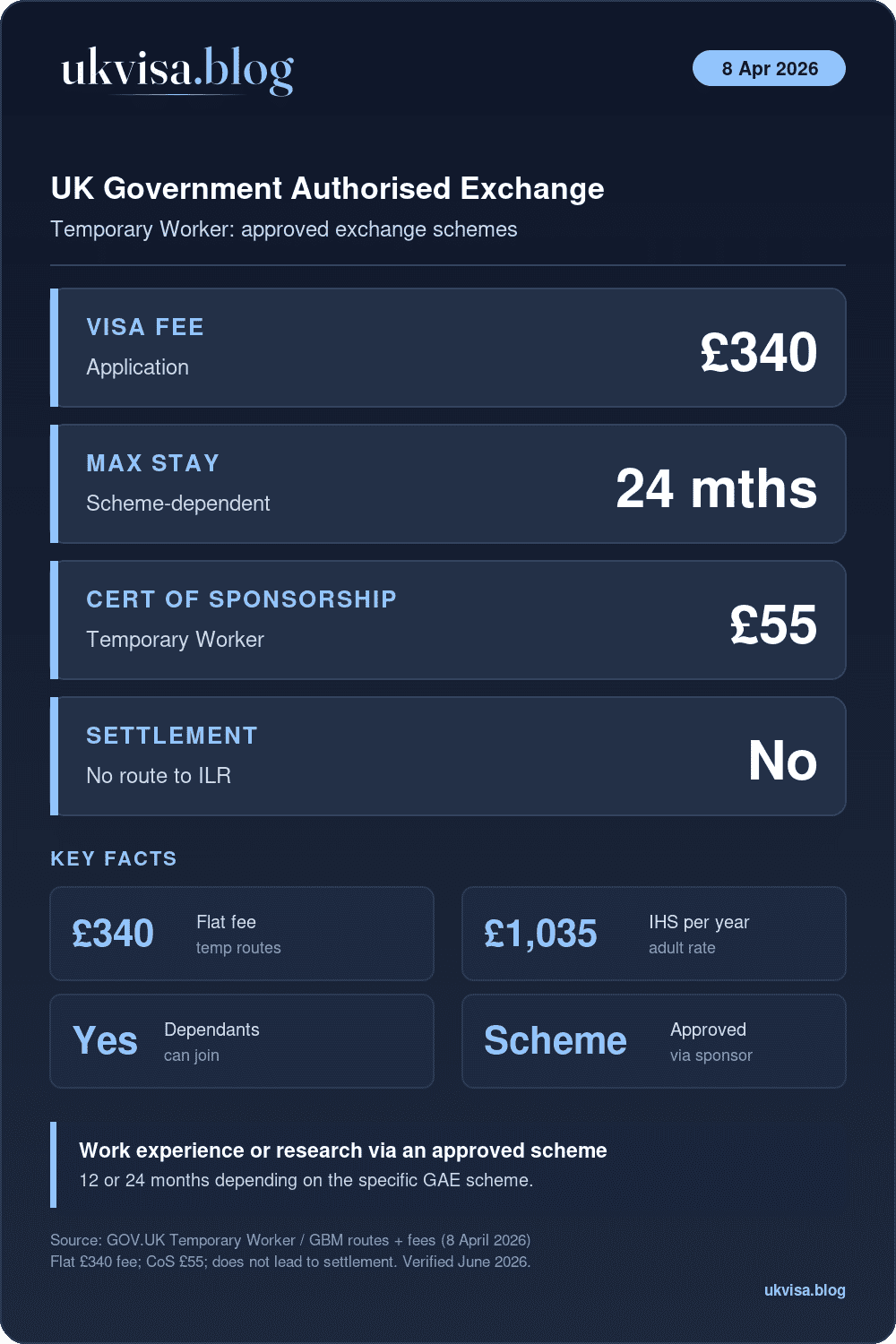
The GAE visa is the UK Temporary Work route for participants in approved exchange schemes. Five main scheme categories: graduate internships and professional placements (12 months); academic and research fellowships (24 months); medical and dental postgraduate training (24 months); language teaching programmes (24 months); and government/diplomatic exchange (24 months). Application fee £340 from 8 April 2026; no English language test; no minimum salary; no Immigration Skills Charge. Sponsored researchers in approved schemes can switch in-country to the Global Talent visa — a unique structural advantage. No age limit on the route itself.
Replaced the T5 (Tier 5) Government Authorised Exchange Visa in December 2020
The current Government Authorised Exchange visa replaced the older T5 (Tier 5) Government Authorised Exchange visa on 1 December 2020 as part of the wider Points Based Immigration System reforms. The substantive rules and approved schemes remained largely the same — the change was primarily nomenclature, the unified Temporary Worker route structure under Appendix Temporary Work — Government Authorised Exchange, and the formal end of the Tier 5 brand. Many sponsors, applicants, and overarching bodies still use "T5 GAE", "Tier 5 Government Authorised Exchange", or "T5 visa" interchangeably with the current name. References across this guide treat the terms as equivalent.
30+ Approved Exchange Schemes
The Home Office publishes a list of 30+ approved exchange schemes under Appendix Government Authorised Exchange Schemes. The schemes cluster into five main categories: graduate internships and professional placements (AIESEC, BUNAC, GTI, Mountbatten Institute); legal training (Bar Council, Law Society); research and academic fellowships (Chevening, Fulbright, UKRI, Chatham House, Commonwealth Scholarships, Sponsored Researchers); medical training (Medical Training Initiative); language and culture (Foreign Language Assistants, China-UK Mandarin Teachers); and government/financial exchange (Finance Ministries and Central Banks). Each scheme is administered by a designated "overarching body" that holds the Home Office sponsor licence.
Graduate Internship and Professional Placement Schemes (12 months)
| Scheme | Overarching Body / Sponsor | Target Profile |
|---|---|---|
| AIESEC UK | AIESEC UK | Student and graduate internships in management, marketing, finance, engineering |
| BUNAC 'Intern in Britain' | BUNAC (British Universities North America Club) | Work experience for students and graduates across multiple sectors |
| GTI (Graduate Trainee Immigration) | GTI Recruiting | Structured internship placements in UK companies |
| Mountbatten Institute | The Mountbatten Institute | Business training and work experience in London |
| Bar Council Scheme | Bar Council of England and Wales | Pupillage and mini-pupillage for overseas-qualified lawyers |
| Law Society Schemes | Law Society of England and Wales / Law Society of Scotland | Training contracts for overseas-qualified solicitors |
Research and Academic Fellowship Schemes (24 months)
| Scheme | Overarching Body / Sponsor | Target Profile |
|---|---|---|
| Chevening Fellowships | Foreign, Commonwealth and Development Office (FCDO) | Mid-career professional fellowships for future leaders |
| US-UK Fulbright Commission | The US-UK Fulbright Commission | Academic and cultural exchange between US and UK |
| UKRI Science, Research and Academia | UK Research and Innovation (UKRI) | Research positions at UK institutions and laboratories |
| Chatham House Fellowship | Royal Institute of International Affairs (Chatham House) | Policy research fellowships in international affairs |
| Commonwealth Scholarships | Association of Commonwealth Universities (ACU) | Academic research scholars from Commonwealth countries |
| Sponsored Researchers | UK Higher Education institutions directly | Independently funded researchers, visiting academics, examiners |
Medical, Language, and Government Schemes (24 months)
| Scheme | Overarching Body / Sponsor | Target Profile |
|---|---|---|
| Medical Training Initiative (MTI) | Academy of Medical Royal Colleges (and individual Royal Colleges) | Postgraduate medical and dental training in NHS hospitals |
| Foreign Language Assistants | British Council | Language teaching assistants in UK schools |
| China-UK Mandarin Teachers Scheme | British Council | Mandarin teaching in UK schools |
| Finance Ministries and Central Banks | Bank of England / HM Treasury (host) — designated overarching body | Government exchange for finance ministry and central bank officials |
| Overseas Government Language Programme | Foreign government via approved UK overarching body | Diplomatic language training (24-month maximum specifically applies) |
Source: Appendix Government Authorised Exchange Schemes; gov.uk approved schemes register.
A common misconception: the India Young Professionals Scheme is NOT administered as a GAE scheme. India YPS operates under its own bilateral framework as a Youth Mobility-style ballot scheme for Indian nationals aged 18-30, separate from the Government Authorised Exchange visa appendix. Similarly, the wider Youth Mobility Scheme (for nationals of Australia, New Zealand, Canada, Japan, South Korea, and other participating countries) has its own visa framework — distinct from GAE. GAE schemes are professional/academic/training programmes with no age restriction; YMS-style schemes are youth-focused with strict 18-30 age caps.
Overarching Body Structure
The defining structural feature of the GAE route is the "overarching body" framework. Unlike most other sponsored visa routes — where the employer who will pay the worker is also the sponsor — the GAE sponsor is the organisation running the scheme, not the host institution where the work is performed.
| Sponsor Type Permitted | Description | Example |
|---|---|---|
| Approved exchange scheme organisation | Overarching body administering the scheme listed in Appendix GAE Schemes | BUNAC for 'Intern in Britain', British Council for Foreign Language Assistants |
| UK Higher Education institution | Direct sponsorship by HEI for sponsored researchers, visiting academics, or examiners | University of Oxford sponsoring a visiting professor |
| UK government department or agency | Direct sponsorship by government body for diplomatic or government exchange | HM Treasury sponsoring a Finance Ministry exchange official |
For most participants, the overarching body relationship is administratively transparent: you apply to the scheme, you're accepted, the scheme issues a sponsorship reference number (not necessarily a full Certificate of Sponsorship — see eligibility section below), and you use that reference number in your visa application. The overarching body remains your formal sponsor for visa compliance purposes throughout your stay — meaning the scheme administrator (not your daily host) is the entity that must report changes to the Home Office, ensure your continued compliance, and notify the Home Office if you cease participation early.
Eligibility Requirements
Be accepted onto one of the 30+ approved exchange schemes listed in Appendix GAE Schemes; hold a sponsorship reference number OR Certificate of Sponsorship from the overarching body; meet the scheme's specific selection criteria (often more demanding than the visa itself); demonstrate £1,270 in personal savings held for 28 consecutive days (waived if A-rated sponsor certifies maintenance OR if you have held a valid UK visa for 12+ months); meet TB test and criminal record certificate requirements where applicable. No English language test, no age limit, no minimum salary.
- Scheme acceptance: Accepted onto one of the 30+ approved exchange schemes listed in Appendix Government Authorised Exchange Schemes. Each scheme has its own selection criteria — typically more demanding than the visa eligibility itself.
- Sponsorship reference: Valid sponsorship reference number OR Certificate of Sponsorship from the overarching body. Unlike most sponsored work routes that require a full electronic CoS, the GAE route accepts a simpler sponsorship reference number for some schemes.
- Genuine exchange role: Activity must be work experience, training, research, fellowship, or an Overseas Government Language Programme — NOT a vacancy-filling exercise displacing what would otherwise be a paid UK position.
- Personal savings: £1,270 in personal savings, held for 28 consecutive days, ending within 31 days of the application date. Exemptions: (a) you have been in the UK with valid permission for 12+ months, OR (b) your A-rated sponsor certifies maintenance.
- ATAS certificate (where applicable): Required for sponsored researchers from certain nationalities working in sensitive research areas (typically advanced sciences, engineering, mathematics, and technology fields). Check the gov.uk Academic Technology Approval Scheme guidance for current scope.
- TB test certificate: Required if applying from a listed country with active TB screening obligations for stays of more than 6 months.
- Criminal record certificate: Required for any country lived in for 12+ months in the last 10 years where applicable.
- NO English language test: The GAE route does not require any Secure English Language Test or CEFR demonstration — though individual schemes (e.g. Chevening, Fulbright) often require English proficiency as part of their own selection criteria.
- NO age limit: Unlike the Youth Mobility Scheme (18-30) or India Young Professionals Scheme (18-30), the GAE route has no age cap. Mid-career and senior professionals routinely use Chevening and Fulbright Fellowships.
- NO minimum salary: No salary floor applies. Schemes typically provide stipends, fellowship payments, or modest training salaries — National Minimum Wage compliance applies where the activity constitutes work under UK employment law.
- Suitability: Must not fall for refusal under general grounds of the Immigration Rules.
Duration: 12 vs 24 Months
The GAE route operates on a two-tier duration model determined by the type of programme rather than by the worker's individual circumstances. The maximum permitted stay is determined by the scheme itself, as listed in Appendix GAE Schemes.
| Programme Type | Maximum Stay | Example Schemes |
|---|---|---|
| Work experience / internships | 12 months | AIESEC, BUNAC, GTI, Mountbatten, Bar Council, Law Society |
| Research | 24 months | Chevening, Fulbright, UKRI, Chatham House, Sponsored Researchers, Commonwealth Scholarships |
| Training | 24 months | Medical Training Initiative, Finance Ministries / Central Banks |
| Overseas Government Language Programme | 24 months | Foreign Language Assistants, China-UK Mandarin Teachers |
| Pre-entry window | +14 days before CoS start date | Permitted for early arrival, settling in |
| Post-end window | +14 days after CoS end date | Permitted for departure, wind-down — must leave UK by visa expiry |
Fees and Costs from 8 April 2026
Application fee £340 from 8 April 2026 (up from £319). Immigration Health Surcharge £1,035/year adults (£776/year under-18s), paid up front for the full grant period. For a 12-month visa: total Home Office cost £1,375. For a 24-month research/training visa: £2,410 (£340 + £2,070 IHS). Sponsor (overarching body) pays £611 flat Temporary Worker sponsor licence and £55 per Certificate of Sponsorship. Immigration Skills Charge does NOT apply. Priority service +£500, super-priority +£1,000 (where available).
| Fee Component | Amount from 8 April 2026 | Notes |
|---|---|---|
| Visa application fee (initial and extension) | £340 per person | Up from £319; same fee inside or outside UK |
| Immigration Health Surcharge — adult | £1,035 per year | Pro-rated for visa duration; paid up front |
| Immigration Health Surcharge — under 18 | £776 per year | Discounted rate for dependent children |
| Personal maintenance | £1,270 | 28 consecutive days; waived if A-rated sponsor certifies OR 12+ months prior valid UK visa |
| Total Home Office charges (12-month internship, single adult) | £1,375 | £340 + £1,035 IHS |
| Total Home Office charges (24-month research/training) | £2,410 | £340 + £2,070 IHS (£1,035 × 2 years) |
| Priority service | +£500 | 5 working days target (where available) |
| Super-priority service | +£1,000 | Next working day target (where available) |
| Sponsor — Temporary Worker sponsor licence | £611 flat | Up from £574; applies regardless of sponsor size |
| Sponsor — CoS assignment | £55 per worker | Temporary Worker CoS rate |
| Sponsor — Immigration Skills Charge | £0 (exempt) | All T5 sub-routes are ISC-exempt |
Source: gov.uk Government Authorised Exchange visa fee schedule; Immigration and Nationality (Fees) Order amendments effective 8 April 2026.
For the wider sponsored route fee comparison across Skilled Worker, GBM and Temporary Worker families, see the UK work visa fees and ISC comparison guide.
How to Apply
GAE visa applications are submitted online via the gov.uk Government Authorised Exchange portal. Critically, the application process begins not with the visa application but with securing acceptance onto the approved exchange scheme. Without scheme acceptance, the Home Office cannot process a GAE visa application.
- Step 1: Apply directly to the approved exchange scheme (BUNAC, Chevening, MTI, Fulbright, UKRI, etc.) following the scheme's selection process — often months in advance and far more competitive than the visa itself.
- Step 2: Receive scheme acceptance and sponsorship reference number (or full Certificate of Sponsorship for some schemes) from the overarching body.
- Step 3: Complete the online UK visa application portal on gov.uk — typically 30–60 minutes.
- Step 4: Pay £340 visa fee and IHS (£1,035/year, pro-rated to grant period).
- Step 5: Verify identity — via the UK Immigration: ID Check app (eligible passports) or biometric appointment at a Visa Application Centre.
- Step 6: Upload supporting documents — passport, scheme sponsorship reference, financial evidence, ATAS certificate (sponsored researchers in sensitive fields), TB and criminal record certificates where applicable.
- Step 7: Decision turnaround — 3 weeks standard (outside UK); 8 weeks standard (in-country switching / extensions). Faster decisions via priority and super-priority services where available.
- Step 8: Travel to the UK up to 14 days before scheme start date; begin the sponsored programme.
What You Can and Cannot Do
| Activity | Permitted? | Notes |
|---|---|---|
| Work in the role described on sponsorship reference | Yes | Primary activity; the entire purpose of the visa |
| Second job — same sector and skill level | Yes — up to 20 hours/week | Outside main scheme hours; same SOC 2020 code level |
| Second job — Immigration Salary List role | Yes — up to 20 hours/week | From the Skilled Worker Immigration Salary List — outside main scheme hours |
| Study (most courses) | Yes | Some courses require Academic Technology Approval Scheme (ATAS) certificate |
| Bring partner and dependent children | Yes | Subject to dependant eligibility and additional fees |
| Take a permanent job | No | Cannot accept permanent employment with the sponsor or any other UK employer |
| Run a UK business | No | Self-employed business activity not permitted |
| Access public funds | No | No recourse to public funds — applies throughout grant period |
| Switch to Global Talent (sponsored researchers only) | Yes — UNIQUE to GAE | Sponsored researchers in approved schemes can switch in-country to Global Talent — see switching section below |
Bringing Your Partner and Children
GAE visa holders can bring eligible dependants — spouse, civil partner, unmarried partner (2-year durable relationship), and dependent children under 18. Each dependant submits a separate UK partner and child dependant visa application.
| Dependant Type | Application Fee | IHS | Maintenance Requirement |
|---|---|---|---|
| Partner / spouse / civil partner / unmarried partner | £340 | £1,035/year | £285 in addition to main applicant's £1,270 |
| First dependent child | £340 | £776/year | £315 in addition |
| Each additional dependent child | £340 | £776/year | £200 in addition |
Dependants can work in any sector without restriction (including paid employment, self-employment, and any role regardless of skill level), can study without limitations, and can travel in and out of the UK freely during the visa period. Dependant permission aligns with the main applicant's grant end-date.
Switching to Global Talent or Other Routes
Unlike most Temporary Worker routes, the GAE visa permits one significant in-country switching pathway: sponsored researchers in approved schemes (UKRI Science, Research and Academia; Sponsored Researchers; Chevening; Fulbright) can switch in-country to the Global Talent visa — provided they secure endorsement from an approved endorsing body (Royal Society, British Academy, Royal Academy of Engineering, UKRI, Tech Nation, Arts Council England). All other GAE visa holders must typically return overseas to apply for any further UK visa route, and the route does NOT lead to settlement.
The Sponsored Researcher pathway under GAE has a unique structural advantage: time on the GAE visa positions sponsored researchers favourably for the Global Talent visa for endorsed leaders in science, engineering, humanities, and digital technology, which DOES lead to settlement (3 years for exceptional talent recipients, 5 years for exceptional promise). Sponsored researchers who have built a UK research portfolio during their GAE placement, and who secure endorsement from one of the six approved endorsing bodies, can apply to switch in-country without leaving the UK. This is a unique exit pathway from a Temporary Worker route into a settlement-leading route.
Other Onward Pathways
- Switch to Skilled Worker (out-of-country): GAE visa holders cannot generally switch to Skilled Worker in-country — they must return overseas and apply for entry clearance. Skilled Worker requires £41,700 salary, RQF Level 3+ occupation, CEFR B2 English (from 8 January 2026), and the new sponsor holding a Worker sponsor licence.
- Re-apply for another GAE scheme: No cooling-off period applies, so workers can in principle move between approved GAE schemes — but the total time on the route is bounded by the scheme-specific maximums (12 or 24 months), and successive applications must demonstrate distinct exchange purposes.
- Family routes: Where the worker meets eligibility for Spouse, Civil Partner, or other family visa routes (e.g. marrying a British citizen or settled person), in-country switching may be permitted independent of the GAE route's own rules.
Time on the Government Authorised Exchange visa does NOT count toward the 5-year continuous-residence period required for UK permanent residence (ILR). The route is designed for temporary knowledge exchange — not as a stepping stone to settlement, with the partial exception of the Sponsored Researcher → Global Talent switch pathway. Workers planning long-term UK residence should treat the GAE placement as a stand-alone professional opportunity and prepare for either (a) the Global Talent switch (if eligible for endorsement), (b) overseas re-application for Skilled Worker, or (c) return to the home country at the end of the scheme.
- Temporary Work — Government Authorised Exchange route (formerly T5 / Tier 5 GAE, replaced 1 December 2020) — for participants in approved exchange schemes administered by overarching bodies.
- Application fee £340 from 8 April 2026 (up from £319); £1,035/year IHS — total £1,375 for a 12-month visa or £2,410 for a 24-month research/training visa.
- 30+ approved schemes across five categories: graduate internships (AIESEC, BUNAC, GTI, Mountbatten); legal training (Bar Council, Law Society); research and fellowships (Chevening, Fulbright, UKRI, Chatham House, Commonwealth Scholarships, Sponsored Researchers); medical training (MTI); language and culture (Foreign Language Assistants, China-UK Mandarin); government exchange (Finance Ministries and Central Banks).
- Maximum 12 months for internships and work experience; 24 months for research, training, and language programmes — determined by the scheme, not the worker.
- NO age limit (unlike YMS and India YPS at 18-30); NO English language test; NO minimum salary; NO Immigration Skills Charge.
- NO 12-month cooling-off period (unlike Religious Worker and Charity Worker).
- Sponsored researchers can switch in-country to Global Talent visa — unique structural pathway from Temporary Worker to settlement-leading route.
- 14-day pre-entry and 14-day post-end-date windows allow early arrival and orderly departure.
- Does NOT count toward 5-year ILR clock; settlement requires switching to Global Talent (sponsored researchers) or another settlement-leading route.
For official guidance and to start the application, the authoritative entry point is the gov.uk Government Authorised Exchange visa overview. The full list of approved exchange schemes and their administering overarching bodies is set out in Appendix Government Authorised Exchange Schemes. The fee uplifts (£319→£340 visa fee; £574→£611 sponsor licence) took effect on 8 April 2026 alongside Statement of Changes HC 1691 (5 March 2026). UK organisations seeking to become approved overarching bodies should consult the Home Office's Sponsor a Worker (Temporary Worker) guidance. The remaining T5 sub-routes — Religious Worker route for paid religious work, Charity Worker route for unpaid voluntary work, International Agreement route for treaty-based work, and Creative Worker route for creative industries — provide alternative Temporary Worker pathways for different scenarios. For longer-term UK employment, the Skilled Worker permanent UK employment route is the standard settlement-leading alternative.
Frequently Asked Questions about Government Authorised Exchange Visa UK
The Government Authorised Exchange visa (formally Temporary Work — Government Authorised Exchange, formerly T5 GAE / Tier 5 GAE) is the UK Temporary Work route for participants in 30+ approved exchange schemes administered by government agencies, professional bodies, and higher education institutions. The route covers work experience and internships (12 months), research and academic fellowships (24 months), medical and dental postgraduate training (24 months), language programmes (24 months), and diplomatic/government exchange (24 months). Replaced the older Tier 5 framework on 1 December 2020.
From 8 April 2026 the application fee is £340 per person (up from £319). Immigration Health Surcharge is £1,035 per year for adults (£776 per year for under-18s), paid up front for the full grant period. Total worker-side cost for a 12-month internship: £1,375. For a 24-month research, training, or language programme: £2,410. Sponsor (overarching body) pays £611 flat for the Temporary Worker sponsor licence (regardless of size), £55 per sponsorship reference, and is exempt from the Immigration Skills Charge.
Over 30 approved schemes including: graduate internships (AIESEC UK, BUNAC 'Intern in Britain', GTI Recruiting, Mountbatten Institute); legal training (Bar Council, Law Society); research and academic fellowships (Chevening, US-UK Fulbright Commission, UKRI Science Research and Academia, Chatham House, Commonwealth Scholarships via ACU, Sponsored Researchers); medical training (Medical Training Initiative for NHS postgraduate doctors); language teaching (British Council Foreign Language Assistants, China-UK Mandarin Teachers Scheme); government exchange (Finance Ministries and Central Banks). Each scheme has its own selection criteria and is administered by a designated overarching body.
No. The GAE route has no age limit — unlike the Youth Mobility Scheme (18-30) or the India Young Professionals Scheme (18-30). Mid-career and senior professionals routinely use Chevening Fellowships, Fulbright Fellowships, Sponsored Researcher posts, and Medical Training Initiative placements at any age. Individual schemes may set their own age preferences in their selection criteria, but the visa itself imposes no age cap.
No. The GAE visa has NO English language requirement — applicants do not need to take IELTS, Trinity GESE, or any other Secure English Language Test, and there is no CEFR demonstration framework. However, many individual schemes (especially Chevening, Fulbright, and academic research fellowships) require English proficiency as part of their own selection criteria. The visa itself imposes no language test, but most competitive scheme selections do.
The maximum stay depends on the programme type: 12 months for work experience and internships (AIESEC, BUNAC, GTI, Mountbatten, Bar Council, Law Society); 24 months for research, training, and Overseas Government Language Programmes (Chevening, Fulbright, UKRI, MTI, Sponsored Researchers, Foreign Language Assistants, China-UK Mandarin Teachers). The visa grants up to 14 days before the scheme start date and 14 days after the scheme end date. Extensions within the same category are permitted up to the scheme maximum.
Yes. Spouses, civil partners, unmarried partners (2-year durable relationship), and dependent children under 18 can apply as dependants. Each dependant pays £340 visa fee plus £1,035/year IHS (£776 for under-18s). Maintenance: £285 partner, £315 first child, £200 each additional child — waived if the sponsor certifies. Dependants can work in any sector without restriction (including paid employment) and study without limitations during the visa period.
One significant exception applies: sponsored researchers in approved GAE schemes (UKRI Science Research and Academia, Sponsored Researchers, Chevening, Fulbright) can switch in-country to the Global Talent visa, provided they secure endorsement from an approved endorsing body. This is the unique GAE structural pathway to a settlement-leading route. For all other GAE visa holders, switching to Skilled Worker or other sponsored routes typically requires leaving the UK and applying for entry clearance from overseas. Family routes (Spouse, Civil Partner) may permit in-country switching where the worker meets independent eligibility.
Yes. GAE visa holders can take supplementary employment for up to 20 hours per week alongside the main scheme activity. The second job must be in a role at the same SOC 2020 skill level as the main role, OR a role on the Skilled Worker Immigration Salary List. You are also permitted to study during the visa period (subject to Academic Technology Approval Scheme certification for certain courses and nationalities). You cannot take a permanent full-time job or run a UK business.
No. Time on the GAE visa does NOT count toward the 5-year continuous-residence period required for Indefinite Leave to Remain. The route is fundamentally a temporary knowledge exchange visa. The partial exception is the Sponsored Researcher pathway: sponsored researchers can switch to the Global Talent visa, which DOES lead to settlement (3 years for exceptional talent, 5 years for exceptional promise). All other GAE workers must either switch to a settlement-leading route (typically Skilled Worker from outside the UK) or treat the GAE placement as a stand-alone professional opportunity not leading to permanent UK residence.