
The Minister of Religion visa (T2) lets faith-based organisations sponsor religious leaders, missionaries and members of religious orders for pastoral roles in the UK. The visa runs initially up to 3 years and 1 month, can be extended once for a maximum total stay of 6 years, and unlocks Indefinite Leave to Remain after 5 years' continuous residence. From 8 April 2026, the application fee is £819 from outside the UK and £943 for extensions or in-UK switches. The route requires B2 CEFR English, no resident labour market test, and no cooling-off period — making it the long-term religious-work pathway for individuals taking on a leading congregational role.
The T2 Minister of Religion visa is the long-term religious-work route to settlement — it's distinct from the Religious Worker visa (T5), which is temporary and does not lead to ILR. The Minister of Religion route now operates with NO cooling-off period (removed in late 2020 alongside Skilled Worker reforms), permits in-UK switching from most categories, and grants an eVisa rather than a physical BRP from 2024 onward. ILR after 5 years requires B1 English, the Life in the UK test, and ongoing sponsorship.
- What is the Minister of Religion Visa (T2)?
- Eligibility Requirements
- Minister of Religion Visa Fees 2026
- The Genuineness Test
- How to Apply
- Visa Duration, Extensions and Maximum Stay
- No Cooling-Off Period for Minister of Religion
- Settlement (ILR) Pathway After 5 Years
- Minister of Religion vs Religious Worker Visa
- Frequently Asked Questions
Minister of Religion Visa UK (T2) Guidance 2026
The Minister of Religion visa supports UK faith-based organisations and religious orders that need to bring established religious leaders, missionaries, or order members from overseas to perform a mainly pastoral leading role within their congregation. The route sits under Appendix T2 Minister of Religion of the Immigration Rules and runs in parallel with — but distinctly from — the temporary Religious Worker route under Appendix Temporary Work – Religious Worker.
What is the Minister of Religion Visa (T2)?
The Minister of Religion visa (T2) is a UK long-term work visa for individuals sponsored to lead congregational worship and perform pastoral duties for a licensed UK faith-based organisation or religious order. It runs for up to 3 years and 1 month initially, can be extended once to a 6-year total, and leads to Indefinite Leave to Remain after 5 years. The "T2" prefix is a legacy reference to the old Tier 2 framework — the route remains one of the few visa categories still officially named with Tier numbering.
The route enables a sponsor — a UK religious organisation holding a Minister of Religion sponsor licence — to assign a Certificate of Sponsorship (CoS) to an overseas religious functionary, who then applies for entry clearance from outside the UK or for permission to stay if already inside. Unlike the Skilled Worker route, there is no fixed minimum salary threshold and no Immigration Salary List requirement — but the role must offer the "going rate" for similar pastoral positions and comply with National Minimum Wage where applicable.
Eligibility Requirements
To qualify for a Minister of Religion visa you must be aged 18 or over on the date of application, hold a valid Certificate of Sponsorship from a licensed Minister of Religion sponsor, meet the English language requirement at B2 CEFR in reading, writing, speaking and listening, demonstrate genuine intention and ability to perform the sponsored role, and have at least £1,270 in savings held for 28 consecutive days (unless the sponsor certifies maintenance on the CoS).
Core Eligibility Criteria
- Age 18+: Must be aged 18 or over on the date of application (paragraph MOR 1.3 of Appendix T2 Minister of Religion).
- Valid Certificate of Sponsorship: CoS issued by a licensed Minister of Religion sponsor no more than 3 months before the date of application.
- Genuineness: Genuine intention and ability to undertake the sponsored pastoral role described in the CoS.
- English language at B2 CEFR: Meet the B2 CEFR English standard for Minister of Religion in all four components (reading, writing, speaking, listening) under Appendix English Language.
- Financial requirement: £1,270 held for at least 28 consecutive days, ending no more than 31 days before the date of application — unless the sponsor certifies maintenance on the CoS.
- TB certificate: Required if applying from a listed country with TB screening obligations.
- Government scholarship cooling-off: Under MOR 1.4, if the applicant has received a government-funded scholarship covering fees and living costs in the previous 12 months, sponsor consent is required.
- Suitability: Must not fall for refusal under the general grounds of the Immigration Rules.
Going Rate, Not Fixed Salary Threshold
Unlike Skilled Worker, where a £41,700 baseline salary threshold applies from 22 July 2025, Minister of Religion has no fixed minimum salary. The role must offer the "going rate" for the equivalent pastoral position within the sponsor's denomination, must comply with National Minimum Wage / National Living Wage law where the worker is salaried, and the sponsor must certify the remuneration on the CoS. Many roles include accommodation, stipends, or other non-monetary benefits alongside cash salary — this is a normal and accepted feature of pastoral employment.
Minister of Religion Visa Fees 2026
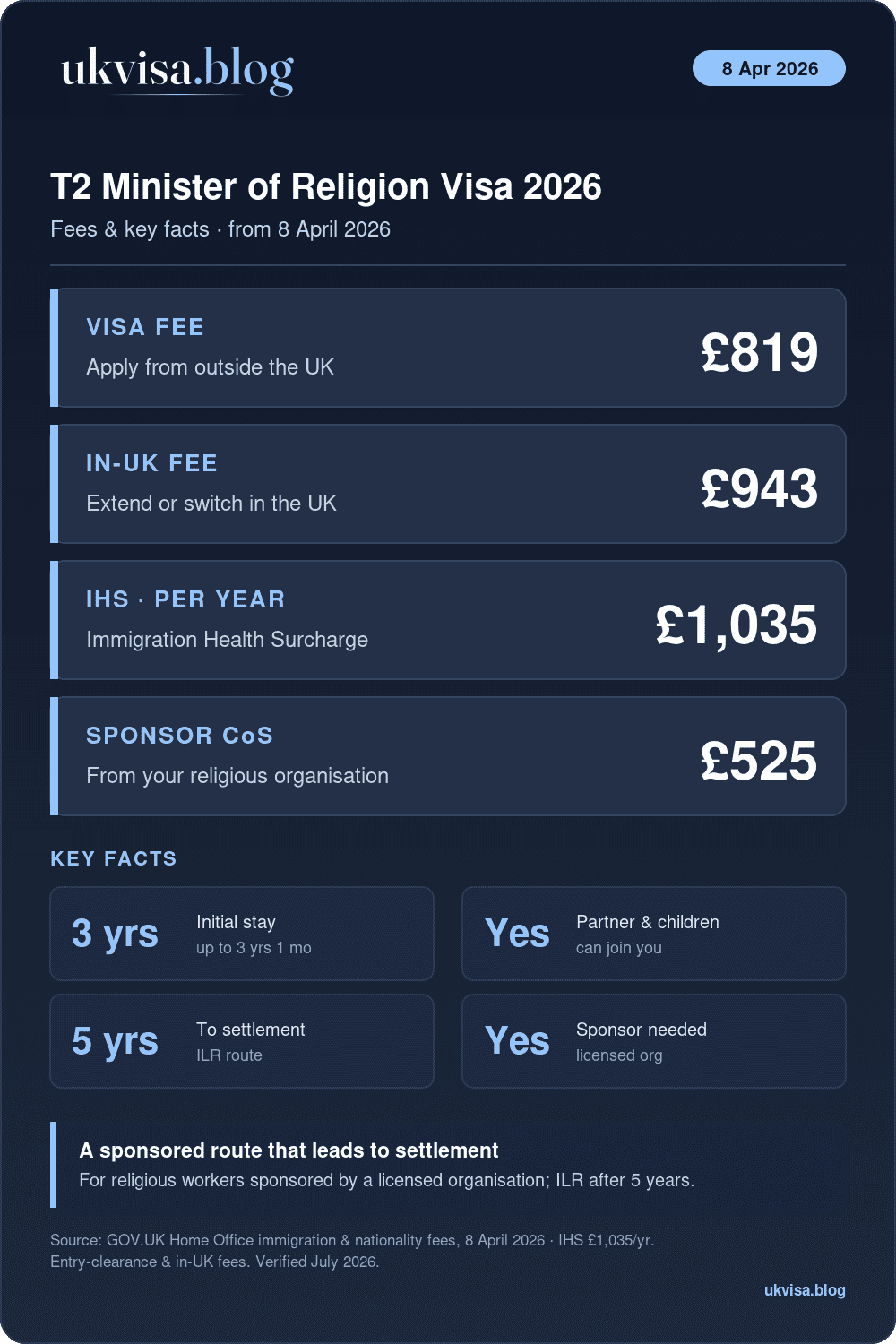
From 8 April 2026, the Minister of Religion visa application fee is £819 per person when applying from outside the UK, or £943 per person when extending or switching inside the UK. Each dependant pays the same fee. The Immigration Health Surcharge (IHS) of £1,035 per year for adults and £776 per year for under-18s applies on top, multiplied by the years of visa granted. A 3-year visa for a single adult applicant from outside the UK comes to £819 + £3,105 IHS = £3,924 total in Home Office charges.
Application Fees from 8 April 2026
| Fee Component | Amount (8 April 2026) | Notes |
|---|---|---|
| Visa application — outside the UK | £819 per person | Main applicant and each dependant pay separately |
| Extension or switch — inside the UK | £943 per person | Higher than out-of-UK fee |
| Immigration Health Surcharge — adult | £1,035 per year of visa | Payable up front for the full grant period |
| Immigration Health Surcharge — under 18 | £776 per year of visa | Same up-front payment rule |
| Priority service uplift (in-UK extensions only) | +£500 | Decision within 5 working days |
| Super-priority service uplift (in-UK extensions only) | +£1,000 | Next working day decision (weekday biometrics) |
| Biometric enrolment | £19.20 for in-UK extensions | Required for some applicants; no fee where ID Check app is used |
Source: gov.uk Minister of Religion visa (T2) application fee schedule, 8 April 2026.
Total Home Office Cost: 3-Year Visa from Outside the UK
- Visa application fee: £819
- Immigration Health Surcharge: £3,105 (£1,035 × 3 years)
- Total Home Office charges: £3,924 per adult applicant
- Family of four (3-year visa): approximately £15,696 before any external English-test or biometric costs
The Immigration Health Surcharge is payable up front for the full grant period — there is no instalment option. ILR applicants are exempt from IHS at the settlement stage; see the wider Immigration Health Surcharge for sponsored workers guide for the cross-route comparison.
The Genuineness Test
The genuineness test runs alongside the formal eligibility checks. Home Office caseworkers assess whether the applicant genuinely intends and is able to undertake the sponsored pastoral role, and whether there are any indicators that the sponsorship may be a vehicle for unauthorised employment in the UK rather than authentic religious work. The test is not a separate stage of the application — it is an assessment applied throughout the decision, with the caseworker entitled to request further evidence or interview where concerns arise.
What Caseworkers Assess
- Knowledge of the role: The applicant's understanding of the specific pastoral duties they will perform and the doctrinal framework of the sponsor.
- Relevant experience: Previous service in similar religious functions, theological training, ordination status, or order membership.
- Knowledge of the sponsor: Familiarity with the sponsoring organisation, its congregation, its history, and any prior relationship.
- Recruitment process: How the applicant was selected — through denominational appointment, congregational call, order placement, or open recruitment.
- Immigration history: Any previous UK visa refusals, breaches of immigration conditions, or patterns suggesting the application is not genuine.
- Sponsor compliance: Information gathered during caseworker scrutiny may also feed into the sponsor's licence compliance record.
If the Home Office requests further evidence under the genuineness assessment, the applicant must respond within 10 business days. Failure to respond within the deadline may result in refusal of the application. If an in-person or remote interview is requested, failure to attend without a valid reason will also result in refusal. Information from the interview may be shared with the sponsor compliance team — non-compliance by the sponsor can lead to revocation of the Minister of Religion sponsor licence, which would end the worker's ability to remain in the role.
How to Apply for a Minister of Religion Visa
All Minister of Religion visa applications are submitted online via the gov.uk portal at gov.uk/minister-of-religion-visa. The applicant can apply up to 3 months before the role start date listed on the Certificate of Sponsorship. Each dependant submits a separate online application and pays the same fee.
- Certificate of Sponsorship reference number from the licensed sponsor — issued no more than 3 months before the application date.
- Current passport or other valid travel document with a blank page for the visa vignette.
- English language evidence: B2 SELT certificate, UK bachelor's or higher degree taught in English, or evidence of nationality from an Appendix English Language majority-English-speaking country.
- Financial evidence: Bank statements covering 28 consecutive days showing £1,270 in savings — unless the sponsor certifies maintenance on the CoS.
- TB test certificate where applying from a country on the TB screening list.
- Criminal record certificate from each country lived in for 12+ months in the previous 10 years (specific to certain occupations and not always required).
- Previous UK visas / passports covering any prior immigration history.
- Marriage certificates / birth certificates for any dependants applying together.
Processing Times
Standard processing of out-of-UK Minister of Religion visa applications is approximately 3 weeks from biometric enrolment. In-UK extension applications typically take up to 8 weeks under standard service. Priority service (£500 uplift) is available for in-UK extensions only and targets a decision within 5 working days. Super-priority service (£1,000 uplift) targets next-working-day decisions for in-UK applications. Out-of-UK applicants may use country-specific premium services where offered — availability varies by Visa Application Centre.
All standard Home Office processing targets can be extended where the caseworker requests further evidence, schedules an interview, or runs additional compliance checks on the sponsor.
eVisa, Not BRP
Successful Minister of Religion visa decisions now grant an eVisa — a digital record of immigration status accessed through a UKVI account — rather than a physical Biometric Residence Permit. The transition to digital-only eVisas was completed by the end of 2024 for new grants. Existing BRP holders retain their physical card until expiry but can also access their eVisa through the UKVI account portal. Travel and right-to-work checks now reference the eVisa via a share code rather than the BRP.
What You Can Do on a Minister of Religion Visa
- Work for the sponsor in the role described in the Certificate of Sponsorship.
- Second job permitted in certain circumstances — typically up to 20 hours per week in the same profession or in a shortage occupation, on top of the main sponsored role.
- Voluntary work permitted alongside the sponsored role.
- Study permitted as long as it does not interfere with the sponsored role — no separate Student visa needed.
- Travel freely in and out of the UK during the visa period.
- Bring dependants — partners and children under 18 can apply as UK dependent visa applicants, each paying the same £819 / £943 fee plus IHS.
- Cannot access public funds — most benefits and welfare payments are restricted.
- Cannot work as a professional sportsperson or coach, or be self-employed in unrelated work.
Visa Duration, Extensions and Maximum Stay
An initial Minister of Religion visa is granted for up to 3 years and 1 month, or the period of employment stated on the Certificate of Sponsorship plus 14 days, whichever is shorter. The visa can be extended once for another 3 years, taking the cumulative time on this route to a maximum of 6 years. Within that 6-year window, the worker becomes eligible to apply for ILR at the 5-year mark provided continuous-residence and other requirements are met.
Extending the Visa
- Apply online before the current visa expires.
- Hold a fresh CoS from the licensed sponsor confirming continued employment.
- Continue to meet the English language requirement and the financial maintenance test.
- £943 fee per applicant plus IHS for the new grant period.
- Section 3C of the Immigration Act 1971 automatically extends current leave while an in-time extension application is pending.
No Cooling-Off Period for Minister of Religion
The 12-month cooling-off period that previously applied between Minister of Religion grants was removed when the route was rewritten under Appendix T2 Minister of Religion from 1 December 2020 — alongside the removal of the cooling-off period for Skilled Worker. There is now NO cooling-off period for the Minister of Religion route. Applicants can return to the UK on a fresh CoS without waiting 12 months between grants. The cooling-off period DOES still apply to the temporary Religious Worker visa (T5) — that is a separate route.
This is one of the most significant practical reforms for the Minister of Religion route — and an area where outdated guidance from before 1 December 2020 frequently misleads applicants and sponsors. The 12-month wait between grants no longer applies under the current Appendix T2 framework. The Resident Labour Market Test was also removed for Minister of Religion at the same time. The Religious Worker visa (T5), governed by Appendix Temporary Work – Religious Worker, retains both the cooling-off period and the resident labour market consideration.
A religious leader whose previous Minister of Religion visa expired or was curtailed can be re-sponsored and re-enter the UK as soon as a fresh CoS is assigned — there is no mandatory 12-month gap. This also makes in-UK switching from Religious Worker (T5) into Minister of Religion (T2) much more practical: inexperienced religious workers can build relevant experience under T5, then move into the long-term pastoral T2 route once they are qualified for a leading congregational role, without leaving the UK.
Settlement (ILR) Pathway After 5 Years
The Minister of Religion visa is one of the few sponsored work routes that still leads to Indefinite Leave to Remain after a continuous 5-year qualifying period. ILR cements permanent residence in the UK without immigration conditions, and unlocks the 12-month wait before British citizenship after 12 months of ILR. The ILR application uses the SET(O) form with a £3,226 fee from 8 April 2026.
ILR Eligibility
- 5 years' continuous residence: Under Minister of Religion (or a combination of Minister of Religion and other qualifying sponsored routes) — see 180-day absence rule for continuous residence.
- Most recent leave is Minister of Religion: The latest grant must be under Appendix T2.
- Ongoing sponsorship: The sponsor must confirm the worker's services are still required and that the role meets the requirements at the ILR stage.
- Knowledge of Language and Life (KoLL): Pass the Life in the UK settlement test and meet B1 CEFR English under Appendix KoLL (note: the limited-leave standard is B2; the ILR standard is B1 minimum).
- 180-day absence rule: No more than 180 days outside the UK in any rolling 12-month period during the qualifying period.
- Apply from inside the UK: ILR submissions cannot be made from outside the UK.
- Suitability: Must not fall for refusal under general grounds.
Time spent under qualifying sister routes can combine with Minister of Religion time toward the 5-year ILR clock — including Skilled Worker route for sponsored employment, Global Talent, and Innovator Founder leave. The full cross-route picture is at the ILR settlement framework across UK visa routes guide.
Minister of Religion vs Religious Worker Visa: Key Differences
The single most common error in sponsoring overseas religious staff is choosing the wrong route. The Minister of Religion visa (T2) is for leading pastoral roles and leads to settlement; the T5 Religious Worker visa is for supporting non-pastoral roles, is temporary, and does not lead to settlement. The two routes have different fees, different English requirements, and different cooling-off rules.
| Feature | Minister of Religion (T2) | Religious Worker (T5) |
|---|---|---|
| Role type | Mainly pastoral, leading a congregation | Non-pastoral, supporting religious activities |
| Initial grant | Up to 3 years and 1 month | Up to 2 years |
| Maximum stay | 6 years (extendable once) | 2 years (no extension) |
| Settlement (ILR) | Yes — after 5 years | No — not a settlement route |
| Application fee (outside UK) | £819 | £319 (lower temporary-worker rate) |
| English language | B2 CEFR required (4 components) | None — no English language test |
| Cooling-off period | None (removed Dec 2020) | 12 months still applies |
| Resident Labour Market Test | Not required | Required in most cases |
| Governing rules | Appendix T2 Minister of Religion | Appendix Temporary Work – Religious Worker |
Refusal and Administrative Review
If a Minister of Religion application is refused, the standard remedy is administrative review challenge process under Appendix AR — there is no general right of appeal for points-based work refusals. The administrative review is limited to addressing caseworking errors and must usually be submitted within 14 days of receipt of the decision (28 days for out-of-UK refusals). Where the refusal concerns sponsor compliance rather than caseworking error, the sponsor's licence position should be assessed before the worker re-applies — a revoked sponsor licence makes re-application under the same CoS impossible.
Section 3C of the Immigration Act 1971 automatically extends existing leave during a pending in-time administrative review. Where the original application was made out of time, section 3C does not apply.
- The T2 Minister of Religion visa is the long-term religious-work route to UK settlement — distinct from the Religious Worker (T5) temporary route.
- Fee from 8 April 2026: £819 outside UK / £943 for in-UK extensions or switches (per applicant; same for dependants).
- Immigration Health Surcharge £1,035/year for adults, £776/year for under-18s, paid up front for full grant period.
- B2 CEFR English language required across all four components — reading, writing, speaking, listening.
- Initial grant up to 3 years + 1 month; extendable once for total 6-year maximum stay.
- NO cooling-off period and NO Resident Labour Market Test for Minister of Religion (removed Dec 2020) — cooling-off still applies to Religious Worker (T5).
- Successful applications are issued an eVisa rather than a physical BRP.
- £1,270 maintenance held for 28 consecutive days unless sponsor certifies on the CoS.
- ILR available after 5 years' continuous residence, B1 English, Life in the UK test, and continuing sponsorship; £3,226 ILR fee from 8 April 2026.
For sponsors, the consolidated gov.uk Sponsor a Minister of Religion or Religious Worker guidance (version 04/26, in force from 8 April 2026) is the authoritative caseworker reference for licence applications and CoS assignment. The applicant-facing entry point for visa applications is the gov.uk Minister of Religion overview, and the underlying immigration rules sit at Appendix English Language for the B2 standard. For organisations holding a licence, ongoing compliance ties into the wider UK sponsor licence framework.
Frequently Asked Questions about Minister of Religion Visa UK
The Minister of Religion visa (T2) is a UK long-term work visa for individuals sponsored to perform a mainly pastoral leading role within a UK faith-based organisation or religious order — including ministers, pastors, priests, imams, rabbis, missionaries, and members of religious orders. Initial grant is up to 3 years and 1 month, extendable once for a total 6-year maximum stay. The route leads to Indefinite Leave to Remain after 5 years' continuous residence, distinguishing it from the temporary Religious Worker visa (T5) which does not lead to settlement.
From 8 April 2026, the visa application fee is £819 per person when applying from outside the UK, or £943 per person when extending or switching inside the UK. Each dependant pays the same fee. The Immigration Health Surcharge of £1,035 per year for adults (£776 for under-18s) applies on top, paid up front for the full grant period. A 3-year visa for a single adult from outside the UK comes to £3,924 total. Priority service is available for in-UK extensions only, at +£500 for a 5-working-day decision.
The genuineness test is the Home Office's assessment of whether the applicant truly intends and is able to perform the sponsored pastoral role described on the Certificate of Sponsorship. Caseworkers examine the applicant's knowledge of the role, relevant experience, understanding of the sponsoring organisation, recruitment process, and immigration history. Where concerns arise, the Home Office can request further evidence within a 10-business-day deadline or schedule an interview. Failure to respond or attend without valid reason can result in refusal.
No — unlike Skilled Worker, the Minister of Religion route has no fixed minimum salary threshold (Skilled Worker requires £41,700 from 22 July 2025). The role must offer the "going rate" for similar pastoral positions within the sponsor's denomination, comply with National Minimum Wage / National Living Wage law where the worker is salaried, and the sponsor must certify appropriate remuneration on the Certificate of Sponsorship. Many roles include accommodation, stipends, or other non-monetary benefits alongside cash salary.
No. The 12-month cooling-off period that previously applied between Minister of Religion grants was removed when the route was rewritten under Appendix T2 Minister of Religion from 1 December 2020 — alongside the removal of the cooling-off period for Skilled Worker. There is now NO cooling-off period for Minister of Religion. The cooling-off period DOES still apply to the temporary Religious Worker (T5) visa, which is a separate and distinct route. Outdated guidance referencing a 12-month wait between Minister of Religion grants no longer reflects the current rules.
Standard processing of out-of-UK Minister of Religion applications takes approximately 3 weeks from biometric enrolment. In-UK extension or switch applications typically take up to 8 weeks under standard service. Priority service (£500 uplift, in-UK extensions only) targets a decision within 5 working days; super-priority service (£1,000 uplift) targets the next working day. Processing can be extended where the caseworker requests further evidence, schedules an interview, or runs sponsor compliance checks.
The Minister of Religion visa (T2) is for mainly pastoral, congregation-leading roles — runs for up to 6 years and leads to ILR after 5 years. Fee is £819 outside UK and requires B2 CEFR English. The Religious Worker visa (T5) is for non-pastoral supporting roles — runs for a maximum of 2 years with no extension, no settlement pathway, fee £319, and no English language requirement. The T5 route also still retains the 12-month cooling-off period and the Resident Labour Market Test; the T2 route has neither.
Yes. Eligible dependants include the applicant's spouse, civil partner, unmarried partner in a 2-year durable relationship, and children under 18 (or over 18 if already in the UK as a dependant). Each family member submits a separate online application and pays the same visa fee (£819 outside UK / £943 inside UK) plus the relevant Immigration Health Surcharge. Dependants can work and study in the UK without further restriction, except for working as a professional sportsperson or coach. Dependants also become eligible for ILR after their own 5 years' continuous residence.
Yes — switching into Minister of Religion from inside the UK is permitted from most other visa categories. Common switching routes include Religious Worker (T5), Skilled Worker, Student, and Graduate. Switching is NOT permitted from Visitor visas, Short-Term Student, Parent of a Child Student, Seasonal Worker, Domestic Worker in a Private Household, or where the applicant is on immigration bail or has compassionate leave. The in-UK switch application fee is £943 and the same eligibility requirements apply — CoS, B2 English, financial maintenance, and genuineness.
After 5 years' continuous residence as a Minister of Religion (or combined with other qualifying sponsored routes), the applicant can apply for Indefinite Leave to Remain. Requirements include: most recent leave under Appendix T2; ongoing sponsorship confirming the worker's services are still required; pass the Life in the UK test; meet B1 CEFR English under Appendix KoLL (lower than the B2 standard for limited leave); no more than 180 days outside the UK in any rolling 12-month period during the qualifying period; and application from inside the UK. The ILR fee from 8 April 2026 is £3,226 per applicant.