
Understanding UK Spouse visa refusal reasons is essential for anyone planning to bring their partner to the United Kingdom. This comprehensive guide examines the most common reasons applications fail under Appendix FM in 2026 — from accommodation issues and relationship evidence shortfalls to the £29,000 financial threshold — and explains your options if your spouse visa is refused, including appeal rights and fresh applications.
Source: Home Office Immigration System Statistics, year ending March 2026 + Tribunal Statistics
- Understanding Spouse Visa Refusal Reasons
- UK Spouse Visa Refused: Accommodation Issues
- Relationship Evidence Failures
- Financial Requirement Failures
- Common Mistakes in Applications
- Medical and Mental Health Refusals
- Extension and ILR Refusal Reasons
- Appealing a Spouse Visa Refusal
- FAQs: Spouse Visa Refusal
Understanding UK Spouse Visa Refusal Reasons
Spouse visa refusal reasons fall into several categories under Appendix FM of the Immigration Rules. UK Visas and Immigration assesses whether applicants meet eligibility requirements relating to relationship genuineness, financial stability, accommodation adequacy, and English language proficiency. Failing to meet any of these requirements can result in your UK family settlement visa application being refused.
Understanding why spouse visas are refused helps you prepare a stronger application. The most common refusal grounds in 2025-2026 include inadequate financial evidence following the £29,000 threshold increase, insufficient proof of a genuine and subsisting relationship, failure to meet accommodation requirements, and errors or omissions in the application form. This guide examines each category in detail, providing practical strategies to avoid refusal.
UK Spouse Visa Refused: Accommodation Issues
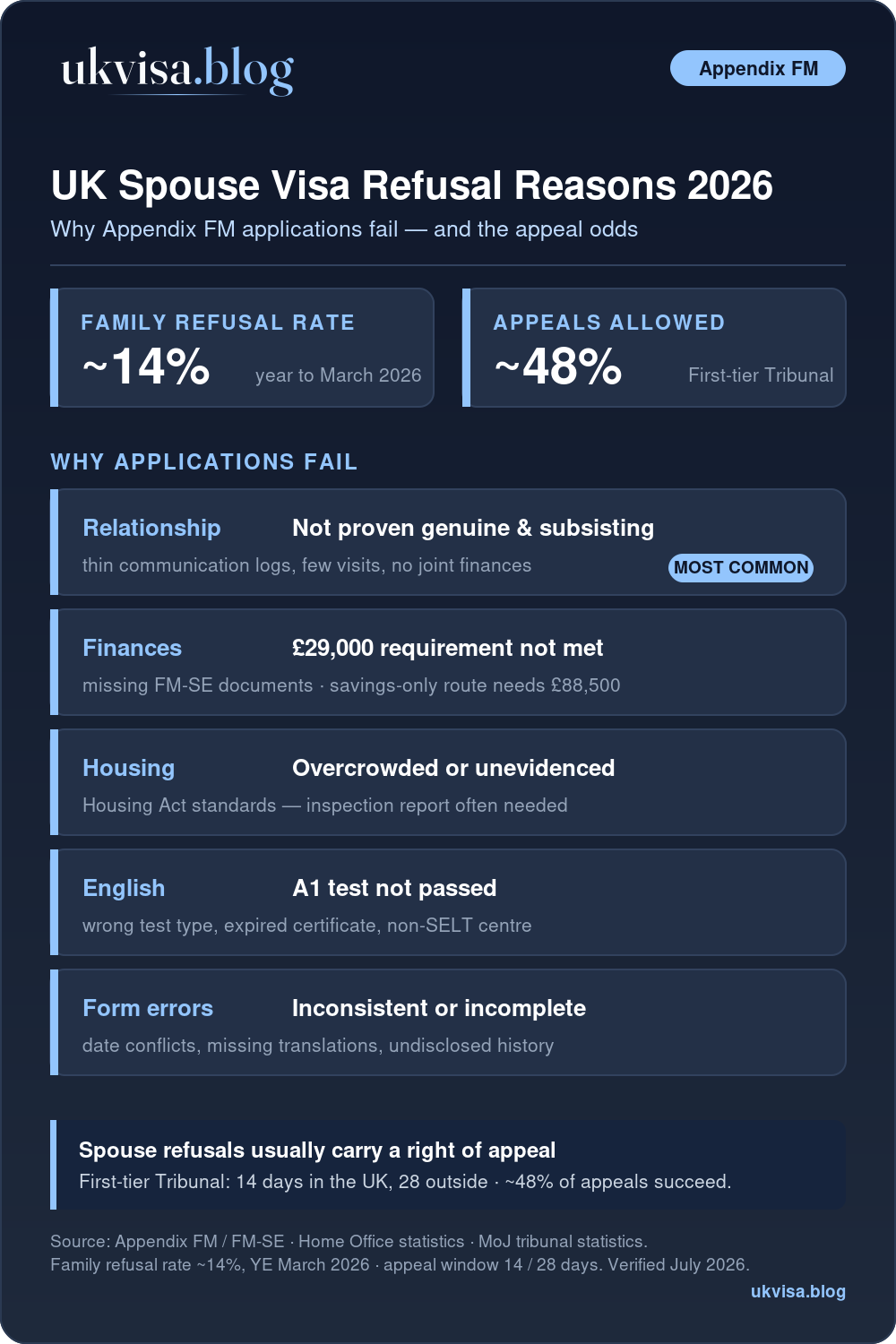
A UK spouse visa can be refused for accommodation issues if the property is overcrowded under the Housing Act 1985, unsuitable for the family size, or if insufficient evidence is provided. You must prove your accommodation meets UK housing standards and will not be overcrowded when your partner arrives. An Independent Housing Inspection Report is often required for shared or family-owned arrangements.
Accommodation refusals are among the most common spouse visa refusal reasons in 2026. Under the Immigration Rules, accommodation must be adequate for the family without being overcrowded or contravening public health regulations. Many applicants underestimate the documentation required to prove housing meets these standards. For detailed evidential requirements, see our complete housing standards guide for partners.
Why Spouse Visas Are Refused for Accommodation
- Overcrowding concerns: The property does not have sufficient bedrooms for all occupants under the Housing Act 1985 space and room standards
- Insufficient evidence: Missing tenancy agreement, property inspection report, or landlord consent letter
- Shared accommodation: Living with extended family without clear evidence of available space and exclusive use
- Temporary housing: Short-term arrangements that do not demonstrate stable accommodation
- Property condition: Evidence suggesting the property does not meet health and safety standards
How to Avoid Accommodation Refusals
To prevent your spouse visa being refused on accommodation grounds, provide comprehensive documentation including:
- Property inspection report: An official assessment confirming the property meets housing standards
- Tenancy agreement or mortgage statement: Proving your right to occupy the property
- Landlord consent letter: Written permission for your partner to reside at the property
- Floor plan or photographs: Showing room sizes and sleeping arrangements
- Council tax statement: Confirming occupancy and property address
Relationship Evidence Failures
Spouse visas are refused for relationship evidence failures when UKVI is not satisfied the relationship is genuine and subsisting. This includes insufficient communication records, inconsistent statements between partners, lack of cohabitation evidence, or concerns about marriages of convenience. Insufficient relationship evidence is the most common spouse visa refusal reason in 2025-2026.
Proving a genuine and subsisting partnership is fundamental to spouse visa success. UKVI caseworkers examine the evidence carefully to identify marriages of convenience, where the primary purpose is immigration rather than genuine partnership. Both partners must demonstrate consistent knowledge of each other and provide substantial evidence of their relationship history, ideally spanning the entire duration of the relationship.
Common Relationship Evidence Refusal Reasons
- Inconsistent information: Contradictory details in partner statements about how you met, relationship timeline, or future plans
- Limited communication evidence: Insufficient call logs, messages, or video call records showing regular contact
- Lack of physical meetings: Few or no visits between partners before the application
- No shared financial commitments: Absence of joint accounts, shared bills, or financial transfers
- Short relationship duration: Applications submitted shortly after marriage without sufficient relationship history
Strong vs Weak Relationship Evidence
| Evidence Type | Strong Evidence | Weak Evidence |
|---|---|---|
| Communication | Daily calls, video chats over 12+ months | Sporadic messages, no video evidence |
| Visits | Multiple trips with flight bookings, photos | Single visit or no physical meetings |
| Photographs | Photos over time with family, events | Few photos from single occasion only |
| Financial | Joint account, regular money transfers | No financial connection between partners |
Financial Requirement Failures
Spouse visas are refused for financial reasons when applicants fail to meet the £29,000 minimum income requirement (in effect since 11 April 2024), provide incomplete documentation, or use inadmissible income sources. Employment gaps, inconsistent payslips, or insufficient savings under Category D (£88,500 minimum) can also trigger refusal. The threshold remains unchanged for 2026.
Meeting the spouse visa income evidence rules is often the most challenging aspect of the application. The minimum income threshold increased significantly in April 2024, and the documentation requirements are strictly enforced. Even small errors or omissions in financial evidence can lead to refusal. The £29,000 threshold remains in place for 2026 — proposed increases to £34,500 and £38,700 are paused following the Migration Advisory Committee review in June 2025.
Common Financial Refusal Reasons
- Below minimum income: Gross annual income falls short of the £29,000 threshold
- Incomplete documentation: Missing payslips, bank statements, or employer letters
- Employment gaps: Unexplained periods without income during the assessment period
- Inadmissible income: Using income sources not accepted under Appendix FM (certain benefits, third-party support)
- Self-employment errors: Insufficient tax returns, accounts, or business evidence under Category F or G
- Savings calculation errors: Cash savings not meeting the formula or held for fewer than 6 consecutive months
- Combining savings with self-employment: Not permitted — savings cannot be combined with Category F or G income
Common Mistakes in Spouse Visa Applications
Common mistakes leading to UK spouse visa refusal include incomplete application forms, inconsistent information between documents, missing supporting evidence, incorrect fee payments, and failure to disclose immigration history. Even minor errors can result in refusal under the strict evidential requirements of Appendix FM.
Application errors are preventable spouse visa refusal reasons that affect many applicants. The Home Office requires precise information, and your UK Spouse visa supporting documents guide must align with your stated circumstances throughout. Inconsistencies between the application form, evidence bundle, and partner statements are frequently cited refusal grounds.
Mistakes That Cause Spouse Visa Refusals
- Incomplete forms: Leaving sections blank or providing vague answers
- Date inconsistencies: Conflicting dates across application form and supporting documents
- Missing translations: Documents not in English without certified translations
- Unsigned documents: Employer letters or declarations without proper signatures
- Wrong fee payment: Paying incorrect visa fee leading to invalid application
- Undisclosed immigration history: Failing to mention previous refusals or overstays — a serious credibility issue
- Expired documents: Submitting out-of-date English test certificates or TB test results
English Language Refusal Reasons
Meeting the A1 SELT requirement for partners is mandatory for spouse visa applicants. Common refusal reasons include:
- Wrong test type: Taking an English test not on the UKVI-approved Secure English Language Test list
- Below required level: Not achieving CEFR A1 for initial applications or A2 for extensions
- Expired certificate: English test results older than two years at application date
- Unapproved test centre: Taking the test at a facility not designated as a SELT centre
Medical and Mental Health Refusals
Spouse visas are rarely refused solely on medical or mental health grounds. UKVI does not deny family visas based on mental health history alone. However, refusals may occur if an applicant fails the mandatory TB test for applicants from listed countries, has an untreated infectious disease, or if their condition raises concerns under Part Suitability of the Immigration Rules.
Questions about medical and mental health in visa applications cause significant concern for applicants. Medical conditions alone are not grounds for refusing a spouse visa unless they pose a public health risk or the applicant cannot be adequately maintained without recourse to public funds.
Do People Get Denied Family Visas Over Mental Health History?
Mental health history alone is not a basis for refusing a UK spouse visa. UKVI does not discriminate against applicants with mental health conditions, disabilities, or chronic illnesses. The assessment focuses on whether the applicant meets the specific requirements of Appendix FM, not their health status.
However, medical-related refusals may occur in these circumstances:
- TB test failure: Applicants from listed countries must pass a tuberculosis screening from a Home Office-approved clinic
- Infectious diseases: Active, untreated infectious conditions that pose public health risks
- Maintenance concerns: If medical costs would require recourse to public funds beyond what is permitted
Spouse Visa Extension and ILR Refusal Reasons
Spouse visa extension refusals commonly occur due to relationship breakdown, failure to meet the higher A2 English requirement, or financial shortfalls. ILR refusals after the spouse route typically involve failing the Life in the UK test, not meeting B1 English, breaking continuous residence with absences exceeding 180 days in any rolling 12-month period, or unspent criminal convictions.
The spouse visa is granted initially for 33 months (entry clearance) or 30 months (in-country switch), after which you must apply for an extension before eventually qualifying for UK long-term settlement. Different refusal reasons apply at each stage of the 5-year journey.
Spouse Visa Extension Refusal Reasons
- Relationship no longer subsisting: Evidence that the couple has separated or the relationship has ended
- English level not met: Failure to achieve CEFR A2 for the FLR(M) extension stage (higher than initial A1)
- Financial requirements not maintained: Sponsor's income has fallen below the threshold
- Late application: Applying after the current visa has expired without valid reason
- Immigration breaches: Violations during the initial visa period such as unauthorised work or breach of conditions
ILR Refusal Reasons After Spouse Visa
- Life in the UK test not passed: Mandatory requirement for settlement applications
- English B1 not achieved: Higher English requirement at the SET(M) settlement stage
- Absences exceeding 180 days: Spending more than 180 days outside the UK in any rolling 12-month period
- Continuous residence broken: Single absence of more than 6 months breaking the qualifying period
- Criminal convictions: Unspent convictions or serious offences affecting suitability
- Relationship ended: The marriage or civil partnership has broken down before ILR eligibility
Appealing a UK Spouse Visa Refusal
If your spouse visa is refused, you typically have the right to appeal to the First-tier Tribunal within 28 days (if outside the UK) or 14 days (if inside the UK). The appeal allows you to challenge the refusal on human rights grounds under Article 8 ECHR. Alternatively, you may submit a fresh application addressing the refusal reasons.
Understanding your options after a spouse visa refusal is crucial. Unlike most visitor visa refusals, family visa refusals usually carry appeal rights to the First-tier Tribunal (Immigration and Asylum Chamber). Our comprehensive guide on the spouse visa appeal timeline and costs provides detailed information on the tribunal procedure, while our general immigration appeal guide covers other appeal categories.
Remedies After Spouse Visa Refusal
| Option | Deadline | Best For |
|---|---|---|
| First-tier Tribunal Appeal | 28 days (outside UK) / 14 days (inside UK) | When UKVI misapplied the rules or overlooked evidence on Article 8 grounds |
| Reapplication strategy after refusal | No deadline | When circumstances have changed or stronger evidence available |
| Withdraw and reapply | No deadline | When refusal grounds are clearly fixable with better documentation |
- Most common refusals: Insufficient relationship evidence, financial shortfalls, accommodation issues, application errors
- Financial threshold: £29,000 confirmed unchanged for 2026 — MAC review June 2025 produced no further increase
- Mental health: Not a basis for refusal — UKVI does not discriminate on mental health grounds
- Application errors: Preventable causes — incomplete forms, date inconsistencies, missing translations
- Extension/ILR: Different requirements including higher English levels (A2 extension, B1 ILR)
- Appeal rights: Most spouse visa refusals carry appeal rights to the First-tier Tribunal — deadline 14 days (UK) or 28 days (overseas)
- Appeal success rate: Approximately 48% of spouse visa appeals are allowed at First-tier Tribunal
Frequently Asked Questions about Spouse Visa Refusal Reasons
What are the most common UK spouse visa refusal reasons?
The most common spouse visa refusal reasons in 2026 are: failure to meet the £29,000 minimum income requirement, inadequate proof of a genuine and subsisting relationship, accommodation not meeting Housing Act 1985 standards, not passing the required A1 English language test, and errors or omissions in the application form or supporting documents. Insufficient relationship evidence remains the single most common refusal ground.
Can a spouse visa be refused for accommodation issues?
Yes, spouse visas are commonly refused for accommodation issues. The property must be adequate for the family without being overcrowded according to UK Housing Act 1985 standards. You need to provide proof such as a property inspection report, tenancy agreement, and landlord consent letter. Shared accommodation with extended family is scrutinised more carefully and typically requires an Independent Housing Inspection Report.
Do people get denied family visas over mental health history?
No, mental health history alone is not a basis for refusing a UK spouse visa. UKVI does not discriminate against applicants with mental health conditions. Medical-related refusals only occur for public health concerns such as failing the mandatory TB test from listed countries or having an untreated infectious disease. Having depression, anxiety, or other mental health conditions will not result in visa refusal.
What are spouse visa extension refusal reasons?
Spouse visa extension refusal reasons include: the relationship no longer being genuine and subsisting, failure to meet the CEFR A2 English requirement (higher than the initial A1), the sponsor's income falling below the £29,000 threshold, submitting the FLR(M) application late after the visa expired, or immigration violations during the initial visa period such as unauthorised work or breach of conditions.
What are the ILR refusal reasons after spouse visa?
ILR refusal reasons after the spouse visa route include: not passing the Life in the UK test, failing to achieve CEFR B1 English level, spending more than 180 days outside the UK in any rolling 12-month period, a single absence exceeding 6 months breaking continuous residence, unspent criminal convictions, or the relationship ending before completing the 5-year qualifying period.
Can I appeal a UK spouse visa refusal?
Yes, most spouse visa refusals include a right of appeal to the First-tier Tribunal (Immigration and Asylum Chamber). You must appeal within 28 days if you are outside the UK or 14 days if inside the UK. The appeal is typically on human rights grounds under Article 8 of the European Convention on Human Rights. Your refusal letter will confirm your specific appeal rights and the deadline for submission.
What are the chances of spouse visa refusal in the UK?
Spouse visa refusal rates vary based on the quality of applications and applicant circumstances. Family visa refusals run at approximately 14% overall. Well-prepared applications with comprehensive evidence typically succeed. The main risk factors are: applying before meeting the income threshold, submitting weak relationship evidence, inadequate accommodation proof, or making application errors. Refusal rates are higher for certain nationalities and first-time applicants.
How can I avoid UK spouse visa refusal?
To avoid spouse visa refusal: ensure your sponsor meets the £29,000 minimum income requirement with comprehensive Category A-G documentation, provide extensive evidence of your genuine relationship spanning the entire relationship timeline, submit a property inspection report confirming adequate accommodation, pass the required A1 SELT at an approved test centre, complete all application sections accurately, and disclose any previous immigration issues honestly. Professional immigration advice can help complex cases.
For the official government guidance on spouse visa refusal grounds, visit gov.uk Family Visas or review the full Appendix FM Immigration Rules.