
The standard ILR processing time in 2026 is up to 6 months from the biometric appointment, applying to almost all Indefinite Leave to Remain routes — Spouse / Partner (SET M), Skilled Worker (SET O), Long Residence (SET LR), Private Life, and BN(O). Priority service cuts this to 5 working days for £500; Super Priority to next working day for £1,000. From 8 April 2026 the standard fee rose to £3,226 (from £3,029). This guide covers the service standard by category, the priority pathways, current fees, what causes delays, how to check your status, and the 2026 policy landscape.
Source: UKVI in-country visa decision waiting times service standards; Home Office Immigration System Statistics, year ending March 2026 (152,306 settlement grants); Statement of Changes HC 1691 (laid 5 March 2026); 2026 Home Office fees order (effective 8 April 2026)
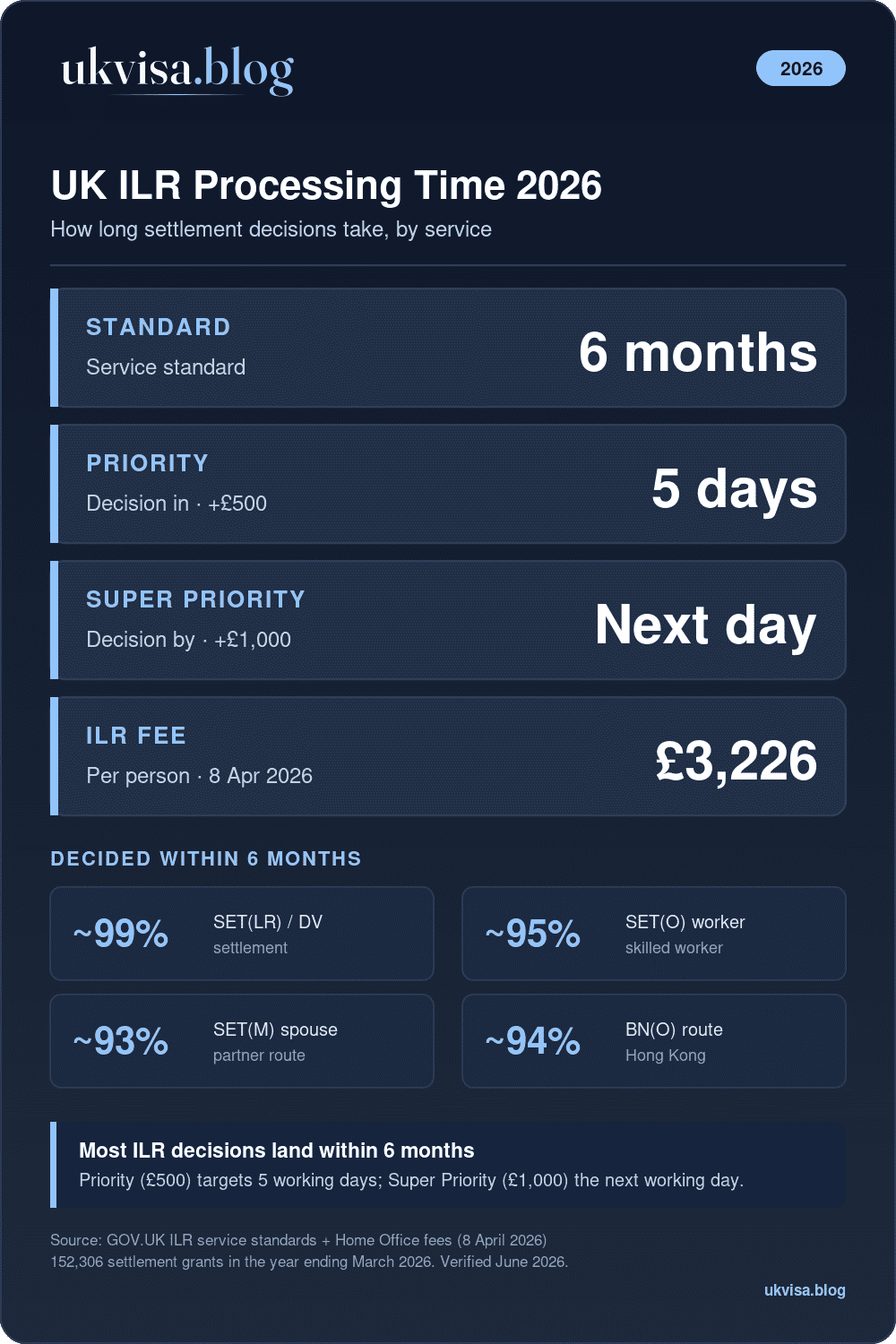
The UKVI 6-month service standard for ILR is unchanged in 2026. Performance by category: SET LR and SET DV ~99% within 6 months; SET O (Skilled Worker) ~95-96%; BN(O) ~94%; SET M (Spouse / Partner) ~93%. Fees from 8 April 2026: standard ILR £3,226 (raised from £3,029), Priority £500, Super Priority £1,000. Volumes: 152,306 settlement grants in the year ending March 2026 (down 11% YoY). The Earned Settlement consultation closed 12 February 2026 (outcome pending); HC 1691 introduces a B2 settlement English standard from 26 March 2027.
- ILR Processing Time 2026 — Overview and Service Standards
- ILR Decision Time by Category — SET M, SET O, Long Residence, BN(O)
- Priority and Super Priority ILR — £500 / £1,000 Pathways
- Spouse ILR Processing Time — SET M Route
- Skilled Worker ILR Processing Time — SET O Route
- Long Residence ILR Processing Time — 10-Year Route
- BN(O) Settlement Processing Time
- Private Life Route ILR Processing Time
- What Causes ILR Processing Delays Beyond 6 Months
- How to Check Your ILR Application Status
- ILR Fees 2026 — £3,226 Standard from 8 April
- UK ILR New Rules 2026 — Earned Settlement and HC 1691
- Frequently Asked Questions
ILR Processing Time 2026 — Standard 6 Months, Priority 5 Days, Super Priority Next Day
ILR processing time refers to how long UKVI takes to decide an Indefinite Leave to Remain qualifying framework application from the date the applicant attends their biometric appointment. The UKVI service standard is up to 6 months across virtually all settlement categories — SET M (Spouse / Partner), SET O (Skilled Worker), SET LR (Long Residence), Private Life, and BN(O). The standard is a target, not a guarantee — straightforward applications are typically decided within weeks; non-straightforward applications requiring additional verification, security checks, or document requests can take longer. Two paid expedited services compress the timeline: Priority Service at £500 delivers a decision within 5 working days; Super Priority Service at £1,000 delivers a decision by the end of the next working day. Availability of expedited services varies by category and channel.
ILR Processing Time 2026 — Overview and Service Standards
The standard ILR processing time in 2026 is up to 6 months from the biometric appointment date, applying to all settlement routes — Spouse / Partner (SET M), Skilled Worker (SET O), Long Residence (SET LR), Private Life, BN(O), and other ILR categories. Priority Service: 5 working days for £500 (available on most categories). Super Priority Service: next working day for £1,000 (available on SET M and SET O; limited elsewhere; not available where biometrics were taken via the UK Immigration: ID Check app). Most straightforward applications are decided well within the 6-month standard — 93-99% depending on category. Non-straightforward cases requiring security checks, document verification, or criminal history assessment may take longer.
ILR Decision Time by Category — SET M, SET O, Long Residence, BN(O)
All major ILR categories share the same UKVI service standard of up to 6 months from biometric appointment. Actual processing performance varies by route: Long Residence (SET LR) — approximately 99% within 6 months; Domestic Violence (SET DV) — approximately 99%; Skilled Worker (SET O) — approximately 95-96%; Spouse / Partner (SET M) — approximately 93%; BN(O) settlement — approximately 94%. Most decisions are issued well within the 6-month target. Cases involving criminal history, security checks, or complex residence calculations typically take the longest. Priority and Super Priority services are available on most categories.
ILR Service Standard by Category (2026)
| ILR Category | Service Standard | Priority Available | Super Priority Available |
|---|---|---|---|
| Spouse / Partner (SET M) | Up to 6 months | Yes (£500 / 5 working days) | Yes (£1,000 / next working day) |
| Skilled Worker (SET O) | Up to 6 months | Yes | Yes |
| Long Residence 10-year (SET LR) | Up to 6 months | Yes (Priority only) | Limited |
| Long Residence 20-year (Private Life) | Up to 6 months | Limited | No |
| Domestic Violence (SET DV) | Up to 6 months | Limited | Limited |
| Protection / Refugee settlement | Up to 6 months | No | No |
| BN(O) settlement | Up to 6 months | Yes (Priority only) | Limited |
| Tier 1 Investor / Innovator / Global Talent | Up to 6 months | Yes | Yes |
| No Time Limit (NTL) | Up to 6 months | Limited | Limited |
Priority and Super Priority ILR — £500 / £1,000 Pathways
Priority Service costs £500 and delivers an ILR decision within 5 working days of biometric appointment. Super Priority Service costs £1,000 and delivers a decision by the end of the next working day after biometrics. Both services are added to the standard £3,226 ILR fee (from 8 April 2026). Availability varies by ILR category — SET M (Spouse) and SET O (Skilled Worker) routinely offer both services; Long Residence and BN(O) typically offer Priority but rarely Super Priority. Super Priority is not available where biometrics were captured via the UK Immigration: ID Check app rather than a UKVCAS / SSC appointment. See our UK priority visa pathways guide.
ILR Priority Service Comparison Table
| Service | Processing Time | Additional Fee | Best For |
|---|---|---|---|
| Standard | Up to 6 months from biometrics | None (just the £3,226 ILR fee) | Applicants with flexible timelines |
| Priority | 5 working days from biometrics | £500 (on top of £3,226) | Work or travel deadline within 1-2 months |
| Super Priority | End of next working day after biometrics | £1,000 (on top of £3,226) | Time-critical decisions; complete documents |
Spouse ILR Processing Time — SET M Route
Spouse / Partner ILR (SET M) applications follow the standard 6-month UKVI service target, with approximately 93% decided within 6 months of biometrics. Both Priority Service (£500 / 5 working days) and Super Priority Service (£1,000 / next working day) are routinely available. Most refusals or delays relate to the financial requirement under UK Spouse visa rules (£29,000 income threshold since March 2024), gaps in cohabitation evidence, or absences exceeding the 180-day annual limit during the 5-year qualifying period. The HC 1691 B2 English settlement standard applies to SET M from 26 March 2027. Note: this is the settlement stage — for the mid-route 30-month FLR(M) renewal (an 8-week standard), see spouse visa extension processing time.
Skilled Worker ILR Processing Time — SET O Route
Skilled Worker ILR (SET O) applications follow the same 6-month UKVI service standard. Approximately 95-96% are decided within 6 months of biometrics. Both Priority Service (£500 / 5 working days) and Super Priority Service (£1,000 / next working day) are routinely available. Common SET O delay triggers: gaps or discrepancies in salary evidence (the sponsored salary throughout the qualifying period must meet the relevant threshold for each year); absences exceeding 180 days in any consecutive 12-month period; sponsor licence issues; PAYE / National Insurance discrepancies. The Skilled Worker sponsored employment framework continues to drive significant ILR volumes — Skilled Worker is now the largest ILR-driving route by application volume.
Long Residence ILR Processing Time — 10-Year Route
Long Residence ILR (SET LR — 10 continuous years lawful residence) applications also follow the 6-month standard, and have the strongest historical performance with approximately 99% decided within 6 months. The 10-year Long Residence route under paragraph 276B of the Immigration Rules allows ILR for applicants who have been continuously and lawfully resident for 10 years. The 20-year Private Life route (different paragraph framework) is also possible where continuous residence is 20 years; the Private Life processing time also follows the 6-month standard but Super Priority is typically not available. See our 180-day absence rule for continuous residence guide for the qualifying-period framework.
BN(O) Settlement Processing Time
BN(O) settlement applications follow the standard 6-month UKVI service target, with approximately 94% of decisions issued within 6 months. BN(O) status holders qualify for ILR after 5 years of continuous residence on the BN(O) route. The BN(O) settlement route delivered 7,214 grants in year ending March 2026 at a 98% grant rate. Priority Service (£500) is available; Super Priority Service is typically not available for BN(O). See our British National (Overseas) settlement pathway guide for the eligibility framework, the new Adult Child route (renamed from Household Member, with 1979 eligibility expansion), and the £206 (30-month) / £285 (5-year) BN(O) fees from 8 April 2026.
Private Life Route ILR Processing Time
The Private Life route to settlement typically follows the standard 6-month UKVI target. Applications are made under Appendix Private Life and require either the qualifying residence period (typically 20 years for adults, or 5+ years for some young-person cases) AND that removal would breach Article 8 ECHR private life rights. These applications are often document-heavy and may take longer to decide. Priority Service is sometimes available; Super Priority typically is not. Most refusals retain First-tier Tribunal appeal rights on Article 8 grounds — see our Article 8 ECHR family and private life rights guide.
What Causes ILR Processing Delays Beyond 6 Months?
ILR applications can exceed the 6-month standard for several reasons: incomplete documentation (missing payslips, bank statements, residence evidence); security checks; criminal history needing further assessment; document verification where authenticity is questioned; travel history gaps where absences exceed 180 days in a qualifying year; and English language or Life in the UK test certificate issues. Peak spring / autumn volumes also slow processing. UKVI writes to the applicant if a case is treated as non-straightforward. See our UK visa delay troubleshooting guide.
Common ILR Delay Triggers
- Missing or inconsistent salary evidence: Payslips and bank statements must cover the entire qualifying period with consistent figures
- Absences exceeding 180 days: More than 180 days outside the UK in any 12-month period of the qualifying residence typically requires explanation
- Criminal record disclosure: Any disclosed conviction (UK or overseas) typically triggers a Part Suitability assessment
- Document authenticity concerns: Any suspicion of fraud triggers investigation (verification requests to issuing bodies)
- SELT or Life in the UK certificate issues: Expired certificates, fraud allegations against the test centre, or non-canonical providers
- Sponsor licence issues (Skilled Worker): Sponsor under audit or licence revoked during qualifying period
- PAYE / National Insurance discrepancies: Mismatch between HMRC records and applicant-supplied salary evidence
How to Check Your ILR Application Status
You can check your ILR application status through several channels. UKVI online portal: log in to your application account using the email address and application reference number; you'll see status updates at key stages. Email notifications: UKVI sends automatic email updates when biometrics are received, when the application is allocated to a caseworker, and when a decision is issued. Direct UKVI enquiry: if your application exceeds the 6-month standard, you can contact UKVI through the online enquiry form. MP enquiry: your Member of Parliament can make enquiries on your behalf for cases significantly exceeding the standard. For status-check questions specifically, the UKVI online portal is the canonical source.
Methods to Check ILR Application Status
- UKVI online portal: Log in to your application account with the email address used to submit the application — primary tracking method
- Email notifications: Check the inbox associated with your application for automatic UKVI updates — biometric receipt, allocation, decision
- UKVI online enquiry: Submit an enquiry through gov.uk if your application is past the 6-month standard
- Telephone enquiry: UKVI Contact Centre is available for general queries (note: paid premium-rate service for some enquiries)
- MP enquiry: Constituency MP can raise an enquiry on your behalf for applications significantly past the standard or where exceptional circumstances apply
- Sopra Steria / UKVCAS portal: If biometrics were submitted at a UKVCAS / Sopra Steria centre, that portal shows initial appointment / submission status
ILR Fees 2026 — £3,226 Standard from 8 April
The standard ILR application fee from 8 April 2026 is £3,226 per applicant (raised from £3,029 — a £197 increase). Optional add-ons: Priority Service +£500 (5 working days); Super Priority Service +£1,000 (next working day). Biometric enrolment: typically included; some categories require a £19.20 biometric fee at the UKVCAS appointment. Immigration Health Surcharge: NOT payable on ILR applications (the IHS is only payable on time-limited leave). The full Home Office fee schedule for ILR, eVisa, and citizenship is detailed in our Home Office fees overview guide.
ILR Fee History
| Effective Date | Standard ILR Fee | Change |
|---|---|---|
| 9 April 2025 | £3,029 | From £2,885 (+£144 / +5.0%) |
| 8 April 2026 | £3,226 | +£197 (+6.5%) under 2026 Home Office fees order |
UK ILR New Rules 2026 — Earned Settlement and HC 1691
Two major 2026 ILR policy developments are in flight. The Earned Settlement consultation closed on 12 February 2026 (outcome pending). It proposed extending the qualifying period from 5 to 10 years for some routes, and requiring adult dependants to qualify for ILR in their own right rather than tracking the principal applicant. HC 1691 (laid 5 March 2026) introduces a B2 English settlement standard from 26 March 2027 across most ILR routes — B2 rather than the current B1 under CEFR. Existing applicants in qualifying periods are protected by transitional arrangements. Always check current Home Office guidance for the rules in force when you apply.
- Use the correct SET form for your route — SET M (Spouse), SET O (Skilled Worker), SET LR (Long Residence), SET DV (Domestic Violence), SET F (Other family)
- Complete all sections of the online application form accurately — no blank fields
- Gather 5+ years of continuous residence evidence (10 for SET LR, 20 for Private Life 20-year route)
- Verify your Life in the UK test certificate is valid and your SELT certificate is at B1 or above (B2 from 26 March 2027 under HC 1691)
- Accurately calculate any absences from the UK during the qualifying period — under 180 days per consecutive 12-month period
- Prepare financial / salary evidence for your route — payslips, bank statements covering the full qualifying period
- Include passport(s) covering the entire qualifying period and all previous eVisa / BRP records
- Pay the correct £3,226 application fee (from 8 April 2026), plus £500 (Priority) or £1,000 (Super Priority) if using expedited service
- Disclose all criminal convictions (UK and overseas), prior visa refusals, and immigration history honestly — non-disclosure triggers a 10-year deception ban
- Standard ILR processing time: up to 6 months from biometric appointment date
- Priority Service: 5 working days for £500 (most categories)
- Super Priority Service: next working day for £1,000 (SET M, SET O; limited elsewhere)
- Standard ILR fee from 8 April 2026: £3,226 (raised from £3,029)
- Immigration Health Surcharge is NOT payable on ILR applications
- Settlement grants: 152,306 in year ending March 2026 (down 11% year-on-year)
- Spouse ILR (SET M): ~93% decided within 6 months; Skilled Worker (SET O): ~95-96%; Long Residence (SET LR): ~99%; BN(O): ~94%
- Super Priority NOT available where biometrics were taken via UK Immigration: ID Check app
- Track applications via UKVI online portal; UKVI email notifications cover biometric receipt, allocation, decision stages
- For applications past 6 months: contact UKVI directly or via MP enquiry
- Earned Settlement consultation closed 12 Feb 2026 — outcome pending; HC 1691 introduces B2 settlement English standard from 26 March 2027
- Transitional arrangements typically protect applicants already in qualifying periods when rules change
Frequently Asked Questions about ILR Processing Time
The standard ILR processing time in 2026 is up to 6 months from your biometric appointment date — applying across all major settlement routes including Spouse / Partner (SET M), Skilled Worker (SET O), Long Residence (SET LR), and BN(O). Priority Service reduces this to 5 working days for an additional £500; Super Priority Service offers next working day decisions for £1,000 (subject to availability). Actual processing times vary based on application complexity, security checks, and UKVI workload. Approximately 93-99% of straightforward applications are decided within the 6-month standard depending on category.
The standard decision time for Spouse / Partner ILR applications (SET M form) is up to 6 months from biometrics. Home Office performance data indicates approximately 93% of SET M applications are decided within this 6-month service standard. Both Priority Service (£500 / 5 working days) and Super Priority Service (£1,000 / next working day) are routinely available for SET M. Most spouse ILR delays relate to gaps in the financial requirement evidence, cohabitation evidence, or absences exceeding the 180-day annual limit during the 5-year qualifying period.
Super Priority Service is available for most major ILR categories including SET M (Spouse / Partner) and SET O (Skilled Worker). It costs £1,000 on top of the standard £3,226 ILR fee and provides a decision by the end of the next working day after your biometric appointment. Key limitations: not available where biometrics were captured via the UK Immigration: ID Check app (only UKVCAS / Sopra Steria appointment biometrics qualify); not offered for Protection / Refugee settlement, Long Residence 20-year, or EU Settlement Scheme applications; subject to availability that varies with UKVI workload. Check availability when booking the appointment.
ILR applications can exceed the 6-month standard for several reasons. Incomplete documentation (missing payslips, bank statements, or continuous residence evidence) is the most common cause. Security checks triggered by certain backgrounds, criminal history disclosure requiring further assessment, document verification investigations where authenticity is questioned, travel history gaps where absences from the UK exceed 180 days in a qualifying year, and issues with English language or Life in the UK certificate validity all extend processing time. UKVI will typically write to the applicant if the case is treated as non-straightforward and expected to exceed the standard service period.
Check your ILR application status through the UKVI online portal using the email address you used to submit the application — this is the primary tracking method. UKVI also sends automatic email notifications at key stages (biometric receipt, caseworker allocation, decision issued). If your application exceeds the 6-month standard, contact UKVI directly via the online enquiry form. For cases significantly past the standard or with exceptional circumstances, your Member of Parliament can raise an enquiry on your behalf. The Sopra Steria / UKVCAS portal also shows initial appointment status if biometrics were submitted there.
The standard ILR application fee from 8 April 2026 is £3,226 per applicant — raised from £3,029 (a £197 / 6.5% increase) under the 2026 Home Office fees order. Optional expedited services: Priority Service +£500 (5 working day decision), Super Priority Service +£1,000 (next working day decision). The Immigration Health Surcharge is NOT payable on ILR applications — the IHS is only payable on time-limited leave. Biometric enrolment is typically included in the fee, but some applicants may pay a £19.20 biometric fee at the UKVCAS appointment. Children and dependants pay the full £3,226 fee each — there is no family discount.
As of May 2026, the standard 5-year qualifying period remains in place for most ILR routes including Spouse / Partner, Skilled Worker, and other major work routes. The Earned Settlement consultation closed on 12 February 2026 — the outcome is pending. The consultation proposed reforms including extending the qualifying period from 5 to 10 years for some routes, and requiring adult dependants to qualify for ILR in their own right rather than tracking the principal applicant. Until any rule change is published in a Statement of Changes, the existing 5-year framework continues to apply. Transitional arrangements typically protect existing applicants in qualifying periods when rules change.
Long Residence ILR applications (SET LR — 10 continuous years lawful residence under paragraph 276B) follow the same 6-month UKVI service standard but have the strongest historical performance — approximately 99% of SET LR applications are decided within 6 months of biometrics. The 20-year Private Life route (different paragraph framework) is also possible where continuous residence is 20 years; the Private Life processing time also follows the 6-month standard but Super Priority Service is typically not available. Priority Service is available for SET LR for an additional £500.
After ILR approval, your digital immigration status is available online immediately — log in to your UKVI account to view and share your eVisa status. The Home Office has phased out physical BRP cards in favour of digital eVisa status, so most ILR applicants now receive eVisa confirmation only. Your eVisa is the canonical proof of ILR status — share it electronically when needed (rental, employment, banking) by generating a View and Prove share code. No physical document is issued for digital-only grants.
If your ILR application is refused, UKVI sends a decision letter explaining the reasons. Depending on your circumstances, you may have a right to administrative review (for caseworker errors in applying the Immigration Rules), an appeal to the First-tier Tribunal (where Article 8 ECHR family or private life rights are engaged), or you may submit a fresh ILR application addressing the refusal reasons with strengthened evidence. Your refusal letter will specify which options are available and the deadlines (typically 14-28 days). For the framework, see our refusal recovery and administrative review guides.
For the official UKVI service standards across in-country applications, see UKVI visa decision waiting times — in-country applications. For the Statement of Changes introducing the B2 settlement standard, see Immigration Rules: Statement of Changes. For the Earned Settlement consultation framework and any published outcome, see Home Office consultations. For the underlying long residence and settlement framework, see the consolidated Immigration Rules on gov.uk.