
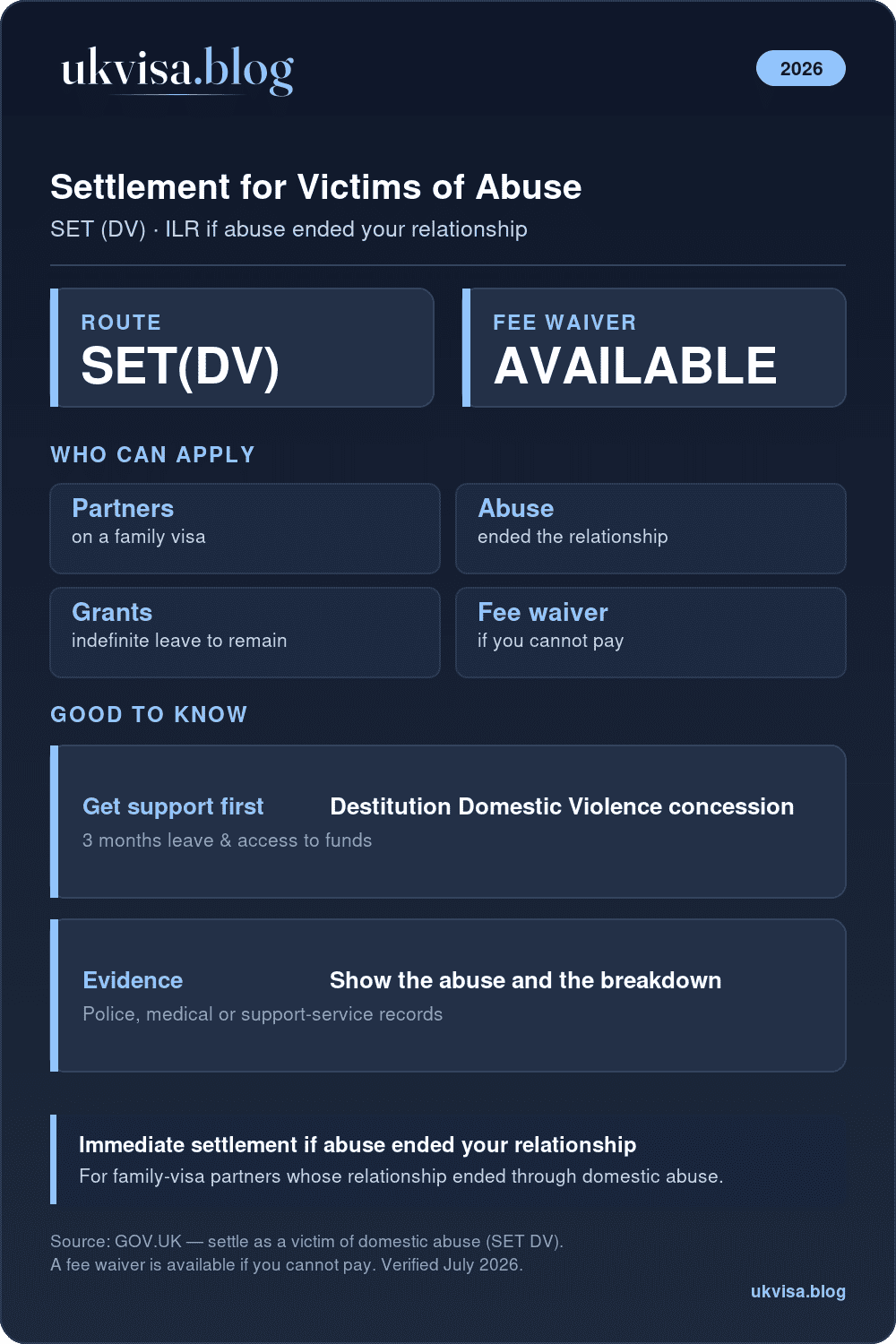
SET(DV) gives settlement to someone whose relationship broke down because of domestic abuse, independently of the partner they held permission through. No qualifying period, no financial requirement, no English or Life in the UK test, expired permission accepted — and a fee waiver where you cannot pay.
UK Family Visas
SET DV Guidance: Understanding Domestic Violence ILR in 2026
What Is the SET DV Application?
The settlement application for a person whose relationship has permanently broken down because of domestic abuse. Since 31 January 2024 it is governed by Appendix Victim of Domestic Abuse, which replaced the provisions in Appendix FM. There is no minimum residence period, no financial requirement, and no English or Life in the UK requirement. The fee is £3,226, and a waiver is available.
If you are in danger now, immigration status is the second problem. Domestic abuse services, refuges and the police can help regardless of your immigration status, and the Migrant Victims of Domestic Abuse Concession below exists specifically to give you three months of permission and access to public funds while you decide what to do. Nothing in this route requires you to stay in the relationship or to have already left it in any particular way.
Domestic abuse under the Domestic Abuse Act 2021 is far wider than physical violence: emotional, psychological, financial and sexual abuse all count, as do controlling and coercive behaviour. The Home Office assesses all forms equally, so a case built on coercive control is not weaker than one built on injuries.
Abandonment Overseas Now Counts
Appendix VDA recognises transnational marriage abandonment — where a sponsor deliberately strands their partner abroad, typically during a family visit, to prevent their return. Victims can apply from outside the UK for entry clearance for settlement, having previously had no route at all.
There is a further point worth knowing. For abandonment cases the standard of proof is lower: a reasonable degree of likelihood rather than the balance of probabilities that applies to in-country claims. That difference recognises how little evidence a person stranded abroad is usually able to gather.
Who Can Apply
Eligibility turns on what permission you last held and on why the relationship ended. Nothing turns on how long you were here or on what you earn — those requirements are disapplied entirely.
Qualifying Permission
| Last granted permission as | Eligible under Appendix VDA |
|---|---|
| Partner under Appendix FM | Yes, except fiancé(e) or proposed civil partner |
| Spouse, civil partner or durable partner under Appendix EU | Yes |
| Partner of a refugee under Appendix FM, Part 11 or Family Reunion | Yes |
| Partner under Appendix Armed Forces or Part 7 | Yes |
| Victim of domestic abuse under Appendix FM | Yes |
| Holder of leave under the Migrant Victims concession | Yes |
| Dependant of a worker, student or graduate | No — but the concession below is still open |
Source: Appendix Victim of Domestic Abuse; Home Office guidance version 23.0, updated 17 July 2026.
The guidance adds that some cohorts falling outside Appendix VDA should nonetheless be granted settlement outside the Immigration Rules where the other requirements are met. Where a case is close to the boundary, that is worth raising expressly rather than assuming the route is closed.
Expired Permission Does Not Bar You
You do not need to hold valid permission when you apply. What matters is that your last grant was as a qualifying partner. Victims frequently delay for months or years, and the rules are drafted to accommodate that rather than to punish it.
How the Guidance Grades Evidence
| Tier | What it covers |
|---|---|
| Conclusive | Criminal conviction, police caution, CPS charging decision, civil court order or finding of fact, a Domestic Abuse Protection Order or Domestic Violence Protection Order |
| Compelling | Letters from domestic abuse professionals, medical reports of injuries consistent with abuse, a MARAC referral, witness statements |
| Considered | Police attendance reports, arrest records, your own statement, correspondence showing abusive behaviour |
Source: Appendix Victim of Domestic Abuse guidance version 23.0.
Evidence is assessed in the round rather than against a checklist. Where documents cannot be obtained — because an abuser controlled the phone, the papers and the money — a detailed personal statement explaining that absence is itself evidence, and the guidance expects caseworkers to treat it that way.
Making the Application
The application is made online. Fee, biometrics and document upload follow the ordinary settlement pattern, and the substantive work is the evidence rather than the form. Our guide to the UK visa application form covers the mechanics.
SET(DV) Costs from 8 April 2026
| Item | Amount |
|---|---|
| SET(DV) application | £3,226 |
| With an approved fee waiver | Nil |
| Immigration Health Surcharge | Not payable on settlement applications |
| Administrative review, if refused | £80 |
| Priority and super priority | Not available |
Source: Home Office immigration and nationality fees, 8 April 2026.
The Fee Waiver, and How It Is Handled
You qualify where you have nowhere to live and cannot afford accommodation, or have accommodation but cannot meet essential living costs, or have a very low income where paying would harm a child's wellbeing. Bank statements, local authority letters and letters from support organisations all serve as evidence.
The guidance contains a protection worth knowing about: before rejecting a fee waiver claim, the Home Office should make at least two attempts, over a minimum of eight weeks, to obtain further evidence. A first request for more information is not a refusal, and it should not be treated as one. Wider fee context sits in our Home Office fees guide.
Timescales and Children
Decisions on this route commonly take around six months from biometrics, and no priority service is offered. You can continue to live and work in the UK while it is pending. Dependent children under 18 are included in the parent's application and do not need to complete the abuse sections themselves; a dependant aged 18 or over must meet the English and Life in the UK requirements.
The Migrant Victims of Domestic Abuse Concession
The concession — formerly the Destitute Domestic Violence Concession — grants three months of leave outside the rules, with permission to work and no prohibition on recourse to public funds. That means Universal Credit and housing support can be claimed while the settlement application is prepared.
Who It Reaches
It is wider than Appendix VDA. Alongside partners under Appendix FM and Appendix EU and partners of refugees, it covers the partner of someone with permission on a work route or as a student, and partners under the Ukraine Scheme. Those groups cannot settle under Appendix VDA, but they can use the concession to get immediate status and support.
What Happens at the End of Three Months
You must either apply for settlement under Appendix VDA if eligible, make a different immigration application, or leave. Doing nothing means becoming an overstayer and losing entitlement to public funds. For those outside Appendix VDA, that different application is usually a human rights claim — see our guide to the 10-year family life route.
If the Application Is Refused
Refusals turn on the two eligibility questions rather than on anything else. Our guide to partner visa refusal grounds covers the general pattern, but this route's grounds are narrower.
- Evidence of abuse: what was supplied does not establish, on the applicable standard, that abuse occurred and caused the breakdown.
- Wrong prior permission: the last grant was as a dependant on a work or study route, or as a fiancé(e).
- Relationship not permanently ended: material suggesting the relationship continues.
- Suitability: criminality or immigration breaches — though the guidance allows for circumstances arising from the abuse itself.
- Incomplete application: unanswered sections or missing documents.
The Available Remedies
There is generally no appeal against a settlement refusal on this route unless the application raised a human rights claim. Administrative review is the usual remedy at £80, within the deadline stated in the refusal letter, where the error was one of caseworking. A fresh application with stronger evidence is often faster than either.
Where an error of law is involved, judicial review is available but should not be attempted without advice. Where Article 8 grounds were part of the application, an appeal to the First-tier Tribunal may be open on that aspect. The evidence you assembled for the partner route and its supporting documents can usually be reused, and the financial requirement never applies here. Proving the breakdown itself is covered in our guide to the partner relationship test.
Sources: Appendix Victim of Domestic Abuse of the Immigration Rules; Home Office caseworker guidance, version 23.0, updated 17 July 2026; the Migrant Victims of Domestic Abuse Concession guidance; and the fee table of 8 April 2026. If you need help now, GOV.UK sets out how to report domestic abuse and find support. Figures verified 22 August 2026.
Frequently Asked
Questions about SET DV Applications
£3,226 per person from 8 April 2026, up from £3,029. No Immigration Health Surcharge is payable because settlement applications are exempt. A full fee waiver is available where you are destitute or cannot meet essential living costs, and the Home Office should make at least two attempts over a minimum of eight weeks to obtain evidence before rejecting a waiver claim.
Commonly around six months from your biometrics appointment, and there is no priority or super priority service on this route. You can continue living and working in the UK while the application is pending, and permission that expired before you applied does not affect that.
No. Both the Life in the UK requirement and the English language requirement are disapplied for victims of domestic abuse applying under Appendix VDA, as is the financial requirement. A dependant aged 18 or over applying alongside you does have to meet the English and Life in the UK requirements.
It has been replaced by the Migrant Victims of Domestic Abuse Concession, which does the same job. It grants three months of leave outside the rules with permission to work and no prohibition on recourse to public funds, so Universal Credit and housing support can be claimed while a settlement application is prepared.
Yes. Appendix VDA requires only that your last grant of permission was as a qualifying partner, not that it is still current. Many victims delay for a long time before applying, and the rules are written to accommodate that rather than to penalise it. Expired permission is not a bar and should not stop you applying.
Appendix VDA does not reach you, but the Migrant Victims of Domestic Abuse Concession does — it expressly covers partners of people on work and study routes, and partners under the Ukraine Scheme. That gives three months of status, work rights and access to public funds, within which a different application, usually on human rights grounds, must be made.
Yes, where you are a victim of transnational marriage abandonment — deliberately stranded abroad by your sponsor to prevent your return. Appendix VDA allows an application for entry clearance for settlement in those cases, and the standard of proof is lower than for in-country claims: a reasonable degree of likelihood rather than the balance of probabilities.
Children under 18 are included in your application and do not have to complete the sections about the abuse themselves, which spares them a second account of it. A dependant aged 18 or over is treated differently and must meet the English language and Life in the UK requirements in their own right.
There is generally no appeal unless the application raised a human rights claim. Administrative review at £80 is the usual remedy where the error was one of caseworking, within the deadline the refusal letter states. A fresh application answering the stated reasons is often faster. Judicial review exists for errors of law, but take advice before pursuing it.