
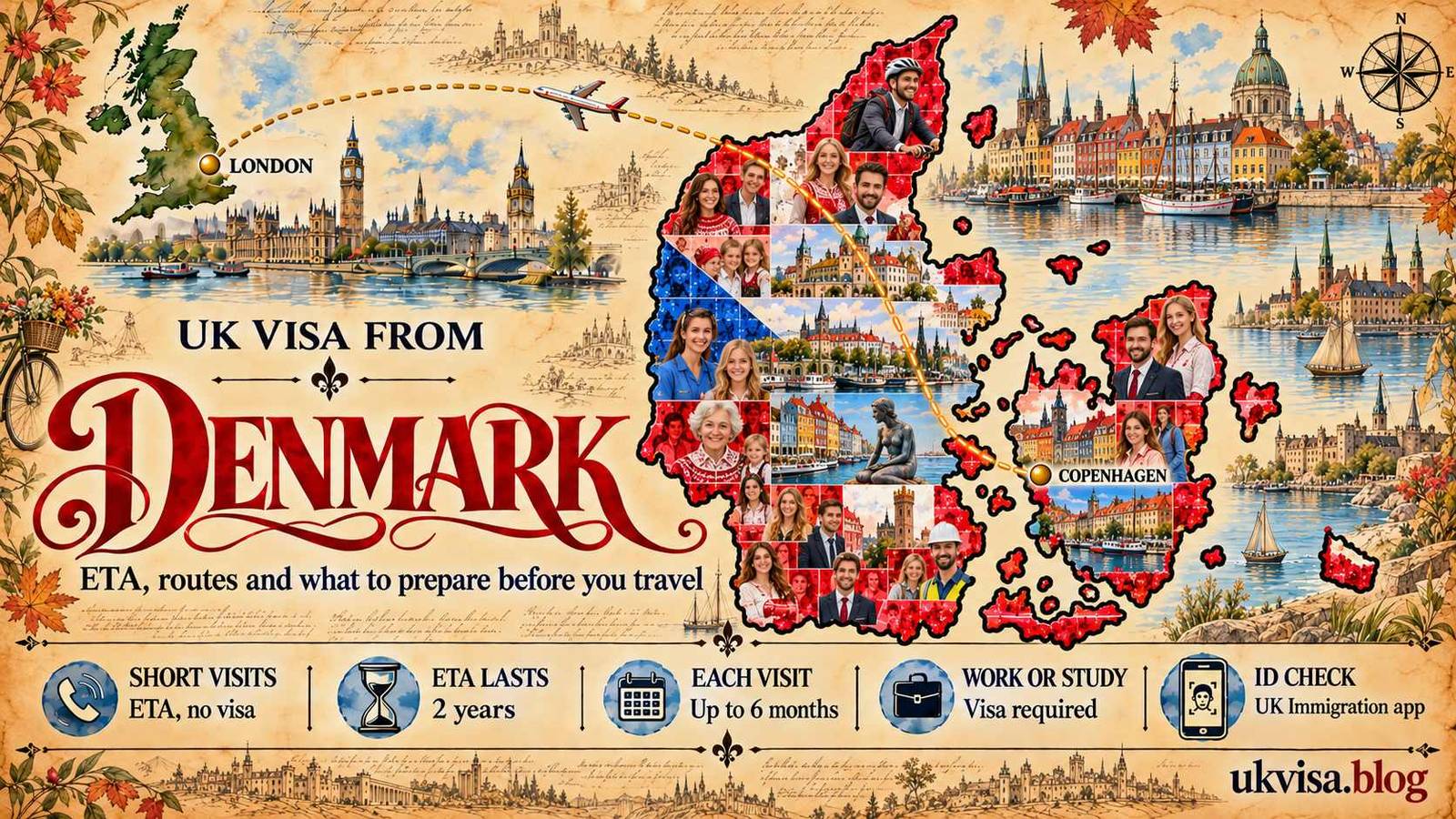
This guide covers the UK visa from Denmark in 2026: the ETA Danish passport holders now need, current fees, and the visa routes for work, study, and non-EU residents. Tens of thousands of Danes live in Britain, and Copenhagen and London are under two hours apart. Since Brexit, Danish travellers need a £20 (about €24) ETA approved before boarding.
UK Visas from Denmark
UK Visa from Denmark 2026: ETA Requirements, Fees & Danish Passport Entry
UK Entry Requirements for Danish Citizens
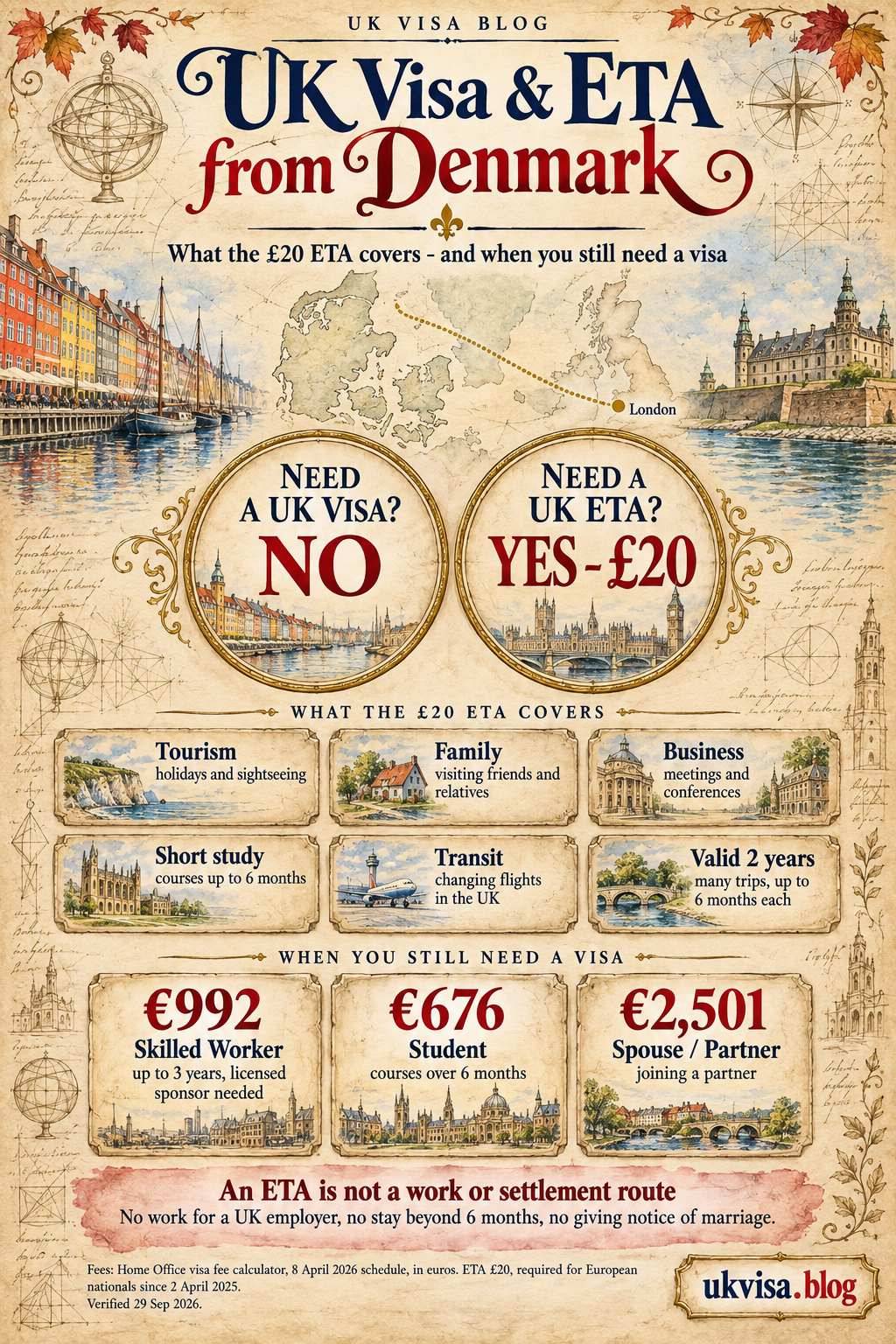
Danish citizens do not need a visa for visits of up to six months, but they do need an ETA (£20, about €24, valid two years) obtained through the UK ETA App. Non-EU residents of Denmark need a Standard Visitor visa (€164) instead, with biometrics at the Copenhagen visa centre. For work, study, or family stays, Danish nationals apply for the relevant visa and verify their identity through the UK Immigration: ID Check App.
Denmark and England share a thousand years of entangled history — Viking settlement, the Danelaw, and King Cnut’s North Sea empire that united the English and Danish crowns in 1016. Modern ties are close, with Denmark among the UK’s steady European trading partners. Since Brexit, though, Danish travellers face the same ETA system as other visa-exempt nationals, checked at boarding.
- A valid passport: covering the duration of the stay — a Danish ID card is not accepted.
- An approved ETA: £20 (about €24), valid two years, via the UK ETA App.
- Evidence of return or onward travel.
- Accommodation details: a booking or a host’s address.
- Enough funds: to support the visit without working.
- Genuine intention to leave within six months.
At the border, officers may ask about your plans, accommodation, and funds, though detailed questioning is rare for Danish visitors. Keeping your booking and return ticket on your phone speeds things up. Travellers from elsewhere in Europe face the same system, including those covered by our France guide.
Do I Need a Visa for the UK from Denmark?
It depends on your nationality, not your residence. Free movement between the EU and UK ended on 31 December 2020, so Danish citizens are now visa-exempt nationals for short visits — they can visit without a visa but cannot work, study courses over six months, or access public funds. According to the official gov.uk ETA guidance, Danish citizens have needed an ETA since 2 April 2025, with a 99.6% issue rate — approval is effectively automatic. Those settled before Brexit may hold status under the EU Settlement Scheme and need neither an ETA nor a visa.
The full rules, exemptions, and how the scheme works across nationalities are covered in our guide to the Electronic Travel Authorisation (ETA). The same ETA route applies to UK visa rules for German citizens.
UK Tourist Visa from Denmark
“UK tourist visa from Denmark” means different things by nationality. A Danish passport holder visiting as a tourist only needs the £20 ETA — covering tourism, family visits, business meetings and negotiations (never paid work), short courses up to 30 days, private medical treatment, and transit. A non-EU national living in Denmark must apply for a Standard Visitor visa, regardless of how long they have lived there.
For repeat trips, the multi-year visit visa allows unlimited entries over two, five, or ten years while still capping each stay at six months — it spreads the cost for frequent travellers.
UK Visa Fees from Denmark 2026
Home Office fees are set in pounds; for applicants in Denmark the gov.uk system displays them in euros, and the ETA is charged in pounds. The figures below are pulled from the official fee calculator and are non-refundable.
UK visitor and short-stay fees from Denmark (2026)
| Visa Type | Fee | Max Stay Per Visit |
|---|---|---|
| ETA (Danish citizens) | £20 (≈ €24) | 6 months |
| Standard Visitor (6 months) | €164 | 6 months |
| Long-term Visitor (2 years) | €615 | 6 months |
| Long-term Visitor (5 years) | €1,097 | 6 months |
| Long-term Visitor (10 years) | €1,371 | 6 months |
| Marriage Visitor | €164 | 6 months |
| Private Medical Treatment | €284 | 11 months |
| Direct Airside Transit (DATV) | €50 | Airside only |
| Visitor in Transit | €91 | 48 hours |
Source: Home Office immigration and nationality fees, 8 April 2026 schedule, as displayed in euros; ETA per GOV.UK.
UK work, study and family visa fees from Denmark (2026)
| Visa Category | Fee (EUR) |
|---|---|
| Student | €678 |
| Skilled Worker (up to 3 years) | €995 |
| Skilled Worker (over 3 years) | €1,966 |
| Health and Care Worker (up to 3 years) | €394 |
| Youth Mobility Scheme | €413 |
| Partner / Family visa | €2,508 |
| Adult Dependent Relative | €4,417 |
| Priority service | +€608 |
| Super Priority service | +€1,215 |
Source: Home Office immigration and nationality fees, 8 April 2026 schedule, as displayed in euros.
The Immigration Health Surcharge
Any visa over six months also carries the Immigration Health Surcharge, charged in pounds at £1,035 a year — students and Youth Mobility participants pay £776. It is paid on top of the visa fee. Health and Care Worker visa holders are exempt.
UK Visa from Denmark for Non-EU Residents
Denmark’s non-EU communities — Turkish, Pakistani, Filipino, Indian, and others — often travel to the UK for family, business, or tourism. A Danish residence permit does not grant visa-free UK travel — only your passport nationality decides the requirement. Visa-national passport holders pay €164 for a six-month Standard Visitor visa; applications go through the visa centre in Copenhagen, with processing of about three weeks.
- Valid passport with adequate remaining validity.
- Danish residence permit (opholdstilladelse) proving legal stay.
- Employment contract or study enrolment in Denmark.
- Bank statements: showing funds for the trip.
- Travel plan and accommodation for the UK visit.
- Ties to Denmark: tenancy, family, or ongoing work.
Danish Residence Strengthens Your Application
Legal residence in Denmark — especially permanent residence — helps a UK visitor application by showing strong ties and a clear reason to return. Build the file using our UK visa supporting documents checklist, and if a relative is hosting you, our guide to the sponsor’s invitation letter shows what to include. If a visit was refused before, see why UK visas are refused and the odds when reapplying.
Working and Studying in the UK
A Danish passport no longer confers UK work rights — free movement ended on 31 December 2020, so Danish nationals now need permission to work or study long-term. The upside is convenience: as an EU national, you verify your identity through the UK Immigration: ID Check App rather than attending a visa centre, and UK visa grant rates for Danish applicants are high across all routes.
Skilled Worker, Youth Mobility and Student Routes
The Skilled Worker route needs a job offer from a licensed sponsor and a salary meeting the £41,700 general threshold; the fee is €995 for up to three years or €1,966 beyond, leading to indefinite leave to remain after five years. Danish citizens aged 18 to 35 can use the Youth Mobility Scheme (€413, two years). For courses over six months, the Student visa costs €678; after a degree the Graduate route gives two years’ post-study work. A partner visa (€2,508) carries a £29,000 income requirement.
How to Apply for a UK Visa from Denmark
Danish citizens do almost everything by app: the ETA App for short visits, and the ID Check App for full visa applications — no visa centre visit needed. Non-EU residents use the Copenhagen visa centre for biometrics. For an ETA there is no form beyond the app itself — download it, scan your passport, take a photo, and pay.
- Complete the online application and pay the fee at gov.uk.
- Danish citizens: give biometrics via the UK Immigration: ID Check App from home.
- Non-EU residents: book biometrics at the Copenhagen visa centre.
- Upload your supporting documents.
- Wait for the decision — about 3 weeks standard, 5 days on priority.
- Receive your eVisa or a vignette in your passport.
Processing Times and Delays
Standard processing is about three weeks for non-settlement visas and up to twelve weeks for settlement routes; ETAs are usually decided within minutes. If a decision runs late, our guide on UK visa delays explains how to chase it, priority and super-priority services can speed things up where available, and you can track timelines with our guide to processing after biometrics.
For official confirmation, use the gov.uk visa checker and the Standard Visitor visa guidance. Nordic neighbours are covered in our guides to the UK visa from Sweden, Norway, Finland, and Iceland. Sources: Home Office immigration and nationality fees, 8 April 2026 schedule; GOV.UK ETA guidance. Figures verified August 2026 against the 8 April 2026 fee schedule.
Frequently Asked
Questions about UK Visas from Denmark
No visa is needed for visits up to six months, but Danish citizens must hold an ETA before travelling. It costs £20 (about €24), lasts two years, and is obtained through the UK ETA App. The requirement has applied since 2 April 2025 and is enforced at boarding — without an approved ETA, carriers will not let Danish travellers board transport to the UK. For work or study, the appropriate visa is required.
For Danish citizens the cost of a UK visit is simply the £20 ETA (about €24) — there is no visit visa to buy. Non-EU residents of Denmark pay €164 for the six-month Standard Visitor visa, with longer options at €615 for two years, €1,097 for five, and €1,371 for ten. Those applications run through the Copenhagen centre and take about three weeks.
No. Since 1 October 2021, EU identity cards are no longer accepted at the UK border for most travellers, so Danish visitors need a full passport plus the ETA. The main exceptions are those with EU Settlement Scheme status, who can still use a national ID card. If your passport has expired, renew it before booking — the ETA links to the passport you apply with.
Not without a work visa. The main route is the Skilled Worker visa (€995–€1,966), needing sponsorship from a licensed UK employer and a salary at or above the £41,700 general threshold. Danish nationals aged 18–35 may also use the Youth Mobility Scheme (€413). Business meetings are allowed on an ETA, but paid work is not.
No. An opholdstilladelse proves your status in Denmark but carries no UK travel rights. Visa-national passport holders — Indian, Pakistani, Iranian, and others — still need a Standard Visitor visa (€164) for any UK trip, while visa-exempt nationals need an ETA. Only your passport nationality decides the requirement, however long you have lived in Denmark.
ETAs are usually decided within minutes, up to three working days. Standard visa processing is about three weeks for visitor and other non-settlement visas, and up to twelve weeks for settlement visas such as partner routes. Priority service (€608) targets five working days for visitor visas, and super priority (€1,215) aims for the next working day where available.
A Danish citizen with an ETA can stay up to six months per visit for tourism, family, or business. There is no annual cap on visits, but frequent or very long stays may prompt questions about whether you are a genuine visitor. Working, studying long-term, or settling all require the relevant visa with its own conditions.
The UK ETA App is for applying for an Electronic Travel Authorisation, which Danish citizens use for short visits up to six months. The UK Immigration: ID Check App is for giving biometrics when applying for an actual visa — work, study, or family. In short, the ETA app is for visiting and the ID Check app is for longer stays that need a visa.
Nej — til besøg på op til seks måneder er en ETA nok. Den koster £20 (cirka €24), gælder i to år og søges via appen UK ETA. Kravet har været gældende siden den 2. april 2025 og kontrolleres ved boarding. Til arbejde, studier over seks måneder eller familiesammenføring kræves det tilsvarende visum; den, der har status under EU Settlement Scheme, behøver hverken ETA eller visum.
ETA til besøg koster £20 (cirka €24). De fulde visa: Standard Visitor €164 (seks måneder), studievisum €678, Skilled Worker €995 (op til 3 år), Youth Mobility €413 og partnervisum €2,508. Gebyrerne betales online ved ansøgningen, og danske statsborgere verificerer deres identitet via appen UK Immigration: ID Check — uden besøg på et visumcenter. Ikke-EU-borgere afgiver biometri på visumcentret i København.