A UK visa refusal letter — formally a Notice of Refusal served under Appendix SN (Service of Notices) — is the official Home Office document recording a refusal, citing the Immigration Rules the application failed under, and identifying recovery options with their deadlines. It follows a six-section structure: header with the GWF / VAF reference, decision statement, reasons, evidence assessment, and next steps. Deadlines run from the letter date: 14 days in-country, 28 days out-of-country for administrative review or appeal; 3 months for judicial review. This guide covers the letter's anatomy, reference numbers, the email-vs-letter distinction, replacing a lost copy, and recovery options.

Appendix SNService of Notices Framework
14 / 28 daysAdmin Review Window (In / Out of Country)
3 monthsJudicial Review Time Limit
GWF / VAFApplication Reference Number Format

Source: Appendix SN (Service of Notices) of the Immigration Rules; Home Office decision communication guidance; UKVI Sheffield decision-making centre framework, May 2026

What's Current in 2026 — UK Visa Refusal Letter Framework

The substantive UK visa refusal letter framework is unchanged in 2026. Appendix SN (Service of Notices) governs how refusal decisions are served — by email notification followed by the physical letter (with the returned passport for entry clearance, or via the UKVI online account in-country). The 14-day / 28-day administrative review and appeal windows, and the 3-month judicial review deadline, are unchanged. Templated delay emails operate alongside — not instead of — the formal letter. A delay email is never a refusal; only a Notice of Refusal is the formal refusal document.

UK Visa Refusal Letter 2026 — Service of Notice, VAF Number, and Recovery Options

A UK visa refusal letter is the official Home Office Notice of Immigration Decision that records a refusal, sets out the legal and evidential basis, identifies the remedies available, and starts the clock on time-limited recovery options. Every recovery route — administrative review, tribunal appeal, judicial review, reconsideration, or fresh application — depends on first understanding what the letter says. It is structured to a Home Office template: header, decision statement, reasons citing specific Immigration Rules, evidence assessment, and next steps. For grounds, see our common refusal reasons and Part Suitability grounds guides.

Uk Visa Refusal Letter Explained 2026: The Ground Cited, Your Options Appeal Or Administrative Review Or Reapply, The Deadline, The Evidence Gap
How to read a UK visa refusal letter, 2026. Source: GOV.UK refusal and review guidance. © ukvisa.blog

What is a UK Visa Refusal Letter? Appendix SN Framework

Quick Answer

A UK visa refusal letter is the official Home Office Notice of Immigration Decision served under Appendix SN (Service of Notices). It records a refusal, identifies the Immigration Rules paragraphs the application failed under, and sets out the recovery options. The letter is the single source of truth — the email notification is only an alert that a decision has been made, with no reasons or remedies. It is delivered with the returned passport (out-of-country) or via the UKVI online account (in-country).

UK Visa Refusal Letter (Notice of Immigration Decision): The official Home Office document served under Appendix SN of the Immigration Rules recording a visa refusal. It identifies the specific Immigration Rules paragraphs the application was refused under, sets out the caseworker's reasoning and evidence assessment, and identifies the available recovery options with their deadlines. It is the operative document for all refusal recovery — without it, the applicant cannot identify the specific grounds for challenge.

UK Visa Refusal Letter Structure — Standard Six-Section Format

Quick Answer

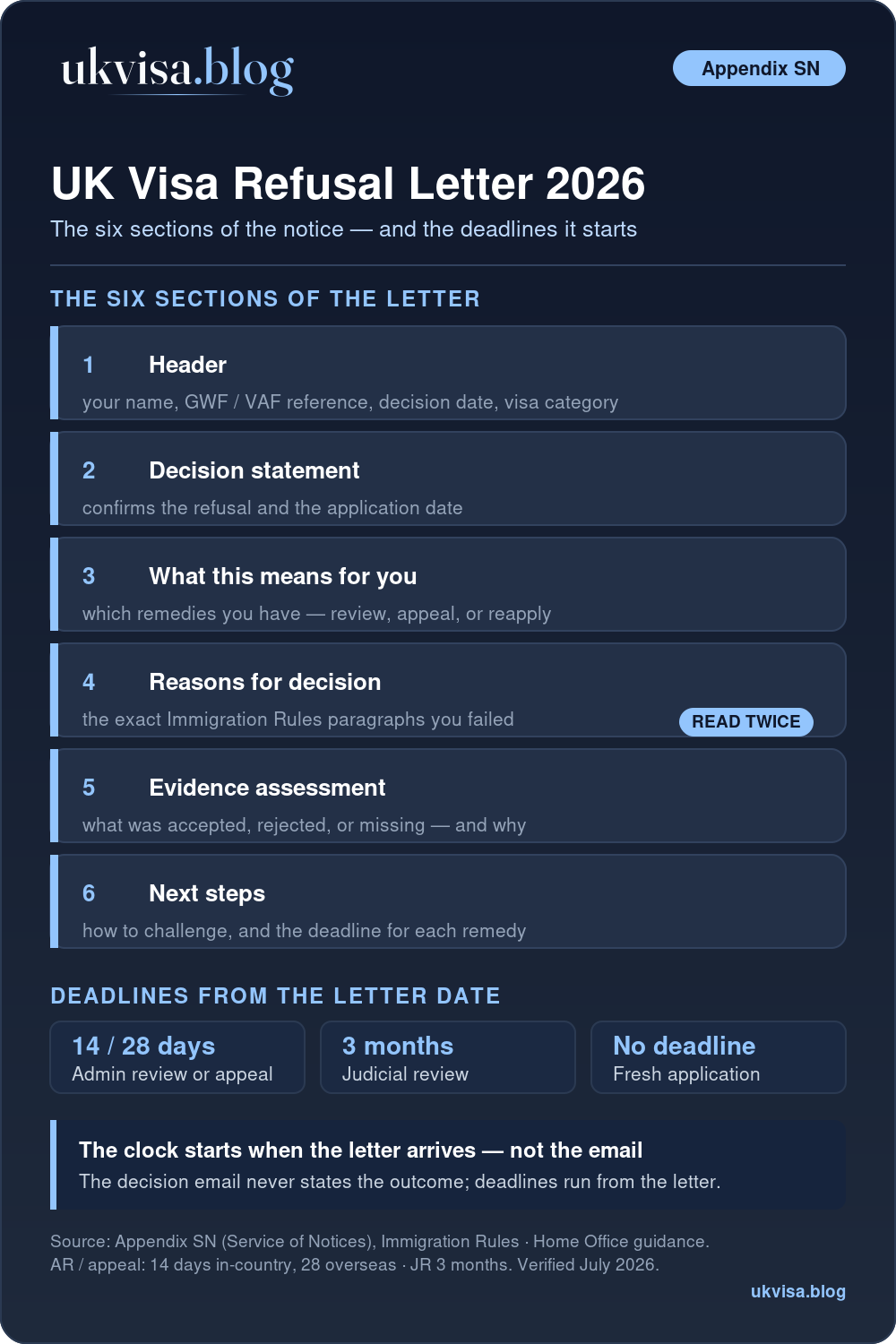
Every UK visa refusal letter follows a standardised six-section structure: (1) Header with applicant name, GWF / VAF reference, decision date, caseworker reference; (2) Decision statement confirming the refusal; (3) What this means for you identifying remedies; (4) Reasons for decision setting out paragraph-by-paragraph the Immigration Rules failed under; (5) Evidence assessment explaining accepted, rejected, or missing documents; (6) Next steps with administrative review or appeal instructions and deadlines.

Section-by-Section Breakdown

  • Section 1 — Header: Applicant full name, address, application reference (GWF or VAF number), decision date, caseworker / officer reference, and visa category applied for
  • Section 2 — Decision statement: Short paragraph confirming the application has been refused, naming the visa category, and identifying the date the application was submitted
  • Section 3 — What this means for you: Brief explanation of the remedies available — administrative review eligibility, appeal rights (if any), and instructions to read the full reasons section
  • Section 4 — Reasons for decision: The substantive section — paragraph by paragraph, the caseworker identifies the specific Immigration Rules the application failed under (e.g. "Paragraph SW 4.2 of Appendix Skilled Worker — failure to meet salary threshold"), explains why each requirement was not met, and references the evidence considered
  • Section 5 — Evidence assessment: Specific discussion of the documentary evidence submitted — which documents were accepted, which were rejected (and why — typically format issues, authenticity concerns, insufficient detail, or wrong document type), and which gaps the caseworker identified
  • Section 6 — Next steps: Detailed instructions on administrative review (where applicable), appeal rights to the First-tier Tribunal (Immigration and Asylum Chamber) where they exist, the deadlines for each remedy (14 or 28 days), and how to submit any chosen remedy
  • Signature block: Entry Clearance Officer or caseworker initials, UKVI decision-making centre identification (most commonly UKVI Sheffield for overseas applications), and a generic "Yours sincerely" closure

VAF / GWF Number Explained — Your Application Reference

Quick Answer

The VAF (Visa Application Form) number and GWF (Global Web Form) number are two names for the same unique reference assigned to a UK visa application. It is typically formatted as GWF000000000 and appears on the application receipt, all UKVI correspondence (including the refusal letter), and the UKVI online account. "VAF" dates from the paper era; "GWF" from the online system. Both refer to the same number — keep it safe for all UKVI communication.

VAF / GWF Number: The unique application reference assigned to every UK visa application submitted through the GOV.UK online system. Formatted as GWF followed by 9 to 12 digits (e.g. GWF000123456). "VAF" refers to the legacy paper form; "GWF" to the current online system. The same number appears on the application receipt, biometric confirmation, decision email, refusal letter, and UKVI online account.

Where to Find Your VAF / GWF Number

  • Application receipt: Issued by UKVI / Sopra Steria / VFS Global when the application was submitted
  • Application confirmation email: The email confirming successful application submission
  • Biometric appointment confirmation: Issued by the Visa Application Centre (VAC) after biometric enrolment
  • UKVI decision email: The notification email when a decision has been made
  • Refusal letter header: Top of the formal Notice of Refusal under "Our Ref" or "Reference"
  • UKVI online account: Visible in the application dashboard under the application reference
  • Bank statement entry: The application fee payment line may include the GWF reference

UK Visa Refusal Email vs Refusal Letter — Different Documents

Quick Answer

UKVI sends a decision notification email when a decision has been made — but it does not state whether the visa was approved or refused. It is a neutral notification triggering passport collection (out-of-country) or directing the applicant to the UKVI online account (in-country). The actual decision is revealed only by the refusal letter (with the returned passport) or the decision letter in the online account. Do not assume refusal from an email — wait for the passport return or online account access.

The Decision Communication Sequence

  • Step 1 — Decision email: UKVI sends an email (and sometimes SMS) confirming a decision has been made, typically within the published processing time after biometrics. The email is neutral — it does not state approval or refusal
  • Step 2 — Passport / document collection: For out-of-country applications, the passport is returned to the original Visa Application Centre or by courier; for in-country applications, the decision is published to the UKVI online account
  • Step 3 — Outcome revealed: If approved, a visa vignette is placed in the passport (out-of-country) or eVisa status is updated (in-country); if refused, the refusal letter is included with the returned passport or available in the online account
  • Step 4 — Recovery clock starts: The deadlines for administrative review, appeal, or judicial review run from the date the refusal letter is received — not from the decision email date
Critical: The Email Is Not the Refusal — Wait for the Letter Many applicants assume a UKVI decision email signals refusal — particularly when it arrives quickly after biometric enrolment. This is not correct. The email is a neutral notification that a decision (approval or refusal) has been made. The actual outcome is revealed only by the refusal letter or the visa vignette in the returned passport. Do not begin refusal-recovery action until the actual refusal letter has been received and read. The recovery clock starts from the letter's receipt date, not the decision email date.

Lost Your UK Visa Refusal Letter? How to Get a Copy

Quick Answer

If you have lost your UK visa refusal letter, five routes are available: (1) check your UKVI online account under application history; (2) search your email for PDF attachments from UKVI; (3) submit a Subject Access Request (SAR) to the Home Office — free, one-month response, full case file; (4) contact the Visa Application Centre where you submitted biometrics; (5) use the UKVI paid enquiry service. You will need your GWF / VAF reference, full name, date of birth, and passport details.

Five Routes to Obtaining a Replacement Refusal Letter

  • Route 1 — UKVI online account: Log into your UKVI account; refused application decision letters are usually retained under "Documents" or "Decision letters". Free; instant; works for most applications submitted in the last few years
  • Route 2 — Email search: Search your inbox and spam folder for messages from UKVI, FCDO, or VFS Global. The decision email may include the refusal letter as a PDF attachment, particularly for in-country applications
  • Route 3 — Subject Access Request (SAR): Submit a formal SAR under the Data Protection Act 2018 to the Home Office; the response — due within one calendar month — provides your full case file including the refusal letter, caseworker notes, and supporting documents. Free; the most comprehensive route
  • Route 4 — Visa Application Centre: Contact the VAC (Sopra Steria, VFS Global, or TLS Contact) where you submitted biometrics. VACs retain copies of decision documents for a limited period and may provide a duplicate
  • Route 5 — UKVI paid enquiry service: The Home Office's commercial enquiry service handles formal requests for case documents at a per-enquiry fee; useful when other routes have not produced the letter
Subject Access Request (SAR): A formal request under the Data Protection Act 2018 and UK GDPR allowing any individual to obtain a copy of all personal data the Home Office holds about them — including refusal letters, decision notes, and caseworker reasoning. SARs are free; the Home Office must respond within one calendar month. Particularly useful where the applicant intends to challenge the refusal through judicial review and needs to demonstrate procedural unfairness.

UK Visa Refusal Letter Sample / Example by Visa Type

Refusal letters across visa categories all follow the same six-section structure under Appendix SN, but the substantive "reasons for decision" section cites different Immigration Rules paragraphs depending on the route. The most commonly refused categories and their typical paragraph citations are set out below. Assembling the right supporting evidence against each cited paragraph is the foundation of any reapplication.

UK Visitor Visa Refusal Letter — Most Common Refusal Type

UK Standard Visitor visa refusals — the largest category by volume — typically cite paragraph V 4.2 of Appendix V (Visitor):

  • Genuine visitor test (V 4.2(a)): "I am not satisfied that you are a genuine visitor seeking entry for a purpose that is permitted by the visitor route"
  • Intention to leave (V 4.2(b)): "I am not satisfied that you will leave the UK at the end of your stated visit"
  • Maintenance and accommodation (V 4.2(c)): "I am not satisfied that you have sufficient funds to maintain yourself for the duration of the proposed visit"
  • Sponsor genuineness (V 4.2(d)): Where a UK sponsor is named, "I am not satisfied that your sponsor is genuinely able and willing to support you"
  • Family ties and economic situation (V 4.2 evidence): "Your family circumstances and economic situation in your country of origin do not satisfy me that you intend to leave"

For the broader visitor visa framework, see our UK Standard Visitor visa guide.

UK Skilled Worker Visa Refusal Letter

Skilled Worker sponsored employment refusal letters typically cite paragraphs of Appendix Skilled Worker:

  • SW 4.1 — Valid CoS: Invalid Certificate of Sponsorship — typically issues with sponsor licence status or CoS allocation
  • SW 4.2 — Genuine vacancy: Concerns about whether the sponsored role is a genuine vacancy
  • SW 6.1 — Salary threshold: Failure to meet the general threshold of £41,700 per year (in force since 22 July 2025) or the published going rate for the occupation, whichever is higher
  • SW 12 — English language: Insufficient evidence of B2 English language proficiency (raised from B1 for first-time applicants from 8 January 2026)
  • SW 14 — Maintenance: Insufficient funds where the sponsor has not certified maintenance on the CoS

UK Student Visa Refusal Letter

UK Student route applications refusal letters typically cite paragraphs of Appendix Student:

  • ST 5 — Valid CAS: Invalid Confirmation of Acceptance for Studies, or sponsor licence revocation
  • ST 18 — Financial requirement: Insufficient maintenance funds held for 28 consecutive days before the application
  • ST 23 — English language: SELT certificate not from approved provider, or below required CEFR level
  • ST 27 — Genuine student test: Concerns about the applicant's genuine intention to study, often raised after credibility interview
  • ST 30 — ATAS: Missing Academic Technology Approval Scheme certificate where required

UK Spouse Visa Refusal Letter

UK Spouse visa refusal letters typically cite paragraphs of Appendix FM (Family Members):

  • E-ECP 2.5–2.10 — Genuine and subsisting relationship: Insufficient evidence the relationship is genuine and subsisting
  • E-ECP 3.1 — Financial requirement: Failure to meet £29,000 minimum income threshold
  • E-ECP 3.4 — Specified evidence: Financial documents not in the form specified in Appendix FM-SE
  • E-ECP 3.7 — Accommodation: Insufficient evidence of adequate accommodation in the UK
  • E-ECP 4.1 — English language: Sponsor language evidence not provided in the required form

Spouse and partner refusals carry a First-tier Tribunal appeal right on Article 8 human rights grounds rather than administrative review. For spouse refusal recovery specifically, see our First-tier Tribunal appeal on human rights grounds guide.

What to Do After Receiving a Refusal Letter — Recovery Options

Quick Answer

Five recovery options after a refusal letter: (1) Administrative review — 14 / 28 days for caseworker error; (2) Statutory appeal to the First-tier Tribunal — 14 / 28 days for Article 8 cases; (3) Judicial review at the Upper Tribunal or High Court — 3 months for unlawful decisions; (4) Reconsideration — limited eligibility for new evidence; (5) Fresh application — no deadline. The right choice depends on refusal grounds and case strength; for complex cases, professional legal advice is essential.

Recovery OptionWhen to UseDeadline from Refusal Date
Administrative reviewWhere the refusal involved a caseworker error in applying the rules14 days (in-country) / 28 days (out-of-country)
Statutory appeal (First-tier Tribunal)Where appeal rights apply — typically Article 8 family life or Article 3 protection cases14 days (in-country) / 28 days (out-of-country)
Judicial review (Upper Tribunal / High Court)Where the decision-making process was unlawful, irrational, or procedurally unfair3 months (promptly)
ReconsiderationWhere new material evidence was not considered (limited eligibility)Typically 14 days (variable by case)
Fresh applicationWhere the refusal reasons can be addressed with stronger evidence and no deception ban appliesNo deadline — apply when ready (full application fee)

For the comprehensive framework, see our reapplication and refusal recovery options guide. For administrative review, see our administrative review guide; for tribunal appeals, the First-tier Tribunal appeal process; for judicial review, judicial review through the Upper Tribunal or High Court; and for reconsideration eligibility, reconsideration application.

Critical Deadlines from Refusal Letter Date

Critical: Deadlines Are Strict — Missing Them Forfeits Recovery Rights The deadlines from the refusal letter date are strictly enforced. Late administrative review applications are rejected; late tribunal appeals are admitted only in exceptional circumstances; late judicial reviews face the 3-month bar plus a "promptness" requirement. The deadline runs from the date the letter is received — not the decision email date. Where the passport is couriered back, the receipt date is when the courier delivers it. For in-country applicants, lodging an in-time appeal or administrative review preserves status under Section 3C leave while the challenge is pending.

UK Visa Refusal Letter Not Received — What to Do

Quick Answer

If you received the decision email but not the physical refusal letter, check first whether the passport has been collected or delivered. If the passport has been returned with a visa vignette and no refusal letter, the visa was approved. If returned without a visa and without a refusal letter, contact the Visa Application Centre immediately. For in-country applications, check the UKVI online account. If significant time has passed since the decision email (more than 2 weeks in-country, more than 4 weeks out-of-country), contact UKVI.

Step-by-Step: Refusal Letter Not Received

  • Step 1 — Check passport status: Confirm whether the passport has been returned (out-of-country) or whether the eVisa status has been updated (in-country)
  • Step 2 — Check UKVI online account: Log in and look for the decision letter under application history. Many in-country refusals are published online before the physical letter arrives
  • Step 3 — Check email and SMS: Search for messages from UKVI, FCDO, VFS Global, Sopra Steria, or TLS Contact. The decision email may include the refusal letter as a PDF attachment
  • Step 4 — Contact the Visa Application Centre: Sopra Steria, VFS Global, or TLS Contact (depending on which VAC handled the application) can confirm dispatch status and provide a duplicate if needed
  • Step 5 — Submit a Subject Access Request: If routine routes do not produce the letter, a SAR provides the full case file including the refusal decision within one calendar month
  • Step 6 — Critical timeline preservation: If the deadline for administrative review or appeal is approaching and the refusal letter has not been received, the deadline can be extended on application — but only if the absence of the letter is documented at the time
Key Takeaways: UK Visa Refusal Letter Framework 2026
  • A UK visa refusal letter is the Home Office Notice of Immigration Decision served under Appendix SN of the Immigration Rules
  • The letter follows a standard six-section structure: header, decision statement, what this means for you, reasons for decision, evidence assessment, next steps
  • VAF and GWF numbers are the same — the unique GWF000000000-formatted application reference assigned by UKVI
  • The decision email does NOT reveal the outcome — only the refusal letter or visa vignette confirms approval or refusal
  • Lost refusal letters can be retrieved via UKVI online account, email archive, Subject Access Request (free), VAC, or paid enquiry service
  • Refusal letters cite specific Immigration Rules paragraphs — these guide the recovery strategy
  • Recovery deadlines: administrative review 14/28 days; appeal 14/28 days; judicial review 3 months; reconsideration ~14 days; fresh application no deadline
  • The deadline runs from the date the refusal letter is received — not the decision email date
  • Most visitor refusals cite V 4.2 of Appendix V; Skilled Worker refusals cite Appendix Skilled Worker; spouse refusals cite Appendix FM
  • Subject Access Request is the most comprehensive route to the full case file — free, one-month response, includes caseworker notes
  • UKVI Sheffield handles most out-of-country entry clearance decisions; in-country decisions are made by Home Office caseworkers at various centres

Frequently Asked Questions about UK Visa Refusal Letters

What is a UK visa refusal letter?

A UK visa refusal letter is the official Home Office Notice of Immigration Decision served under Appendix SN (Service of Notices) of the Immigration Rules. It records a visa refusal, identifies which paragraphs of the Immigration Rules the application failed under, sets out the caseworker's reasons and evidence assessment, and identifies recovery options (administrative review, tribunal appeal, judicial review, reconsideration, or fresh application) with their deadlines. The refusal letter follows a standard six-section structure and is the operative document for all refusal recovery action.

I lost my UK visa refusal letter — how do I get a copy?

If you lost your UK visa refusal letter, five routes are available: (1) check your UKVI online account for the decision letter under application history; (2) search your email inbox and spam folder for messages from UKVI / FCDO / VFS Global; (3) submit a Subject Access Request (SAR) to the Home Office — free, one-month response, provides the full case file; (4) contact the Visa Application Centre where you submitted biometrics; (5) use the UKVI paid enquiry service. You will need your GWF/VAF reference, full name, date of birth, and passport details.

Does the UK visa rejection email mean my visa is refused?

No — the UKVI decision email does not state whether your visa was approved or refused. The email is a neutral notification that a decision (approval or refusal) has been made on the application. The actual outcome is revealed only by the physical refusal letter (delivered with the returned passport for out-of-country applications) or the decision letter in the UKVI online account (for in-country applications). The recovery clock for administrative review or appeal runs from the date the refusal letter is received, not from the decision email date.

What is the VAF number on a UK visa application?

The VAF (Visa Application Form) number — also called the GWF (Global Web Form) number — is the unique reference number assigned to a UK visa application when it is submitted online. The number is typically formatted as GWF000000000 (a 9-12 digit number prefixed by GWF). It appears on the application receipt, biometric appointment confirmation, decision email, refusal letter header, and UKVI online account. "VAF" dates from the paper Visa Application Form era; "GWF" from the Global Web Form online system. Both refer to the same number.

How do I get my refusal letter from the UK embassy?

UK visa refusal letters are not issued by UK embassies directly — they are issued by UKVI decision-making centres (most commonly UKVI Sheffield) and returned through the Visa Application Centre (VAC) where biometrics were submitted (Sopra Steria, VFS Global, or TLS Contact depending on country). To obtain a copy: contact the VAC directly with your GWF/VAF reference, full name, date of birth, and passport details; submit a Subject Access Request to the Home Office for the full case file; or use the UKVI paid enquiry service. The UK embassy is rarely involved directly in visa decision communication.

What does a UK visa refusal letter look like?

A UK visa refusal letter follows a standard six-section structure: (1) Header with applicant name, GWF/VAF reference, decision date, caseworker reference, and visa category; (2) Decision statement confirming refusal; (3) "What this means for you" identifying remedies; (4) Reasons for decision setting out paragraph-by-paragraph the specific Immigration Rules failed under; (5) Evidence assessment explaining accepted, rejected, or missing documents; (6) Next steps with administrative review or appeal instructions and deadlines. The letter is signed by an Entry Clearance Officer (out-of-country) or Home Office caseworker (in-country), with UKVI decision-making centre identification.

UK visa refusal letter not received — what should I do?

If you received the decision email but have not received the physical refusal letter, first confirm whether the passport has been returned. If returned without a visa vignette and without a refusal letter, contact the Visa Application Centre immediately. Check the UKVI online account — many in-country refusals are published online before the physical letter arrives. Search email for PDF attachments. If the deadline for administrative review or appeal is approaching, document the absence in writing immediately — recovery deadlines can be extended on application only if properly documented. Submit a Subject Access Request as a backup.

Can I reapply immediately after a UK visa refusal letter?

Yes — for most visa categories, there is no mandatory waiting period after a refusal. You can submit a fresh application immediately, paying the new application fee. However, simply resubmitting the same application without addressing the specific refusal reasons will almost certainly lead to another refusal. Before reapplying, read the "reasons for decision" section carefully and address each cited Immigration Rules paragraph with stronger evidence. The exception is where the refusal letter identifies a re-entry ban (under Part Suitability) — reapplication is barred for 1, 2, 5, or 10 years until the ban expires.

What are the deadlines after a UK visa refusal letter?

Recovery deadlines from the refusal letter date: administrative review — 14 days (in-country) or 28 days (out-of-country); statutory appeal to the First-tier Tribunal — 14 days (in-country) or 28 days (out-of-country) where appeal rights apply; judicial review at the Upper Tribunal or High Court — 3 months and "promptly"; reconsideration — typically 14 days where eligibility exists; fresh application — no deadline. The deadlines run from the date the refusal letter is received, not from the decision email date. Missing the deadline forfeits the corresponding recovery right except in exceptional circumstances.

Where is the UKVI decision-making centre that issues refusal letters?

Most UK visa decisions on out-of-country entry clearance applications are made at the UKVI decision-making centre in Sheffield. Other major centres include Croydon and Liverpool, though processing volume is heavily concentrated at Sheffield for entry clearance work. In-country applications are decided by Home Office caseworkers at various centres across the UK. The applicant's refusal letter will identify the issuing centre at the foot of the letter (usually "UKVI Sheffield" or similar). For correspondence about the refusal — including administrative review submissions — the address on the refusal letter is the correct destination.

For the formal Immigration Rules framework governing service of refusal notices, see Appendix SN — Service of Notices. For the administrative review framework, see the Home Office administrative review of decisions guidance. For UK Subject Access Requests, see the UKVI Subject Access Request guidance. For appealing a visa or immigration decision, see the appeal against a visa or immigration decision page on GOV.UK.