
A re-entry ban is a fixed period during which an entry clearance application must be refused because of a previous breach of immigration law. The length turns on one thing above all: how you left the UK, and who paid. The clock runs from the date you left, not from the breach, except for deception, where it runs from the refusal.

Re-Entry Bans
UK Re-Entry Bans Under the Part Suitability Rules
What a Re-Entry Ban Is
Part Suitability of the Immigration Rules provides that an application for entry clearance or permission to enter must be refused where the applicant has previously breached immigration laws and the application is made within the relevant time period. That is SUI 11.1. The relevant periods are set out at SUI 12.1.
Bans run 12 months, 2 years, 5 years or 10 years, measured from the date you left the UK (for deception, from the date the application was refused). Leaving voluntarily at your own expense carries 12 months. Leaving at public expense carries 2 or 5 years depending on timing. Removal at public expense, and using deception in an application, each carry 10 years.
The Rule That Reaches Beyond the Period
SUI 11.2 allows an application to be refused even outside the relevant time period where the applicant has acted to frustrate immigration controls. Waiting out a ban is therefore not always enough. A history of absconding, repeated false applications or obstructed removal can be relied on after the fixed period has run.
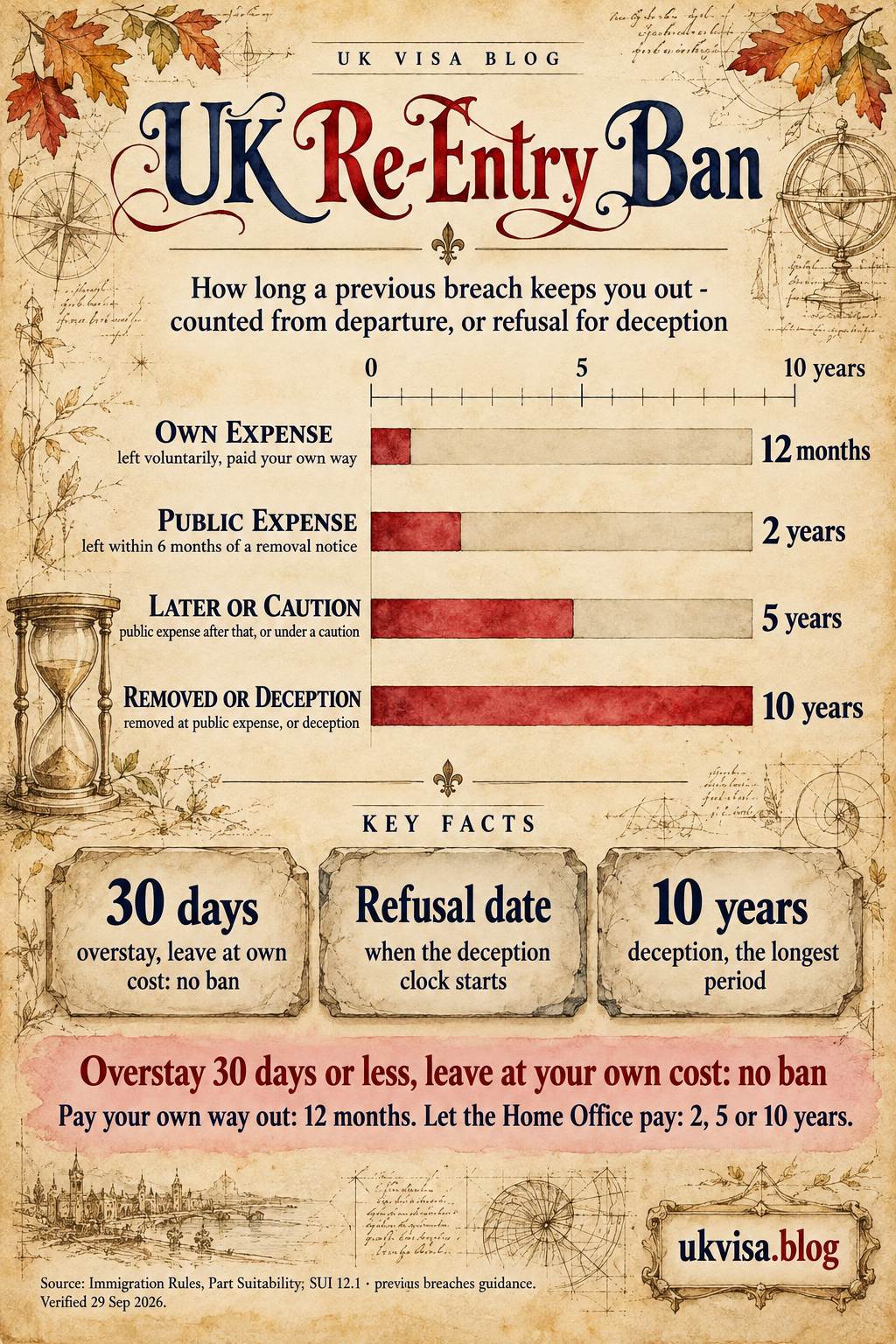
The Durations
Ban Length by How You Left
| Circumstances | Ban length |
|---|---|
| Left the UK voluntarily at your own expense | 12 months |
| Left voluntarily at public expense, within 6 months of a removal notice | 2 years |
| Left voluntarily at public expense, after that 6-month point | 5 years |
| Left or was removed as a condition of a caution | 5 years |
| Removed from the UK at public expense | 10 years |
| Used deception in an application | 10 years |
Source: Immigration Rules, Part Suitability, paragraph SUI 12.1, checked 22 August 2026.
The logic is consistent throughout: the more the taxpayer pays for your departure, and the longer you leave it after being told to go, the longer you stay out. Each period other than deception starts on the date you left the UK, so the same breach can produce very different outcomes depending on what happens next.
Leaving Voluntarily at Your Own Expense
This is the shortest period and the only one you have real control over. Twelve months from the date of departure, provided you funded the journey yourself and were not removed. It is the difference between a year and a decade, decided by a plane ticket.
- Book and pay for the flight yourself: keep the receipt and the booking in your own name.
- Do not wait to be told twice: the longer you remain after a notice, the worse the category.
- Keep your boarding pass and passport stamps: evidence of the date and manner of departure.
- Do not accept assisted return funding blindly: where the state pays, the period lengthens.
- Take advice before you go: some cases have a lawful basis to stay that is worth testing first.
The distinction between leaving at your own expense and at public expense drives everything, and it is you who will need to prove it years later. Keep the ticket, the payment record and the boarding pass. Without them, an entry clearance officer works from Home Office records alone.
Leaving at Public Expense
Where the state funds your departure, the period is two years if you left within six months of a removal notice, and five years if you left after that. Voluntary return schemes usually fall into this category, because the assistance is what makes them work.
That is not a reason to refuse help you genuinely need. Being removed carries ten years, so an assisted departure taken promptly is still far better than waiting to be removed. The point is to understand what you are accepting: two years is a defined price, and the six-month line is the one to stay inside.
A five-year period also applies where someone left or was removed as a condition of a criminal caution. That sits alongside the criminality grounds in the suitability rules, which can bite separately and for longer.
Removal at Public Expense
Ten years, running from the date of removal. This is the outcome for someone who neither left voluntarily nor accepted assistance, and it is the most damaging non-deception category. It also tends to sit alongside an enforcement record that engages SUI 11.2, so the ten years may not be the end of it.
Deportation is a different mechanism again. A deportation order is not a fixed-period ban but a standing exclusion that must be revoked before any application can succeed, and where the Secretary of State has personally directed exclusion, entry clearance or permission must be cancelled outright.
Deception
Using deception in an application carries the same ten-year period under SUI 12.1, running from the date the application was refused. Deception is treated separately from how you left, so it can attach to someone who never overstayed at all — a false document or a concealed refusal is enough.
Common Triggers
- False documents: bank statements, employment letters, qualifications or test certificates.
- Non-disclosure of a material fact: an undeclared refusal, removal or conviction.
- False representations: a stated purpose or relationship that is not genuine.
- A proxy test or an impersonated applicant: treated as deception by the applicant.
- Deception by a representative: where the applicant knew or should have known.
Separately from the ban, deception is a mandatory ground for refusing an application under SUI 9.1, and false material supplied by the applicant or a third party is a discretionary ground for refusal and cancellation under SUI 10.1 and 10.2 — which apply whether or not the material was provided to the applicant’s knowledge. Our page on deception bans covers how allegations are made and answered, and our page on suitability refusal grounds the wider framework.
The Fourteen-Day Exception
SUI 13.1 stops some late applicants being treated as overstayers at all. Under limb (a), an applicant is not treated as an overstayer where the application was made within 14 days of the previous permission expiring and there is good cause, beyond their control, for the late submission.
The Other Limbs
Limb (b) covers an application made within 14 days following a previous refusal. Further limbs cover defined pandemic-era periods, including applications between 1 September 2020 and 28 February 2023 where an exceptional assurance was held. Those are historic but still relevant to anyone whose record contains that window.
Two limits to hold on to. Good cause beyond your control is a condition, not a formality — a hospital admission or a documented emergency is the kind of thing meant. And the relief protects the application from being treated as out of time; it does not give you status during those days.
What a Ban Actually Blocks
A ban bites on applications for entry clearance and permission to enter. Within the relevant period the application must be refused, which means arguing the merits of the underlying route achieves nothing while the period runs.
- Visit applications: including the standard visitor route.
- Work routes: including Skilled Worker, however strong the sponsorship.
- Study and family routes: the strength of the tie does not disapply the rule.
- Not Appendix EU: the settlement scheme and its family permit are outside these provisions.
- Not parts of the asylum provisions: protection claims are governed separately.
Where a refusal engages human rights — most often family life with a partner or child in the UK — the analysis is different, because a rule cannot displace a Convention right. Our page on human rights in UK visa applications explains where that argument runs and where it does not.
Bans and Cancellation Are Different Mechanisms
A ban blocks a future application. Cancellation removes permission you already hold. The same conduct can produce both — deception in an application is a mandatory ground for cancelling entry clearance or permission, and separately carries the ten-year period before a new application can succeed.
Criminality works the same way. A custodial or suspended sentence of twelve months or more is a mandatory cancellation ground; shorter sentences and out-of-court disposals are discretionary. Those sit alongside, not inside, the re-entry ban table, so a person can face a fixed period under SUI 12.1 and a separate criminality ground on top of it.
This matters when reading a refusal. A notice citing only SUI 11.1 and SUI 12.1 is a timing problem that resolves itself. A notice also citing a criminality or deception paragraph is a character finding that does not, and it needs answering on its own terms.
Challenging a Ban
The strongest challenges are factual. The category applied is wrong — you funded your own departure and the record says otherwise. The dates are wrong, so the period has already run. Or the deception finding rests on a document you can show was genuine.
- Read the refusal notice for the paragraph: see our page on reading a refusal letter.
- Assemble the departure evidence: tickets, payment records, stamps, boarding passes.
- Check the start date: the period runs from the date you left the UK, or from the refusal date for deception.
- Consider the route of challenge: administrative review (AR), an appeal where one exists, or judicial review at the Upper Tribunal.
- Take advice on deception findings: they are the hardest to shift and the most damaging.
Applying Once the Period Has Run
The ban ending does not erase the history. You must still declare the breach, the removal or the refusal on every application, and the caseworker still reads it. What changes is that the mandatory refusal no longer applies, so the application is decided on its merits.
Build the application around what has changed since. Stable employment, property, dependants at home, and a purpose with a firm end date. Declare the history plainly and explain it in the additional information field rather than leaving a caseworker to discover it — our page on refusal grounds covers what tends to shift a decision.
Sources: Part Suitability of the Immigration Rules on GOV UK, the Home Office guidance on previous immigration breaches and the statements of changes collection. Figures verified 22 August 2026.
Frequently Asked
Re-Entry Ban Questions
How long is a UK re-entry ban?
12 months, 2 years, 5 years or 10 years under SUI 12.1, depending on how you left the UK and who paid for it.
When does the ban start?
From the date you left the UK, not from the date your permission expired. The exception is deception, where the ten years run from the date the application was refused.
Does leaving on my own avoid a ban altogether?
No, but it produces the shortest period: 12 months where you departed voluntarily at your own expense. Keep the ticket and payment evidence.
Does a voluntary return scheme count as leaving at my own expense?
Generally no. Where the state funds the departure, the period is 2 years if you left within six months of a removal notice and 5 years afterwards.
Why is the deception ban 10 years?
SUI 12.1 sets 10 years for deception used in an application, the same as removal at public expense. It applies whether or not you also overstayed.
Can I be refused after the ban has expired?
Yes. SUI 11.2 allows refusal outside the relevant period where the applicant has acted to frustrate immigration controls, and the history remains relevant to credibility.
Does the ban apply to EU Settlement Scheme applications?
No. Appendix EU and the EU Settlement Scheme family permit sit outside these provisions, as do parts of the asylum provisions.
Does the fourteen-day rule give me two weeks of grace?
No. It stops you being treated as an overstayer where the application is made within 14 days and there is good cause beyond your control. You are still without status in the meantime.
Can a ban be shortened?
The period itself is fixed by the rules. What can change is the category applied — showing you left at your own expense rather than at public expense moves you to a shorter period.
Do I have to declare an expired ban?
Yes. Declare the underlying breach, removal or refusal on every application. An omission that surfaces on a records check is treated far more seriously than the history itself.