
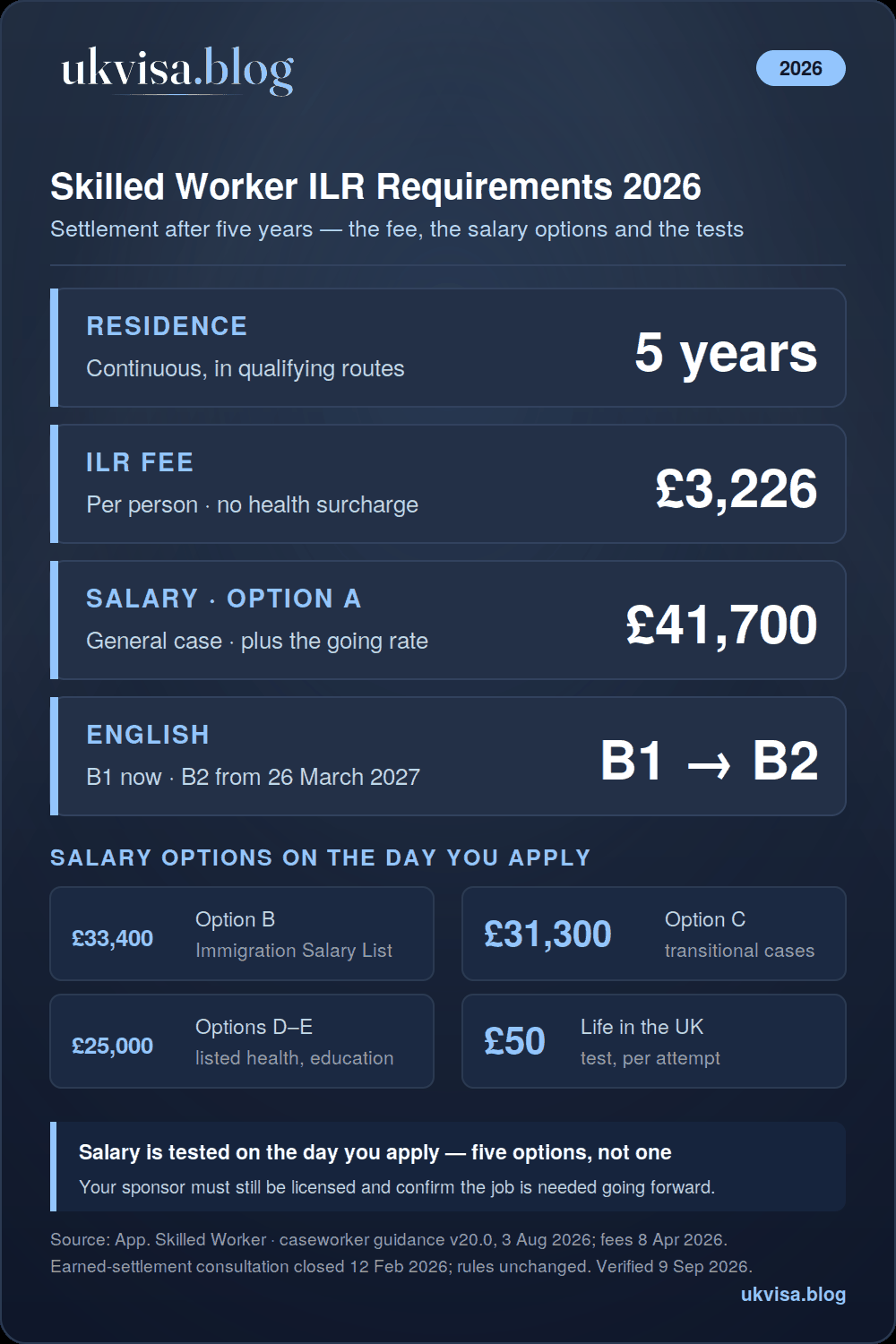
Settlement on the Skilled Worker route is five years of continuous residence, a salary test on the day you apply, the Life in the UK test and English. The fee is £3,226 and no health surcharge is payable. The salary test is the one that catches people — but not in the way most guides describe, because five different settlement thresholds exist, not one.

UK Work Visas
Skilled Worker ILR Requirements 2026: Residence, Salary and Settlement
What Settlement Requires
Five years of continuous residence in qualifying routes, with your most recent permission as a Skilled Worker or Tier 2 (General). Your sponsor must still hold a licence and confirm they need you for the foreseeable future at a qualifying salary. You need the Life in the UK test, English at B1 — rising to B2 for applications from 26 March 2027 — and absences within the limits. The fee is £3,226 and no certificate of sponsorship or health surcharge is needed.
The five years can be built from several routes, not only this one. The caseworker guidance allows time with permission — not as a dependant — in Skilled Worker, Tier 2 (General), Global Talent, Innovator Founder and Innovator, T2 Minister of Religion, International Sportsperson and its predecessors, Representative of an Overseas Business, and Tier 1 in its Exceptional Talent, Entrepreneur, Investor and General forms.
Two points follow from that list. Intra-company transfer time is not on it, so Tier 2 (ICT) and Senior or Specialist Worker permission does not build a settlement clock. And you do not have to have switched from Tier 2 (General) into Skilled Worker to apply — the Immigration Rules definition of Skilled Worker already includes Tier 2 (General) holders.
Absences and Two Pandemic-Era Concessions
Absences are assessed under Appendix Continuous Residence — see the 180-day absence rule for the calculation. Two concessions still matter. Time waiting for a decision on an in-country application made between 24 January 2020 and 30 June 2021, supported by a certificate of sponsorship and granted, counts towards the five years. And a grant of exceptional assurance between 1 September 2020 and 28 February 2023 does not break continuity, though it does not count towards the period either.
The Sponsor's Part
Your sponsor must still hold a Skilled Worker licence, and must confirm both that they require you to work for them for the foreseeable future and that you will be paid at least the qualifying salary for the foreseeable future. The guidance is specific that no new certificate of sponsorship should be assigned for this: an email or letter is enough, as long as it can be verified with the sponsor. The licence framework sits in our sponsor licence guide.
Making the Application
Settlement is applied for online, with biometrics enrolled at a service point and documents uploaded to the case account. No certificate of sponsorship and no health surcharge payment are required at this stage. Dependants who have completed their own qualifying period can be included in the same submission.
- Identity and status: current passport and your eVisa record for every applicant.
- Employer confirmation: a letter or email confirming the role, the salary and that they need you for the foreseeable future.
- Pay evidence: recent payslips with bank statements showing matching deposits.
- Absence record: a complete log of every trip out of the UK across the qualifying period.
- Knowledge of life: the pass notification for the Life in the UK test.
- English: a test certificate, a qualifying degree confirmation, or a nationality exemption.
Do not leave the UK between submitting and the decision. Departure risks the application being treated as withdrawn, and your existing permission goes with it — the general position on delays and what to do about them is in our guide to Home Office delays.
The Settlement Salary Test
Salary is tested on the day you apply, not on the day you were sponsored. The widely repeated claim that only £41,700 will do is wrong: the caseworker guidance sets five options, and which applies depends on what you were sponsored for in your most recent permission.
Settlement Salary Options
| Option | Who it covers | Salary |
|---|---|---|
| A | All cases where none of the others apply | £41,700 plus the going rate |
| B | Most recent permission for an Immigration Salary List job | £33,400 plus the going rate |
| C | Applicants meeting the transitional conditions in the rules | £31,300 plus the going rate |
| D | Shortage-list transitional cases, and listed health or education codes | £25,000 plus the going rate |
| E | Qualifying period includes Tier 2 (General) time in listed science and higher education codes | £25,000 plus the going rate |
Source: Home Office Skilled Worker caseworker guidance v20.0, 3 August 2026. Verified 22 August 2026.
The guidance is explicit on two points. There is no reduction to the £41,700 or £31,300 thresholds for a relevant PhD or for new entrant status, and there is no reduction to the going rate for any reason. A worker who entered at £33,400 as a new entrant on 70% of the going rate must be at the full applicable threshold and the full going rate on the day they apply. The minimum hourly rate applies at settlement too. Where the salary is below the figure on the most recent certificate, caseworkers are told to escalate the case and consider whether conditions have been breached.
If your pay falls short, the options are a rise evidenced by the employer letter, a move to a better-paid sponsored role before applying, or an extension to buy time — an extension does not break continuity. Check the going rate for your code first: some are above £41,700 and some health and education roles sit on pay scales instead. The mechanics are in our salary guide and the occupation code guide.
English at Settlement Changes in 2027
The settlement standard is B1 now. For any settlement application made on or after 26 March 2027, the guidance requires B2 across all four components — reading, writing, speaking and listening. Anyone whose five-year point falls near that date should work out which side of it they will be on, because the higher standard may mean a fresh test. The cross-route detail is in our English requirements guide.
Costs and Timing
The fee is £3,226 per person, including each dependant, so a family of four pays £12,904 before anything optional. No health surcharge is payable on a settlement application. The Life in the UK test is £50 per attempt, and an approved English test is an additional cost where you need one.
What Settlement Costs
| Item | Amount |
|---|---|
| Settlement application, each person | £3,226 |
| Life in the UK test | £50 per attempt |
| Health surcharge | Not payable |
| Certificate of sponsorship | Not required |
| Priority services | £500 or £1,000 where offered |
Source: Home Office immigration and nationality fees, 8 April 2026 schedule; Skilled Worker caseworker guidance v20.0. Verified 22 August 2026.
Standard settlement decisions run to around six months, materially slower than in-route applications — see our settlement timelines guide. Paid faster services exist at the usual rates, but the target timescales for settlement differ from ordinary visa applications, so confirm what you are buying before paying. The full schedule sits in our Home Office fees reference, and the surcharge guide explains why nothing is due here.
The Earned Settlement Proposals
The 2025 White Paper proposes replacing the five-year qualifying period with a ten-year default for most work routes, with faster settlement for higher contributors. The consultation closed on 12 February 2026 and the government response has not been published. Nothing has changed in the Immigration Rules, and the five-year route remains fully in force.
The practical reading is simple. If you are within reach of five years under the current rules, apply when you qualify rather than waiting to see what happens. If your five-year point is further out, plan for the possibility that the framework changes and keep the evidence — absences, payslips, employer letters — in order either way. The wider settlement picture sits in our indefinite leave to remain guide.
After Settlement
Settled status removes the sponsor from your life. You can work for anyone, in any role, at any salary, change jobs without an application, study, and access public funds. Your status is held digitally on your UKVI account rather than on a card, and your employer proves your right to work from that record instead of a certificate.
Two things still bite. Settled status can lapse after a long continuous absence from the UK, so a move abroad needs planning rather than assumption. And immigration history follows you: a previous breach can still surface later, including in the naturalisation assessment — the requirements are in our citizenship guide, and the consequences of past breaches in our re-entry ban guide. The route itself is covered in our Skilled Worker guide.
Sources: GOV.UK settle in the UK; Appendix Skilled Worker; Appendix Continuous Residence; and the Home Office Skilled Worker caseworker guidance version 20.0, published 3 August 2026. Figures verified 22 August 2026.
Frequently Asked
Questions about Skilled Worker Settlement
It depends which of five options applies. Most people need £41,700 plus the going rate. Lower figures of £33,400, £31,300 and £25,000 apply where the most recent permission was for an Immigration Salary List job, where transitional conditions are met, for listed health and education codes, or where the qualifying period includes Tier 2 (General) time in listed science and higher education occupations.
No. The guidance states there is no reduction to the £41,700 or £31,300 thresholds for a relevant PhD or for new entrant status, and no reduction to the going rate for any reason. Someone who entered at £33,400 on 70% of the going rate must be at the full applicable figures on the date of application, which usually means agreeing a rise well in advance.
Yes, in defined routes: Skilled Worker, Tier 2 (General), Global Talent, Innovator Founder and Innovator, T2 Minister of Religion, International Sportsperson, Representative of an Overseas Business, and Tier 1 Exceptional Talent, Entrepreneur, Investor and General. Time as a dependant does not count, and intra-company transfer time is not on the list. Your most recent permission must be Skilled Worker or Tier 2 (General).
B1 for applications now. For any settlement application made on or after 26 March 2027 the standard rises to B2 in all four components. If your five-year point falls close to that date, check which side of it you land on before booking anything — the higher standard can mean sitting a fresh test rather than relying on an earlier pass.
£3,226 per person, including every dependant, so a family of four pays £12,904. There is no health surcharge on a settlement application and no certificate of sponsorship is needed. The Life in the UK test costs £50 per attempt, and you may need to pay for an approved English test. Fees are not refunded if the application is refused.
No, and they should not. The guidance says the sponsor should not assign a new certificate for settlement purposes: a letter or email is sufficient, provided it can be verified with them. What it must confirm is that they still hold a licence, that they need you for the foreseeable future, and that you will keep being paid at least the qualifying salary.
Around six months as a standard service, considerably slower than in-route applications. Paid faster services are available, but their target timescales for settlement differ from those on ordinary visa applications, so check what is on offer before paying. Do not travel outside the UK between submitting and the decision: departure risks the application being treated as withdrawn.
Not yet. The 2025 White Paper proposes a ten-year default qualifying period with faster settlement for higher contributors, but the consultation closed on 12 February 2026 and no response or implementation timetable has been published. The five-year route remains in force. Anyone already close to five years should apply as soon as they qualify rather than waiting for clarity.