
Sponsoring a Skilled Worker means a licence, a certificate for each worker, a skills charge for every year of the visa, and duties that outlast the hire. A five-year sponsorship costs a large employer £8,807 and a small or charitable one £3,536 — none of which may be recovered from the worker. The rule employers get wrong most often is which routes the skills charge actually covers.

UK Work Visas
Skilled Worker Sponsorship Requirements 2026: Licence, Certificates and Costs
What Sponsorship Actually Requires
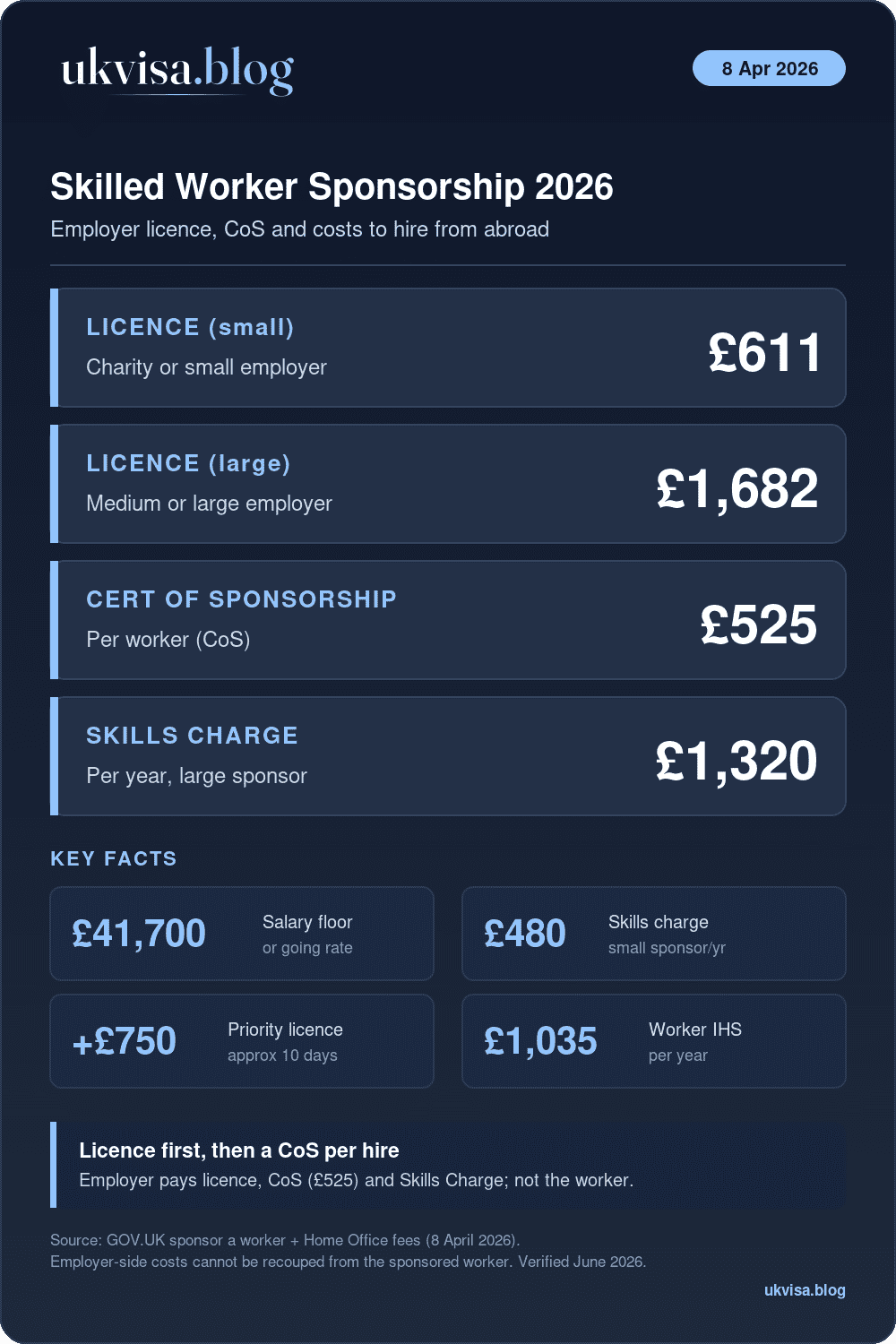
An employer needs a Worker sponsor licence, a genuine vacancy in an eligible occupation code, a certificate of sponsorship assigned through the Sponsorship Management System at £525, the Immigration Skills Charge paid in full for the whole visa, and a salary meeting both the threshold and the going rate. The licence costs £611 for small and charitable organisations and £1,682 for medium and large ones, and takes around eight weeks.
You need a licence to employ almost anyone from outside the UK, including EU, Icelandic, Liechtenstein, Norwegian and Swiss citizens who arrived after 31 December 2020, and including unpaid work such as running a charity. You do not need one for Irish citizens, people with settled or pre-settled status, or people with indefinite leave to remain. Holding a licence guarantees nothing: the worker still has to qualify on the route itself.
The Licence and What It Costs
There are two families of licence. A Worker licence covers skilled, long-term employment — Skilled Worker, Senior or Specialist Worker, Minister of Religion and International Sportsperson. A Temporary Worker licence covers the fixed-term categories, from Scale-up Worker and Creative Worker to Seasonal Worker and the rest of the Global Business Mobility family. You can hold one or both.
Sponsor Licence Fees
| Licence | Small or charitable | Medium or large |
|---|---|---|
| Worker | £611 | £1,682 |
| Temporary Worker | £611 | £611 |
| Worker and Temporary Worker together | £611 | £1,682 |
| Adding a Worker licence to a Temporary Worker licence | No fee | £1,071 |
| Adding a Temporary Worker licence to a Worker licence | No fee | No fee |
Source: GOV.UK, UK visa sponsorship for employers — licence fees. Verified 22 August 2026.
You count as a small sponsor if at least two of these apply: turnover of £15 million or less, assets of £7.5 million or less, or 50 or fewer employees. Registered charities pay the small-sponsor fee regardless. Most Worker licences now run indefinitely while you keep meeting your duties — but a Scale-up Worker or UK Expansion Worker licence lasts four years and cannot be replaced with another one afterwards.
Who Will Not Get a Licence
Unspent convictions for immigration offences, fraud or money laundering disqualify an organisation. So does recent history: no licence if yours was revoked in the last 12 months, or in the last 24 months where it has been revoked more than once. A refused application usually blocks you for six months, unless the refusal was because a representative filed it, because you missed a deadline for reasons outside your control, or because you applied to sponsor Scale-up Workers without qualifying as a scale-up sponsor.
Key Personnel and Rating
You appoint an authorising officer, a key contact and a level 1 user before applying. An approved application is A-rated and your organisation appears on the public register of licensed sponsors. The exception is a UK Expansion Worker licence where the authorising officer is overseas: that starts provisionally, allows exactly one certificate — assigned to the authorising officer so they can enter the UK — and upgrades to A-rating once they have their visa.
Certificates of Sponsorship
A certificate is an electronic record in the Sponsorship Management System, not a document. It carries the occupation code, salary, hours, location and dates, and a reference number the worker quotes on their application. They must apply within three months of assignment. For entry clearance on the Skilled Worker route the certificate must be a Defined one, requested for that specific job and salary rather than drawn from a general allocation.
Certificate Fees by Route
| Route | Fee per certificate |
|---|---|
| Worker routes, except International Sportsperson | £525 |
| International Sportsperson, certificate for more than 12 months | £525 |
| International Sportsperson, certificate for 12 months or less | £55 |
| Temporary Worker routes | £55 |
Source: GOV.UK, UK visa sponsorship for employers — certificates of sponsorship. Verified 22 August 2026.
The occupation code is the most consequential field on the certificate. It fixes the going rate and decides whether the job sits in the route at all, and caseworkers compare the stated duties against the code rather than the job title — see how codes and skill level are assessed. A forced match can be refused as an exaggerated code and can draw a compliance visit.
Third-Party and Agency Working
The sponsor must be whoever holds full responsibility for the duties, functions and outputs of the job. A worker must not be hired out to a third party to fill that party's vacancy, or perform an ongoing routine role or service for it. Contract work has to be a time-bound, non-routine project with a real end date. Labour-supply arrangements dressed as sponsorship are among the commoner reasons applications are refused.
The Immigration Skills Charge
The charge is paid by the sponsor at the moment the certificate is assigned, for the full length of the visa, and it cannot be recovered from the worker. It applies to two routes only: Skilled Worker and Senior or Specialist Worker.
Immigration Skills Charge Rates
| Sponsor | First 12 months | Each additional 6 months | Maximum over 5 years |
|---|---|---|---|
| Medium or large | £1,320 | £660 | £6,600 |
| Small or charitable | £480 | £240 | £2,400 |
Source: GOV.UK, UK visa sponsorship for employers — immigration skills charge. Verified 22 August 2026.
The exemptions run by occupation code, not by route. They cover codes 2111 to 2115, 2119, 2161, 2162 and 2311; entry clearance for less than six months; workers switching from a student route, and their later extension in the same job with the same sponsor; certificate periods that overlap an earlier one; and workers continuously sponsored since a certificate assigned before 6 April 2017. Of the health and care codes only 2113 and 2114 appear. A trust or care provider sponsoring a nurse, doctor or care worker on the Health and Care Worker visa pays the charge in full.
One further exemption is easy to miss on the Senior or Specialist Worker route: no charge where the certificate was assigned on or after 1 January 2023 to an EU national or Latvian non-citizen's passport holder, normally working in the EU for your EU business, temporarily transferred for no more than 36 months. Dependants never attract the charge, and you get a full refund if the visa is refused or withdrawn, or if the worker never comes.
What the Worker Must Meet
Sponsorship is only half of it. The worker must be paid the higher of the applicable salary threshold and the published going rate for the code, prove English, and meet the suitability rules. The general threshold is £41,700, with lower thresholds of £37,500, £33,400, £31,300, £28,200 and £25,000 available only in defined situations — the mechanics are in our going rates and thresholds guide.
English is B2 for first-time applicants and B1 for those extending. Some workers also need a criminal record certificate — our guide covers which — and the health surcharge is payable by the worker on most routes, though not on the health and care route. Applicants can be interviewed where the vacancy looks doubtful; our interview guide covers what is asked. The cross-route standards sit in the English requirements guide.
ATAS: A Duty That Sits With the Sponsor
If you also hold a Student sponsor licence and are sponsoring a worker in a listed occupation code to do research at PhD level or above in a relevant subject, and their nationality is not exempt, they need an ATAS certificate. You answer the ATAS question on the certificate of sponsorship — and where the answer is no but every other condition applies, you must add an explanation, either in the job description field or as a sponsor note afterwards.
Compliance Duties and What Goes Wrong
A licence is conditional and can be suspended, downgraded or revoked at any time. UKVI may visit before granting a licence and unannounced afterwards. The duties are unglamorous and the failures are usually administrative: late reports, thin records, and salaries that drift below the certificate figure.
- Report changes: absences, role and location changes, and departures, through the Sponsorship Management System.
- Keep records: passports, right-to-work checks, contact details and recruitment evidence.
- Keep the vacancy genuine: a real job the business needs, matching the code on the certificate.
- Pay what the certificate says: and report any drop below the threshold.
- Comply with employment law: minimum wage and working time rules — a breach can refuse the visa and cost the licence.
- Never claw back costs: the licence fee, certificate fee and skills charge stay with you; asking the worker to pay can cost the licence.
A downgrade to B-rating stops new certificates until an action plan is completed. Revocation is worse: sponsored workers' permission is cancelled and cut to 60 days, they must find a new sponsor or leave, and the organisation cannot hold a licence again for 12 months — or 24 months if it has now happened more than once.
What a Five-Year Sponsorship Costs
The employer side is the licence once, then a certificate and a skills charge per worker. The worker side is the application fee and the health surcharge. Neither side may pay the other's sponsorship costs.
Five-Year Sponsorship, Employer Side
| Item | Medium or large | Small or charitable |
|---|---|---|
| Sponsor licence, once | £1,682 | £611 |
| Certificate of sponsorship | £525 | £525 |
| Immigration Skills Charge, 5 years | £6,600 | £2,400 |
| Total | £8,807 | £3,536 |
Source: GOV.UK sponsorship fees and immigration skills charge, 8 April 2026 fee schedule. Verified 22 August 2026.
The worker separately pays £1,618 for a Skilled Worker application over three years from outside the UK, plus £5,175 of health surcharge across five years. Faster decisions are available to them at the usual priority rates, and the full picture across routes is in the work-route fee table and the settlement and citizenship fees. Sponsorship also has to survive to the end: workers still need qualifying sponsorship at the settlement stage.
Sources: GOV.UK the employer sponsorship pages on GOV.UK; the sponsor guidance, part 1; the register of licensed sponsors; and the Home Office Skilled Worker caseworker guidance version 20.0, published 3 August 2026. Figures verified 22 August 2026.
Frequently Asked
Questions about Skilled Worker Sponsorship
£8,807 for a medium or large employer: £1,682 for the licence, £525 for the certificate and £6,600 of skills charge. £3,536 for a small or charitable one: £611, £525 and £2,400. The licence is a one-off across every certificate issued during its life, so the marginal cost of a second worker is the certificate plus the charge.
No. GOV.UK warns that the licence may be revoked if you ask a sponsored worker to pay the licence fee or any cost linked to the application, and the same applies to the certificate fee and the skills charge. Recovering the worker's own visa fee and health surcharge by agreement is a different matter, but punitive clawback clauses carry their own legal risk.
No. Exemptions run by occupation code — 2111 to 2115, 2119, 2161, 2162 and 2311 — plus entry clearance under six months, student switchers, certificate overlaps and workers sponsored continuously since before 6 April 2017. Of the health and care codes only 2113 and 2114 qualify, so an NHS trust or care provider sponsoring a nurse or care worker pays in full.
Around eight weeks. You apply online, send the submission sheet and any supporting documents to the address on that sheet as PDF, JPEG or PNG files with short descriptive names, and UKVI may visit your premises before deciding. Documents not in English or Welsh need certified translations, and affidavits must be witnessed by a solicitor, notary or equivalent.
Worker licences generally stay valid for as long as you keep meeting the eligibility requirements, with no renewal cycle. Two exceptions remain: a licence to sponsor Scale-up Workers or UK Expansion Workers is valid for four years, and GOV.UK states you will not be able to apply for another licence to sponsor those types of worker afterwards.
Certificates are cancelled and sponsored workers' permission is cut to 60 days, or to whatever they have left if less, so they must find a new sponsor or leave. The organisation cannot get another licence for 12 months, and for 24 months if it has been revoked more than once. Workers involved in the reasons for revocation lose their permission immediately.
Only where that work is part of the sponsored role and your organisation keeps full responsibility for the duties, functions and outputs. Supplying a worker to fill a third party's vacancy, or to deliver an ongoing routine service for it, falls outside the rules however the contract is drafted. Genuine contract work must be a time-bound project with a real end date.
A Worker licence for Skilled Worker, Senior or Specialist Worker, Minister of Religion and International Sportsperson. A Temporary Worker licence for Scale-up, Creative, Charity, Religious, Government Authorised Exchange, International Agreement, Seasonal and the Global Business Mobility categories other than Senior or Specialist Worker. You can hold both, and adding a Temporary Worker licence to an existing Worker licence is free.