
Some delayed applications receive wording describing exceptionally complex issues rather than the ordinary delay message. It is not a refusal and it names no reason. What it signals is that the case needs specialist consideration rather than a routine check, and that the published waiting time no longer applies to it.

Complex Cases
The “Exceptionally Complex Issues” Notification
What the Message Actually Says
It confirms that the application cannot be decided within the published waiting time because it raises exceptionally complex issues, and that you will be contacted again. It asks for nothing, gives no reasons, states no revised date, and requires no reply.
It means your case has been routed for specialist consideration rather than routine handling. It is not a refusal and predicts nothing about the outcome. Expect months rather than weeks. Do not reply, do not send unsolicited documents, and do not submit a second application. If a document request arrives separately, answer that exactly and by its deadline.
How It Differs From the Ordinary Delay Message
The common delay notification simply says the published time will not be met. This wording goes further by characterising the case. Practically, the difference is duration: an ordinary delay is often measured in additional weeks, while a complex case is usually measured in months.
Why It Is Issued
GOV.UK names the general causes of longer processing: information that needs verifying, further evidence required, an interview needed, and increased demand. The complex wording sits at the far end of that spectrum, where the question cannot be resolved by a standard caseworker.
- Verification with a third party: an employer, an institution, a registrar or an overseas authority.
- Suitability questions: criminality, previous breaches, or an allegation of deception.
- A referral to a specialist team: where policy advice or a specialist unit is involved.
- An interview to be arranged: and then written up before a decision.
- Exceptional circumstances being considered: including any request for leave outside the rules.
- Medical or welfare input: a medical officer, or a child welfare consideration.
Home Office guidance itself marks certain application types as complex regardless of how straightforward they look. In the visitor context those include unaccompanied children, private medical treatment, organ donation, academics staying beyond six months, marriage and civil partnership visits, and permitted paid engagements. A case can be routed as complex simply because of its category.
Where It Appears Most
- Family and partner applications: relationship evidence, sponsor checks and third-party verification — see our spouse route page.
- Sponsored work applications: sponsor or certificate checks — see our Skilled Worker page.
- Applications with a difficult history: previous refusals, removals or cancellations — see our page on cancellation and suitability.
- In-country applications following a visit: where switching is in issue — see our page on switching from a visit visa.
- Categories marked complex by guidance: whatever the individual facts.
What Happens Next, and When
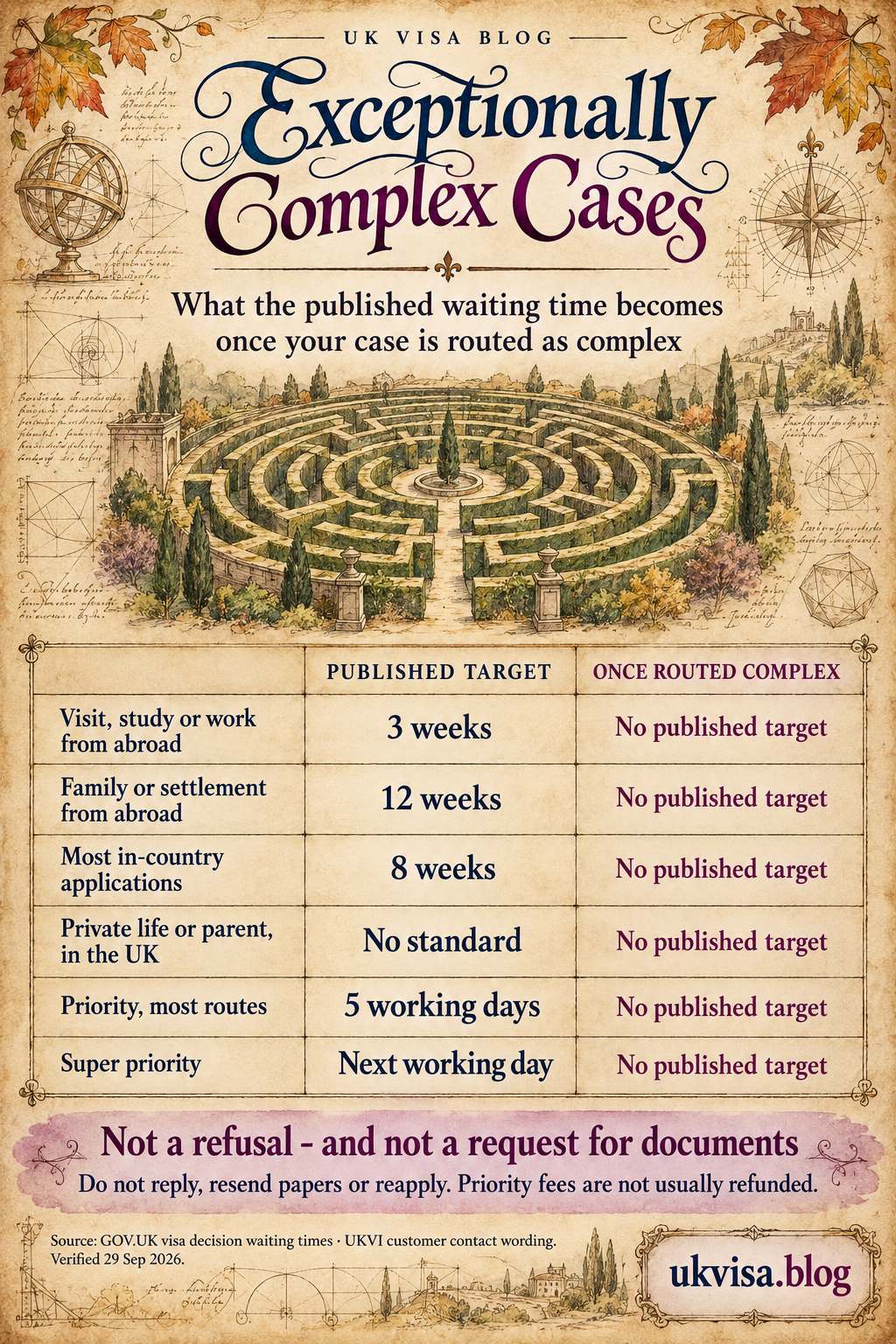
There is no published target for a complex case, because the wording exists precisely to say the target no longer applies. What you can plan around is the standard time it has already left: three weeks from abroad on most routes, twelve weeks for family, eight weeks in country.
In practice the sequence is checks, then any interview, then a decision. Each stage can add weeks, and stages that depend on a third party responding are outside the Home Office’s control as well as yours. Our page on processing after biometrics sets out the published times.
A new application does not overtake the first. It costs another fee, creates a second file on the same facts, and can itself become a complication the caseworker has to resolve. Where an in-country application is pending, submitting another can also affect the section 3C leave protecting your status.
Where the Case Started, and Where It Is Now
| Application | Published waiting time | Once routed as complex |
|---|---|---|
| Visit, study or work from abroad | 3 weeks | No published target |
| Family or settlement from abroad | 12 weeks | No published target |
| Most in-country applications | 8 weeks | No published target |
| Partner on a private life basis, or parent, in country | 12 months | No published target |
| Priority, most routes | 5 working days | Reverts to standard handling |
| Super priority | Next working day | Reverts to standard handling |
Source: GOV.UK visa decision waiting times and faster decision guidance. Checked 22 August 2026.
What to Do
- Keep the registered email and phone working: a document request that goes unanswered becomes a refusal.
- Check spam daily: a notice sent electronically is treated as served the day it was sent.
- Answer any request exactly: what was asked for, by the deadline, quoting the reference.
- Do not send unsolicited documents: unless something material has changed.
- Record what the delay is costing: deferred courses, withdrawn offers, rearranged plans.
- Tell anyone relying on the date: early, while they can still accommodate it.
When to Take Advice
Where you know what the complication is — a previous refusal citing deception, a conviction, a sponsor under scrutiny — advice is worth taking now rather than after a decision. Where you have no idea, it usually is not: the message itself gives a lawyer nothing to work with either.
If Your Passport Is Held
Where the visa application centre retained your passport, a complex case means it stays retained. That rules out travel of any kind, including emergencies, for as long as the case runs. Where a genuine emergency arises you can ask for the document back, but that ordinarily ends the application and the fee is not returned.
Anyone with a passport expiring during the wait should raise it early rather than at expiry. A document that expires while held creates a problem for the decision itself, and it is far easier to address before it happens than afterwards.
MP Letters
Constituents often ask an MP to intervene. Home Office guidance is specific about what that achieves. Where an MP writes to a visa application centre in support of an application, the response is an acknowledgement stating that the letter will be taken into account together with all other available evidence when the application is assessed.
That is the ceiling. Guidance also states that third-party undertakings offered in support cannot be treated as a guarantee that a visitor will comply with their permission, and that caseworkers should not seek one or accept an offer of one. An MP letter is evidence of nothing except that someone wrote it.
Where an MP enquiry does help is on delay rather than merits — asking why an application has sat unanswered far beyond the published time. That is a legitimate question about service, and it is a different request from asking for a decision to go a particular way.
If You Paid for Priority
GOV.UK is explicit: where the Home Office needs more information or has to verify details with another department, the decision may take longer and you will not usually get your money back. A case routed as complex has left the fast queue, and the fee is not refunded because the service was made available.
That is worth knowing before paying rather than after. Priority buys queue position on a case that stays in the queue. Where a case carries the features that attract specialist routing — a difficult history, verification-heavy evidence, an interview likely — the £500 or £1,000 is at real risk. See our page on priority services.
When Legal Action on Delay Becomes Proportionate
Unreasonable delay is itself challengeable. The step is a pre-action protocol letter setting out the timeline against the published waiting time and asking for a decision by a date, followed if necessary by judicial review. A proportion of cases resolve at the letter stage without a claim being issued.
Proportionate means extreme, though. A case a month past a three-week target is late; a case a year past it with no contact and no explanation is something a court might look at. Take advice on where your own case sits before spending anything, because judicial review carries a costs risk that no other remedy does.
Profiles That Attract Complex Routing
- A previous refusal, cancellation or removal: particularly one involving deception.
- Documents that require external verification: qualifications, employment letters, overseas registrations.
- Recently deposited funds: where the origin is not evident from the statements.
- Discrepancies with a sponsor: on facts the sponsor should know.
- A criminal record or immigration breach: engaging the suitability rules.
- A category guidance marks as complex: regardless of the individual facts.
Most of these are addressed at submission rather than afterwards. Consistent figures, documents in the required format, a plain explanation of anything unusual, and disclosure of any history all reduce the chance of a verification detour — see our supporting documents guide.
If the eventual answer is a refusal, the complex routing tells you nothing about which ground was used. Read the notice for the paragraph before deciding anything — our pages on refusal grounds and delays cover both outcomes.
Sources: GOV UK waiting times for applications outside the UK, for applications inside the UK, the faster decision guidance and the Home Office visit caseworker guidance version 17.0 published 25 February 2026. Figures verified 22 August 2026.
Frequently Asked
Complex Case Questions
Does this email mean I will be refused?
No. It records that the case needs specialist consideration and that the published time no longer applies. It contains no findings and predicts nothing about the outcome.
How long will it take now?
There is no published target for a complex case. Expect months rather than weeks, particularly where a third party has to respond before the case can move.
Should I reply to the email?
No. It asks for nothing. Only a document request needs answering, and that arrives separately with a deadline and a list.
Can I send more documents to speed it up?
Unsolicited documents add work rather than speed. Send something only if it was asked for, or if a material fact has genuinely changed.
Will I get my priority fee back?
Usually not. GOV.UK states that where more information is needed or details must be verified, the decision may take longer and you will not usually get your money back.
Will an MP get my case decided?
An MP letter is acknowledged and taken into account with all other evidence. It cannot secure an outcome. It is more useful for questioning an extreme delay than for arguing merits.
Should I apply again while I wait?
No. A second application does not overtake the first, costs another fee, and can complicate both files — and for in-country applicants may affect section 3C leave.
Can I travel while it is pending?
If your passport is with the Home Office, no. If an in-country application is pending, leaving generally ends it. Take advice before making plans.
Is my case complex because of something I did wrong?
Not necessarily. Some categories are treated as complex by guidance whatever the facts, and verification with a third party can be routine. The wording characterises the work, not you.
Can I withdraw and start again?
You can withdraw, but the fee is not refunded and the health surcharge is. A fresh application on the same facts is likely to be routed the same way, so withdrawing rarely solves the underlying issue.
Will the complex routing be mentioned in the decision?
No. The decision states the outcome and, if refused, the paragraphs relied on. The routing is internal and does not appear as a reason either way.
When is it worth taking legal advice?
Where you already know what the complication is — a deception allegation, a conviction, a sponsor under scrutiny. Where you do not, the message alone gives an adviser nothing to act on either.