
There is no separate “family visitor visa” in the Immigration Rules. Relatives visiting you in the UK apply on the Standard Visitor route, and the decision turns on two things a caseworker checks closely when the applicant has family here: whether they will leave at the end of the visit, and whether your support genuinely exists.

Family Visits
Bringing Family to the UK on a Visitor Visa in 2026
What the Family Visitor Visa Actually Is
The route your parents, siblings or adult children use is the Standard Visitor route explained here. “Family visitor visa” is the everyday name for a standard visit whose purpose happens to be seeing relatives. Same application, same fee, same rules — the difference is evidential, not legal.
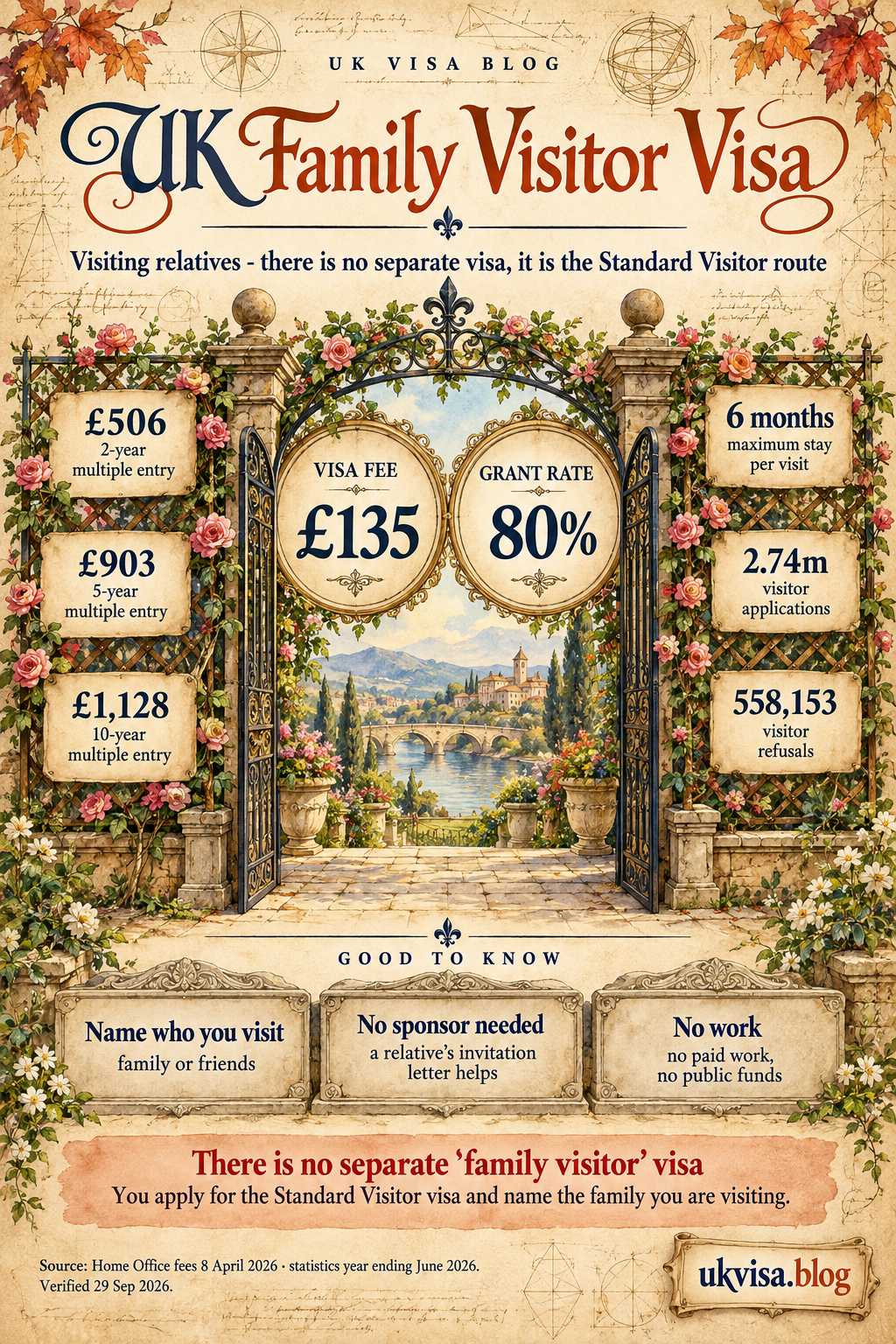
Relatives apply for a Standard Visitor visa costing £135 for up to six months from 8 April 2026. They can normally stay six months per visit, there is no cap on visits per year, and the sponsor’s support only counts if the sponsor is lawfully in the UK and can fund their own household as well.
The evidential difference matters. Where an applicant has several close family members in the UK and few remaining ties at home, caseworker guidance treats that as a reason to doubt they are a genuine visitor. It is not a bar. It means the application has to answer the question rather than ignore it.
Who Can Sponsor a Family Visitor
Sponsorship on the visitor route is not a formal status. Anyone with a genuine personal relationship to the applicant can provide maintenance and accommodation, including family members and friends. What the rules control is whether that support can be counted.
- British and Irish citizens: no restriction, subject to the funding test below.
- Settled residents: indefinite leave to remain or EU Settled Status.
- People with limited permission: work, study or family visas all qualify, provided the permission is valid.
- Friends and wider family: the relationship must be genuine, not the label.
The Condition That Voids Support Entirely
A sponsor in the UK must not be in breach of immigration law at the date the visitor’s application is decided, or at the date the visitor enters. Where they are, the guidance is that the support must be disregarded — not weighed less, disregarded. The applicant is then assessed on their own funds alone, which is usually fatal to the application.
If a sponsor’s support is not declared on the application form and the applicant cannot show the money in their account is genuinely their own, those funds are not counted in the assessment at all. Money that appears in an account shortly before the application, with no declared source, invites checks on where it came from.
A caseworker may also look at the sponsor’s history of supporting previous visitors. Where someone has sponsored visitors who then overstayed or failed to leave, that record can undermine the current application. Our page on the role and duties of a UK visit sponsor covers this in more detail.
Requirements Your Relative Must Meet
Core Eligibility
- Genuine visit: they will leave at the end of the stay and will not live in the UK through repeated visits.
- Permitted purpose: seeing family is tourism and leisure, which is permitted.
- Funds: enough to maintain and accommodate themselves, from their own resources or a declared sponsor.
- Travel costs: the return journey must be paid for or payable.
- No prohibited activity: no work, no access to public funds, no medical treatment beyond the limited permitted cases.
How Funds Are Actually Assessed
There is no set figure. A caseworker looks at income and savings, subtracts ongoing commitments in the home country — rent or mortgage, and anyone the applicant supports financially, including dependants not travelling — and asks whether what remains covers the likely cost of the trip and is reasonable spending given their circumstances.
Where you are funding the visit, you must show you can adequately support yourself and your own dependants as well as the visitor. A sponsor whose own budget is stretched is a refusal risk even when the visitor’s paperwork is perfect. Funds relied on must sit in a financial institution permitted under Appendix Finance.
What a Family Visit Costs in 2026
Standard Visitor Fees from 8 April 2026
| Validity | Previous fee | From 8 April 2026 |
|---|---|---|
| Up to 6 months | £127 | £135 |
| 2 years | £475 | £506 |
| 5 years | £848 | £903 |
| 10 years | £1,059 | £1,128 |
Source: Home Office visa fees table, checked 22 August 2026.
Visitors do not pay the health surcharge, because it applies to permission granted for more than six months on routes that carry it — see our note on when the health surcharge applies. They should carry travel insurance instead, since NHS hospital treatment is chargeable for visitors. A full breakdown sits on our visitor visa fee page.
Priority processing costs £500 on top and targets five working days; super priority costs £1,000 and targets the next working day. Neither improves the decision. Where timing matters, apply early rather than paying to compress a weak application — our guides to processing times after biometrics and what to do about delays set out realistic timelines.
The Invitation Letter
No rule requires an invitation letter and none is refused for lacking one. It is useful because it explains the relationship, the purpose and the funding in one place, and gives the caseworker something to check the rest of the bundle against. That cuts both ways: a letter that contradicts the documents is worse than no letter.
[Your full name]
[UK address]
[Telephone] · [Email]
[Date]
To the Entry Clearance Officer
Re: Visit visa application by [Applicant name], date of birth [DOB], passport number [number]
I am writing to invite my [mother / father / brother / sister] to visit me in the United Kingdom. I am a [British citizen / settled person / holder of leave valid until DD Month YYYY] and I enclose [passport page / share code] as evidence.
I am inviting [Applicant] to stay with me from [date] to [date], a visit of [number] days, so that [specific reason — to meet their grandchild, to attend a graduation, a family occasion].
[Applicant] will stay at my home at the address above, in [describe the room]. I [own / rent] the property and enclose [mortgage statement / tenancy agreement].
I work as [job title] at [employer] earning [amount] gross a year. I enclose [number] months of payslips and matching bank statements. I will meet [state exactly what: accommodation and living costs / all costs including the return flight] and I can do so while supporting myself and [number] dependants without recourse to public funds.
[Applicant] will return to [country] on [date], where [he/she] [works at / owns / cares for — the tie that pulls them home].
Yours faithfully,
[Signature]
[Your full name]
Where Invitation Letters Go Wrong
Four failures recur. Promising to cover “all expenses” when the payslips do not support it. Giving dates that do not match the application form. Claiming a relationship the birth certificates do not evidence. And describing the visit in terms that sound like relocation — “to help with the children while my wife returns to work” reads as an arrangement, not a visit.
Documents That Support a Family Visit
From the Applicant
- Passport: valid, with previous travel history visible.
- Six months of bank statements: showing a pattern, not a sudden deposit.
- Proof of income: employer letter with start date, salary, role and contact details; or business registration and accounts for the self-employed.
- Ties at home: property, employment, dependants remaining behind, pension or care commitments.
- Relationship evidence: birth or marriage certificates linking applicant to sponsor.
From You as Sponsor
- Status evidence: passport, BRP or an immigration status share code.
- Six months of bank statements and payslips: showing the support is affordable.
- Accommodation proof: tenancy agreement, mortgage statement or a letter from the property owner.
- The invitation letter: signed, dated and consistent with everything above.
Documents That Carry Little Weight
GOV.UK’s supporting-documents guide lists items that are less useful as evidence: personal photographs, hotel bookings, flight bookings, travel insurance, driving licences, car ownership, notarial certificates, business cards, credit card statements, bank letters older than a year, and the sponsor’s utility or council tax bills. Sending them thickens the bundle without strengthening it. Our supporting documents guide works through the alternatives.
Long-Term Visas for Frequent Family Visits
Where a relative visits every year, a longer visa costs less per visit and removes the repeat application risk. The visa runs for its full term; each individual stay is still capped at six months.
Cost Per Year of Validity
| Validity | Fee | Cost per year |
|---|---|---|
| 6 months | £135 | £270 if used twice a year |
| 2 years | £506 | £253 |
| 5 years | £903 | £181 |
| 10 years | £1,128 | £113 |
Source: Home Office visa fees table, checked 22 August 2026.
A long-term visa is only worth buying if the travel pattern justifies it and the passport has years left, since the visa is tied to the passport. See our pages on two, five and ten-year visitor visas and on multiple-entry visit visas before committing to the higher fee.
Why Family Visit Applications Get Refused
The Recurring Reasons
Caseworker guidance names the patterns. Few or no family and economic ties in the country of residence combined with several family members in the UK. Discrepancies between what the applicant says and what the sponsor says, particularly where the sponsor should know the facts. Reasons for the visit that are not credible. Information that could not be verified. And any previous deception by the applicant, the sponsor or an immediate family member.
The Family Rules Point Nobody Expects
Where an applicant has previously been refused under the family rules and then applies as a visitor, the caseworker is told to assess whether the visitor route is being used to avoid the rules that apply to family migrants joining British or settled people. A refused spouse or dependent relative application in the history makes a subsequent visit application harder, and the visit needs a purpose and an end date that clearly are not settlement by instalments.
Living Here Through Repeat Visits
There is no “six months in twelve” rule — the guidance states plainly that no maximum period in any given window is specified. What is assessed is whether the pattern shows someone making the UK their home: more time here than at home, return trips only to re-enter, a GP registration, children in UK schools. Where that picture emerges, the application is refused.
If the Application Is Refused
There is no right of appeal against a visit refusal except on human rights or discrimination grounds. The realistic route is a fresh application that answers the refusal notice point by point with new evidence. Our guides to the refusal grounds and how to respond and to visitor visa success rates explain what usually shifts a decision.
One point in the applicant’s favour: where a caseworker is satisfied the rules are met but some concern remains, the guidance directs them to consider granting a shorter visa rather than refusing outright. A six-week grant is not a bad outcome.
When a Visit Is Not the Right Route
The visitor route cannot deliver settlement, and applying repeatedly in the hope that it will produces refusals. Where a relative needs to live here, the correct route is a different one.
- Elderly parents needing care: the adult dependent relative route — a demanding test, but the correct one.
- A parent of a British or settled child: the parent route, not a visit.
- Marrying in the UK: the marriage visitor visa if leaving afterwards, or a fiancé visa if settling.
- Children travelling to visit relatives: see the requirements for child visitors.
- Extending a stay already underway: limited and expensive — see visit visa extensions.
Applications are made online and biometrics given at a visa application centre; our walkthrough of the visit visa application form covers the questions that catch families out, including the declaration of third-party support.
Sources: Appendix V of the Immigration Rules on GOV UK, the permitted activities appendix, the Home Office visit caseworker guidance version 17.0 published 25 February 2026, and the GOV UK guide to supporting documents. Figures verified 22 August 2026.
Frequently Asked
Family Visitor Visa Questions
How much does it cost to bring my parents to the UK for a visit?
£135 each for a visa valid up to six months, from 8 April 2026. There is no health surcharge for visitors. Priority processing adds £500 and super priority £1,000, per applicant.
How long can my parents stay on a visitor visa?
Up to six months per visit. The permission stamp or grant letter sets the actual period, and a caseworker with residual concerns may grant less than six months rather than refuse.
How many times a year can my family visit?
There is no numerical limit. The guidance expressly rejects any “six months in twelve” rule. What is assessed is whether the travel pattern shows the person living in the UK rather than visiting it.
Can a student visa holder sponsor their parents to visit?
Yes. Any lawful immigration status allows you to provide maintenance and accommodation. You must show funds sufficient for yourself and the visitor, which is harder on a student budget — a parent funding their own visit is often the stronger case.
Do we need an invitation letter?
It is not mandatory. It helps by putting relationship, purpose, dates and funding in one document. It hurts if it contradicts the form or the financial evidence.
Can I apply for my relative’s visit visa from inside the UK?
No. The applicant applies from outside the UK and gives biometrics at a visa application centre in their country. You can help complete the online form and pay the fee, but the application is theirs.
Can my parents visit a newborn grandchild?
Yes, that is an ordinary family visit. Keep the stated purpose to the visit itself. Wording that suggests they will provide ongoing childcare so a parent can return to work reads as an arrangement rather than a visit.
Does money I send to my relative’s account count as their funds?
Only if the support is declared on the application form. Undeclared third-party money that the applicant cannot show is genuinely theirs is excluded from the assessment entirely, and recent unexplained deposits attract further checks.
What if my relative was refused a spouse or dependent relative visa before?
Disclose it. The caseworker is directed to consider whether the visit is being used to sidestep the family rules, so the visit needs a defined purpose, a firm return date and evidence of continuing ties abroad.
Can I give a formal undertaking to guarantee my relative leaves?
No useful purpose. Third-party undertakings cannot be treated as a guarantee of compliance, and caseworkers are told not to seek one or accept an offer of one. Evidence of your income and their ties abroad does the work instead.