
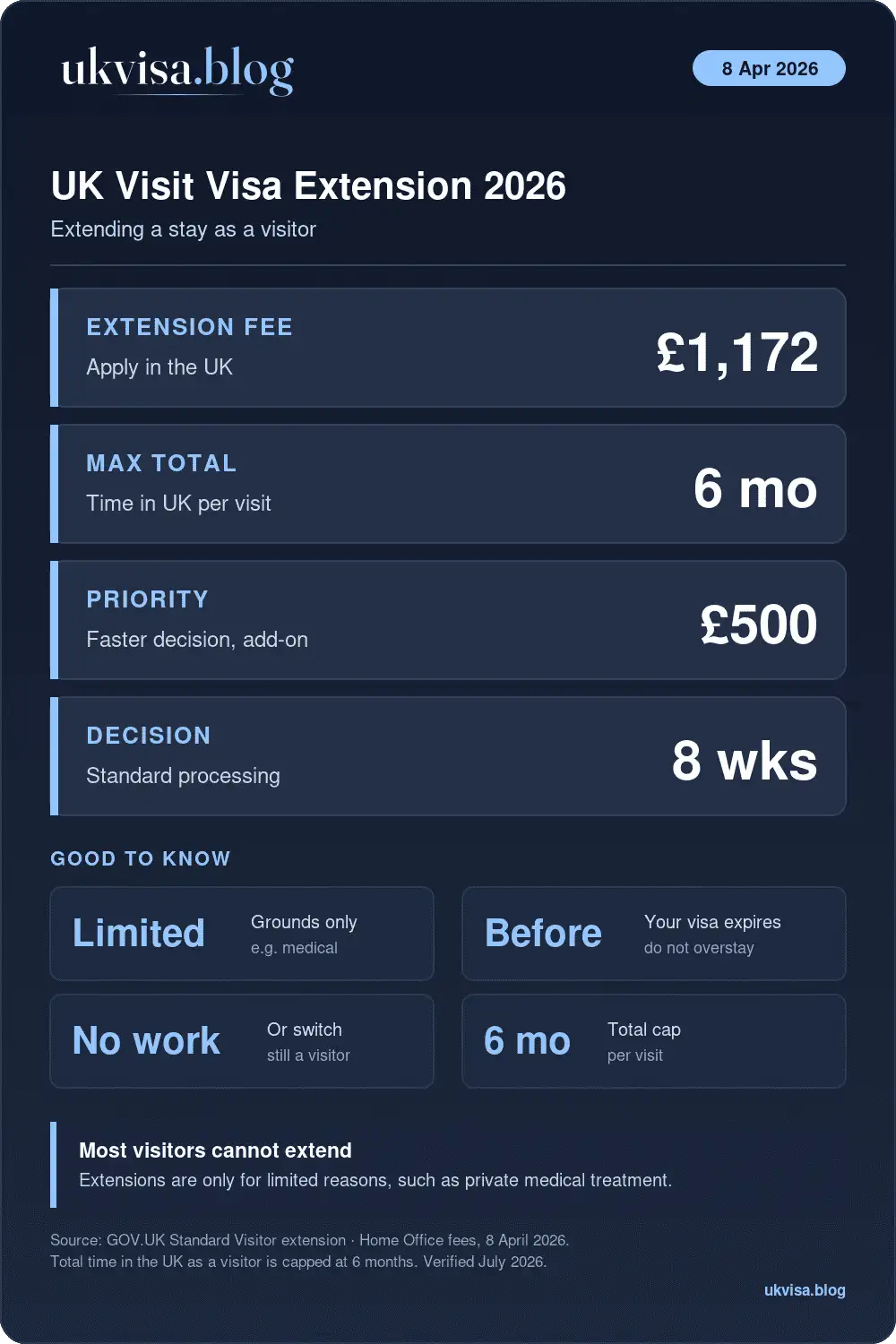
Extending a visit inside the UK costs £1,172 and is possible in far fewer situations than people expect. The ordinary case is simply completing six months from the date you arrived. Beyond that, only three categories can extend at all: private medical treatment, academics, and doctors sitting the PLAB test or on clinical attachments.
Extensions
Extending a UK Visit From Inside the Country
When an Extension Is Actually Possible
Appendix V allows permission to stay as a visitor in defined circumstances, set out at paragraphs V 15.1 to V 15.4. Everything outside those paragraphs, plus completing an initial six months, is refused. The application must be made before your existing permission expires — not before your visa expires, which is often a different date.
Extension costs £1,172 for the main applicant and dependants. The common case is completing six months from arrival where you were granted less. Beyond six months, only private medical treatment, academics and PLAB or clinical attachment candidates can extend, and the total is capped — twelve months for academics, a further six for medical treatment.
Eligibility at a Glance
- An in-time application: made before your current permission expires.
- Continuing genuine visitor status: you will still leave, and are not living here.
- Funds and accommodation: for the whole of the extended period.
- Suitability: no criminality, deception or breach that defeats the application.
- A qualifying category: to go beyond six months in total.
Completing Six Months
This is the case most people need. Guidance gives the example directly: a visitor arriving in January whose long-term visa expires in February may extend as a Standard Visitor until June, provided they meet the rules. A single-entry or six-month visa can also be extended to complete six months in the UK. It buys the balance of six months from arrival, not six more.
The Fee
Extension Costs Compared
| Option | Fee | What it gets you |
|---|---|---|
| Visitor extension in the UK | £1,172 | Main applicant and dependants |
| Fresh 6-month visit visa from abroad | £135 | A new six months per entry |
| 2-year visit visa from abroad | £506 | Repeat visits over two years |
| 5-year visit visa from abroad | £903 | Repeat visits over five years |
| 10-year visit visa from abroad | £1,128 | Repeat visits over ten years |
Source: Home Office visa fees table, checked 22 August 2026.
Why Leaving Is Usually Cheaper
The arithmetic is stark. An extension costs more than a ten-year visa and nearly nine times a fresh six-month one. Where the purpose of the extra time is not one of the qualifying categories, leaving and applying again is cheaper, faster and more likely to succeed — see our visitor fee page for the full comparison.
The Qualifying Categories
Private Medical Treatment Visitors
You must satisfy the decision maker that the costs of treatment already received have been met, and provide documentation from a registered practitioner detailing the continuing need. Extensions here permit a further period, taking total stay beyond six months where the clinical evidence supports it. Our page on visiting for private treatment covers the underlying route.
On a medical extension, where you rely on money held abroad — yours or a third party's — the caseworker must ask for proof that the funds are transferable, because some countries operate strict exchange controls. Where a third party is funding, fresh confirmation of their willingness and ability to pay is required; the original application's evidence is not carried over.
Academic Visitors
Academics extending must continue to intend to carry out the qualifying activity — a formal exchange arrangement, sabbatical research, or clinical practice for an eminent senior doctor or dentist — and be highly qualified within their field. The total stay is capped at twelve months. Accompanying partners and children are covered by the same provision.
PLAB Candidates and Clinical Attachments
A visitor resitting the Professional and Linguistic Assessment Board test must provide written confirmation from the General Medical Council. Overseas medical, dental or nursing graduates seeking an unpaid clinical attachment must have already passed that test. Both are narrow, evidenced categories rather than a general provision for medical professionals.
What the Caseworker Reassesses From Scratch
An extension is not a renewal. The whole genuine visitor test is reapplied: whether you intend only permitted activities and will leave at the end, whether you are living in the UK through frequent and successive visits, whether you intend anything prohibited, and whether you have sufficient funds, maintenance and accommodation for the whole extended period.
Third-party support is reassessed too. The supporter must have a genuine relationship with you, must not be in breach of immigration laws at the time of the decision, and must be able and willing to support you for the full duration of the extended stay. A sponsor whose own permission has lapsed since your arrival takes the support with them.
This is why extensions fail more often than applicants expect. Time already spent in the UK is evidence against the intention to leave, not for it — a request to stay longer, made from inside the country, invites exactly the assessment about making the UK your home that guidance directs caseworkers to carry out.
Exceptional and Compassionate Cases
Where an applicant does not meet the visitor rules but there are compassionate and compelling circumstances, guidance requires the caseworker to consider a referral for leave outside the rules. The referral goes to the Referred Casework Unit on a form stating the justification, with comprehensive evidence and, where relevant, a full medical report, and it needs a manager's authority.
What Counts in Practice
The threshold is genuinely exceptional: a serious medical event preventing travel, the terminal illness of a close family member, a child's welfare. Missing a flight, a delayed passport, or wanting more time with family are not. The evidence has to be in front of the caseworker for a referral to be made, which means submitting it with the application rather than waiting for a refusal.
One related point for escorts. There is no provision in the visitor rules for someone accompanying a private medical treatment visitor to extend beyond six months. Where they need longer, the case must go through the same exceptional circumstances referral.
Making the Application
Extensions are made online from inside the UK using the relevant FLR form — our guide to the FLR forms explains which applies. Our application form walkthrough covers the free-text fields, which here should explain the qualifying category directly.
Section 3C Leave While You Wait
Where a valid application is made before your existing permission expires, section 3C of the Immigration Act 1971 continues that permission while the decision is pending, on the same conditions. You remain lawfully here, still barred from working. An application made even a day late attracts no such protection.
Why Extensions Are Slow
In-country decisions take considerably longer than entry clearance, and priority services are not always available for this application type. See our pages on processing after biometrics, priority options and delays. Plan around a wait of months, not weeks.
Evidence to Provide
- Passport and current permission: the vignette or the grant notice from arrival.
- Proof of the date you entered: the entry stamp or boarding documents.
- Financial evidence: covering the whole extended period, with transferability proved where funds are abroad.
- Accommodation evidence: for the extended stay.
- Ties abroad: confirming you will still leave.
Category Evidence
Medical extensions need proof that treatment costs already incurred have been paid, plus a registered practitioner's letter on the continuing need, the location and the expected end date. Academics need evidence of the exchange, sabbatical or clinical practice. PLAB candidates need written GMC confirmation. Our supporting documents guide covers evidential standards.
If You Arrived Through the ePassport Gates
Nationals of Australia, Canada, Japan, New Zealand, Singapore, South Korea, the United States, EEA states and Switzerland who enter through the ePassport gates automatically receive six months as a Standard Visitor with no endorsement in the passport. Evidence the date of entry with boarding passes and travel bookings, since there is no stamp to point at.
If the Extension Is Refused
A refusal usually ends section 3C protection, and you must leave promptly. Overstaying carries a re-entry ban: twelve months for voluntary departure at your own expense, longer where the taxpayer pays, and ten years for removal at public expense. Our page on cancellation and the suitability rules sets out the ban table.
Read the refusal notice for the paragraph relied on before doing anything else — see our pages on reading a refusal letter and refusal grounds.
The Fourteen-Day Relief, and Its Limits
The suitability rules provide one narrow protection for a late application. An applicant is not treated as an overstayer where the application was made within fourteen days of the previous permission expiring and there is good cause, beyond their control, for the late submission. A separate limb covers an application made within fourteen days of a previous refusal.
Do not plan around it. Good cause beyond your control is a condition rather than a formality, and hospital records or a documented emergency are the kind of thing meant. The relief protects the application from being treated as out of time; it does not give you status during those days, and section 3C does not apply to a late application.
When Reapplying Is Worth It
Rarely, from inside the UK. A second extension application on the same facts fails for the same reason and costs another £1,172. The usual course is to leave in time and apply from abroad, where the fee is a fraction and the assessment starts clean — see our page on applying again after a refusal.
Sources: Appendix V of the Immigration Rules on GOV UK, the Home Office fees table, and the visit caseworker guidance version 17.0 published 25 February 2026. Figures verified 22 August 2026.
Frequently Asked
Visit Extension Questions
How much does a visit visa extension cost?
£1,172, covering the main applicant and dependants. That is more than a ten-year visit visa applied for from abroad.
Can I extend a six-month visit to twelve months?
Only if you fall into a qualifying category. Academics can reach twelve months in total; medical treatment visitors can extend beyond six months on clinical evidence. Ordinary visitors cannot.
My visa expires next week but I arrived only two months ago. Can I stay?
You can apply to extend as a Standard Visitor to complete six months from arrival, provided you apply before your current permission expires and meet the rules.
Can I extend to stay with a sick relative?
Not under the ordinary rules. It would have to go through the compassionate and compelling circumstances referral, which needs comprehensive evidence including a medical report and a manager's authority.
Can I work while my extension is pending?
No. Section 3C continues your permission on the same conditions, and visitor conditions prohibit work.
Can I leave the UK while the application is being decided?
Leaving generally ends the application and the section 3C protection. Take advice before travelling with an application pending.
Can a marriage visitor extend?
No. That route cannot be extended or switched. Marry within the six months and leave.
Can an ADS tour group visitor extend?
No. The thirty-day ADS visa cannot be extended, and you must leave when it expires.
I came through the ePassport gates. How do I prove my entry date?
Use boarding passes, travel bookings and any airline records. Eligible nationals receive six months automatically with no passport endorsement, so there is no stamp to rely on.
Can I extend twice?
Only within the category caps. Academics are limited to twelve months in total and ordinary visitors to six. Repeat applications on the same facts fail and cost £1,172 each time.
Is it better to leave and come back?
Usually. A fresh six-month visa costs £135 against £1,172 to extend, and repeated short visits are assessed far more favourably than an attempt to stretch one stay.