
The Minister of Religion visa is the sponsored route for people taking up a role within a faith community — a minister, missionary or member of a religious order. It runs up to three years and one month, costs £819 from outside the UK or £943 inside, and unlike the temporary religious route it leads to settlement after five years.
UK Work Visas
Minister of Religion Visa UK 2026: Requirements, Fees and Settlement
What the Route Is
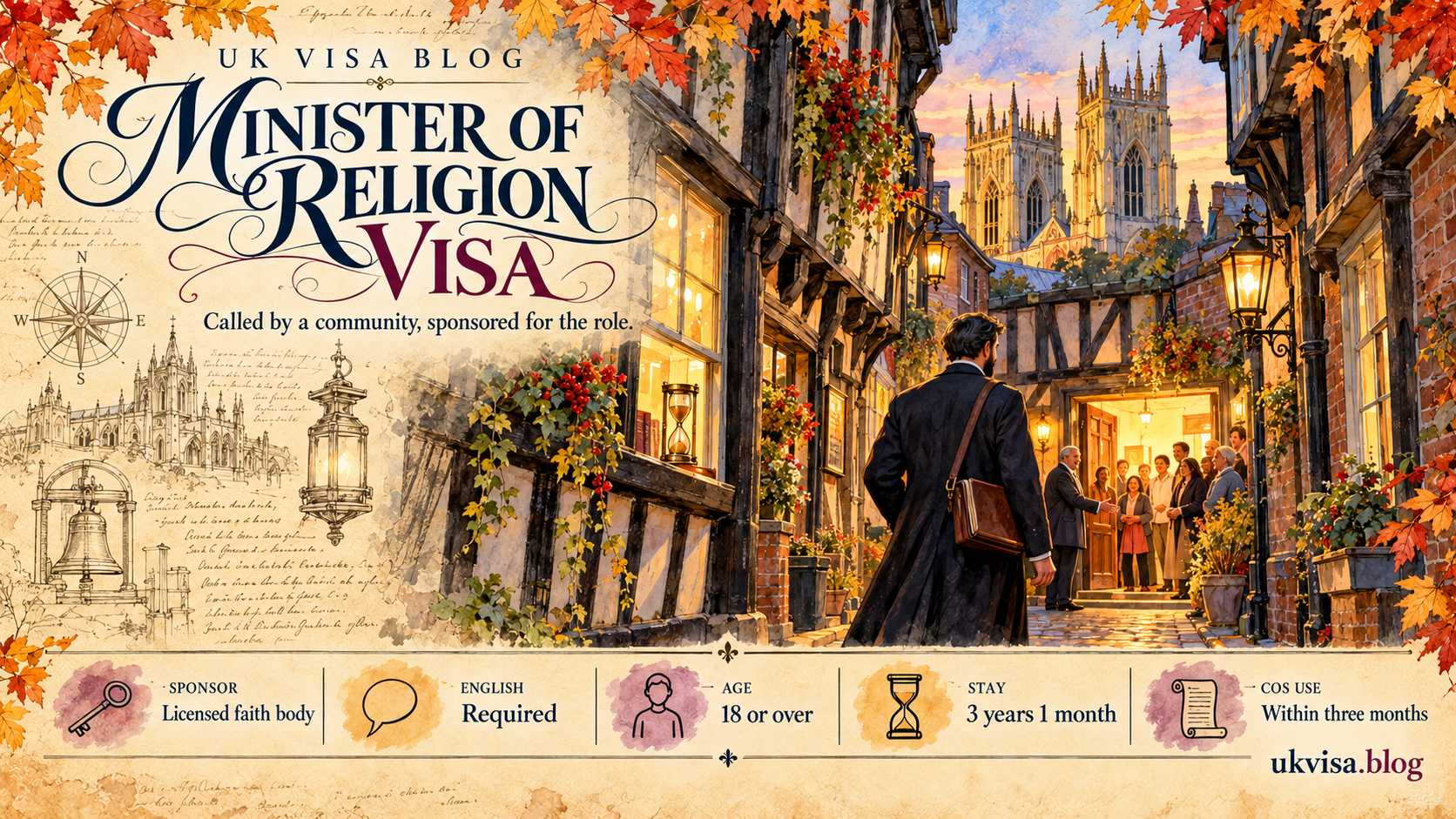
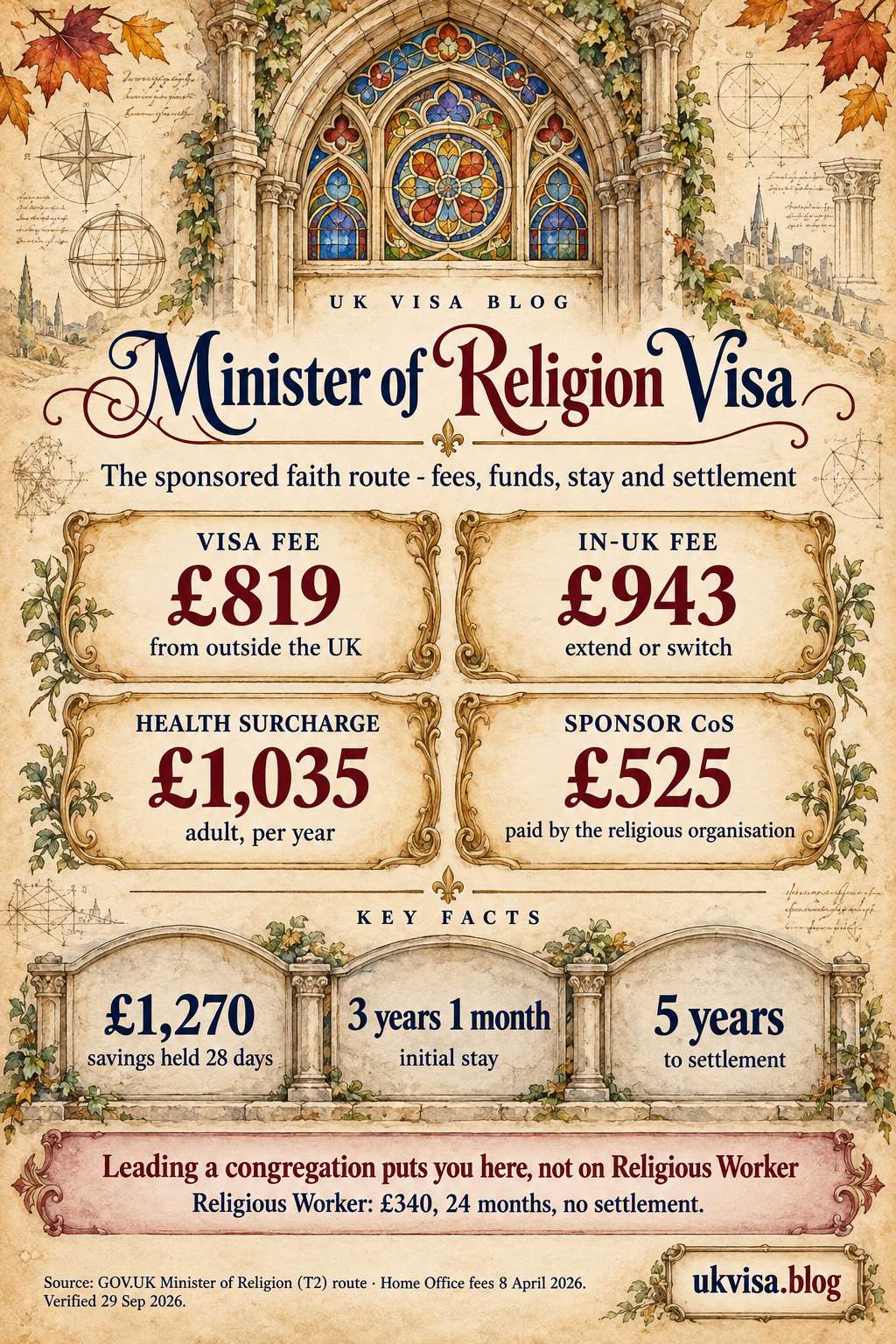
A sponsored work route for someone offered a job within a faith community in the UK — for example as a minister of religion, missionary or member of a religious order. You need a certificate of sponsorship from a licensed employer, English, £1,270 in savings and to be 18 or over. Permission runs up to three years and one month. The fee is £819 from outside the UK and £943 to extend or switch inside it.
Your sponsor checks that you can do the job and that it qualifies for the route, then assigns a certificate of sponsorship and tells you what you will be paid. The certificate is an electronic record, used once, and must be used within three months of being assigned. The wider licensing framework is in the employer sponsorship requirements.
Eligibility
- Certificate of sponsorship: for the job, from a licensed sponsor, used once within three months.
- English: you must prove your knowledge of English — see the CEFR standards and exemptions.
- Money: £1,270 held for 28 consecutive days, day 28 within 31 days of applying.
- Travel history: evidence of your travel over the last five years.
- Age: 18 or over on the date of application.
- Tuberculosis certificate: if you are applying from a listed country.
Two exemptions remove the need to evidence the money: twelve months in the UK on a valid visa, or your employer covering your first month’s costs up to £1,270 by certifying maintenance on the certificate. Your employer must also pay at least the minimum wage and follow the working time rules — a failure on either refuses the application, faith context notwithstanding.
Fees
What the Route Costs
| Who | Apply outside the UK | Extend or switch inside the UK |
|---|---|---|
| Main applicant | £819 | £943 |
| Each dependant | £819 | £943 |
| Health surcharge, adult | £1,035 a year | £1,035 a year |
| Certificate of sponsorship, paid by the sponsor | £525 | £525 |
Source: GOV.UK Minister of Religion visa (T2) and UK visa sponsorship for employers, 8 April 2026 fee schedule. Verified 22 August 2026.
Biometric enrolment carries no fee. The surcharge is paid upfront for the whole grant, which on a three-year permission is £3,105 for an adult — the mechanics are in our health surcharge guide.
What the Sponsor Has to Establish
The route turns on the nature of the role rather than on a salary threshold. The sponsor confirms the job qualifies, and the assessment looks at whether the position is a genuine one within the faith community and whether the applicant can actually do it. Roles that read as administrative support rather than ministry belong on a different route.
Three groups are named on the route: ministers of religion, missionaries and members of religious orders. Each is assessed on what the role actually involves rather than on the title the organisation uses, and the sponsor is answerable for the description it puts on the certificate if a compliance visit follows.
How to Apply
Apply online up to three months before the start date on your certificate. From outside the UK you should get a decision within three weeks. Inside the UK you can pay £500 for the priority service, which targets a decision within five working days, or £1,000 for super priority — by the end of the next working day where biometrics are given on a weekday, or two working days later where the appointment is at a weekend.
Second Jobs and Study
A second job is possible in certain circumstances, alongside voluntary work and study that does not interfere with the sponsored role. The sponsored ministry has to remain the primary activity, and anything that starts to look like the main occupation raises the question of whether the certificate still describes what you are doing.
How Long You Can Stay
Up to three years and one month, or the time given on your certificate of sponsorship, whichever is shorter. You can extend for up to three years at a time, and someone switching into the route from another visa can stay up to three years after the switch. Apply before your current permission expires — an application made afterwards is a different and much worse position.
Travel History and Documents
You must be able to show your travel history over the last five years, which in practice means an accurate account of every trip rather than a rough recollection. A tuberculosis certificate is needed if you have been living in a listed country, and any document not in English or Welsh needs a certified translation submitted alongside the original.
Cooling-Off
This route carries no cooling-off period, which is one of the practical differences from the temporary religious category. Religious Worker permission cannot be granted where the applicant held Religious Worker or Charity Worker permission in the previous 12 months, unless they were outside the UK throughout. Ministers of Religion are not caught by that bar, and can extend continuously towards settlement.
Settlement
After five years you may be able to apply for ILR. Minister of Religion time also counts towards settlement on the wider sponsored framework, and combines with time on routes including Skilled Worker — the caseworker guidance for that route lists T2 Minister of Religion among the qualifying categories.
The usual settlement requirements apply: absences within the 180-day limit, a pass in the Life in the UK test, and continuing sponsorship. Naturalisation follows on the timetable in our citizenship guide.
Minister of Religion Against Religious Worker
The temporary Religious Worker route expressly excludes work falling under the role of a minister of religion, which the caseworker guidance defines as having core duties of leading a congregation in performing the rites and rituals of the faith and in preaching the essentials of the creed. Someone whose role includes those duties must use this route. Someone whose role supports the institution without them cannot. Sponsors decide which certificate to assign, and a certificate can only be used once — so a wrong choice costs the sponsor £525 or £55, the applicant the visa fee, and both of them the time.
The Two Religious Routes Compared
| Feature | Minister of Religion | Religious Worker |
|---|---|---|
| Application fee | £819 outside, £943 inside | £340 |
| Maximum stay | 3 years and 1 month, extendable | 24 months |
| English requirement | Yes | No |
| Cooling-off period | None | 12 months |
| Leads to settlement | Yes, after 5 years | No |
Source: GOV.UK Minister of Religion and Religious Worker visa pages. Verified 22 August 2026.
Planning the Five Years
Because grants run to three years and one month, most people reach settlement on a second grant rather than a third. That makes the timing of the extension the decision that matters: applying before the current permission expires keeps continuity intact, while a gap can reset a clock that is otherwise two-thirds run.
Where Applications Fail
The recurring causes are the wrong route, a certificate that has expired or already been used, money not held for the full 28 days, and English evidence that does not meet the standard. Employer non-compliance with the minimum wage or working time rules is a fourth and sits outside the applicant’s control. A refusal is normally challenged through a review for caseworking error.
You can work for your sponsor in the role on the certificate, take a second job in certain circumstances, do voluntary work, and study so long as it does not interfere with the sponsored role. You cannot claim public funds. Family members can come as dependants under the ordinary dependant rules, each paying their own fee and surcharge and showing their own funds.
Sources: GOV.UK Minister of Religion route page on GOV.UK; Appendix T2 Minister of Religion; the employer sponsorship pages on GOV.UK; and the Home Office Temporary Work caseworker guidance version 38.0 for the boundary with the Religious Worker route. Figures verified 22 August 2026.
Frequently Asked
Questions about the Minister of Religion Visa
£819 per person from outside the UK, or £943 to extend or switch inside it, with each dependant paying the same. On top is the health surcharge at £1,035 a year for adults, paid upfront — £3,105 on a three-year grant. Your sponsor pays £525 for the certificate of sponsorship. Biometric enrolment is free.
Up to three years and one month, or the period on your certificate of sponsorship, whichever is shorter. Extensions run for up to three years at a time, and someone switching into the route from another visa can stay up to three years afterwards. Apply before your current permission expires rather than after.
Yes. Unlike the temporary Religious Worker route, this one has an English language requirement, which you meet in the usual ways — a qualifying degree, a degree taught in English with an Ecctis confirmation, an approved test, or a nationality exemption. It is one of the main reasons applicants end up on the wrong route by mistake.
This one. The Religious Worker route excludes work falling under the role of a minister of religion — core duties of leading a congregation in performing rites and rituals and preaching the essentials of the creed. A role with those duties must be sponsored here, whatever the job title used by the organisation.
No. That is a Religious Worker and Charity Worker rule, where permission cannot be granted if you held either in the previous 12 months unless you were outside the UK throughout. Ministers of Religion can extend continuously, which is what makes the five-year settlement path realistic on this route and not on the temporary one.
About three weeks when applying from outside the UK. Inside the UK you can pay £500 for the priority service, targeting five working days, or £1,000 for super priority — the end of the next working day if you give biometrics on a weekday, or two working days later if the appointment falls at a weekend.
Yes. A partner and children can apply as dependants, each paying the same application fee as you plus their own health surcharge, and each showing they can support themselves. Because the route runs for three years at a time and leads to settlement, dependants on it accumulate a settlement clock of their own alongside yours.
Yes, after five years of continuous residence, subject to the usual absence limits, the Life in the UK test and continuing sponsorship. Time on this route also counts towards settlement in combination with several other sponsored categories, including Skilled Worker, which matters for anyone whose career has crossed between them.