
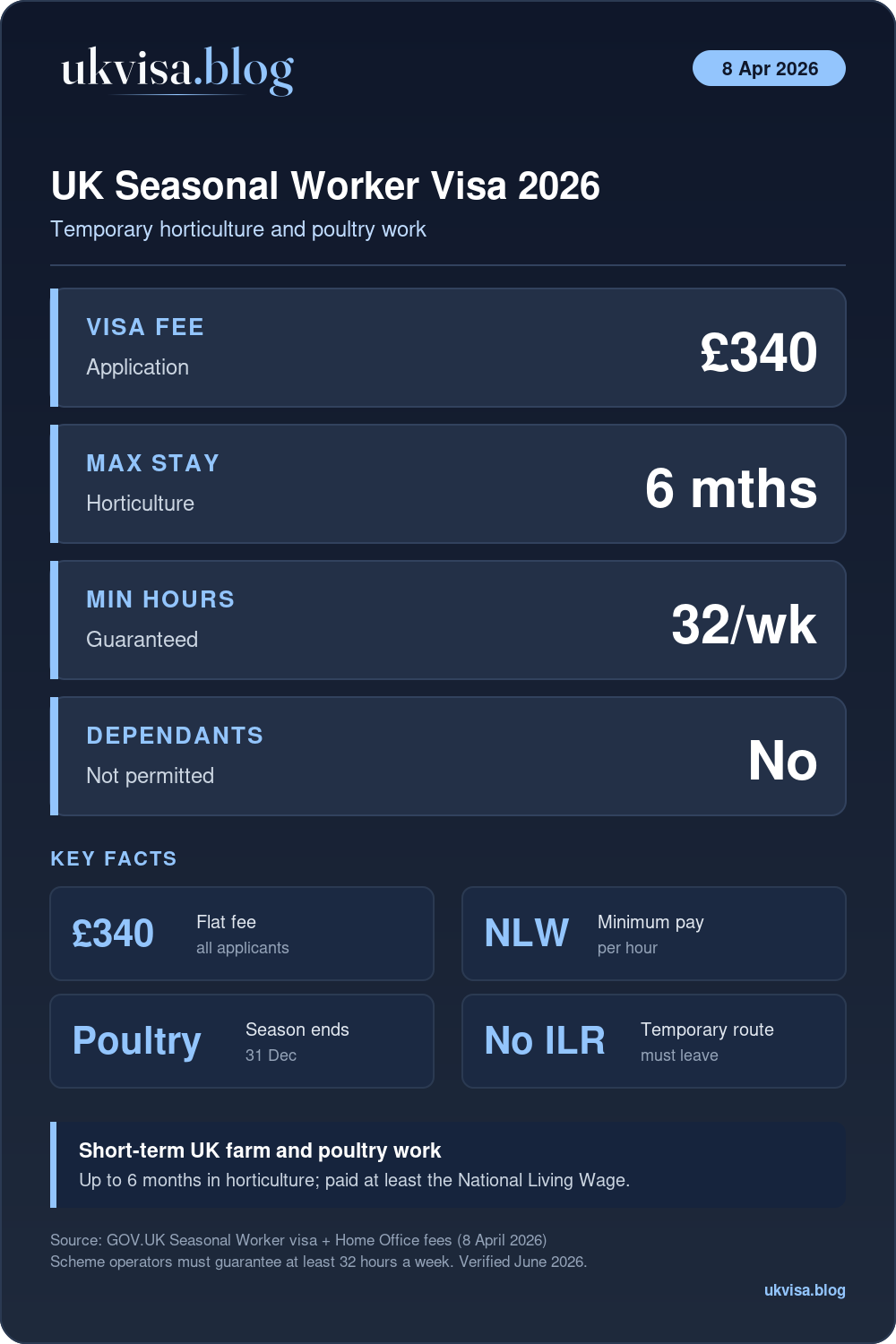
The Seasonal Worker visa brings people to the UK for horticulture for up to six months, and for poultry work in the autumn window. It costs £340, allows no family, no second job and no permanent post — and a four-month cooling-off period governs when a returning worker can come back.

UK Work Visas
Seasonal Worker Visa UK 2026: Sectors, Windows and Conditions
What the Seasonal Worker Visa Is
A sponsored route for seasonal work in horticulture, for up to six months, and in poultry production during a fixed autumn window. You need a certificate of sponsorship reference number from an approved scheme operator, £1,270 in savings, and to be 18 or over. The fee is £340 and decisions usually take about three weeks. No dependants, no second job, and no permanent employment.
The route sits in the Temporary Work family and is the most tightly drawn of them. Everything about it — the sectors, the calendar, the ban on family and second jobs — is designed around temporary agricultural labour, and none of it flexes for individual circumstances.
Which Work Counts as Seasonal
Horticulture is a closed list rather than a general idea of farming. The caseworker guidance defines it as growing protected vegetables in glasshouse systems; field vegetables grown outdoors, including herbs, leafy salads and potatoes; soft fruit; top or orchard fruit; vines and bines, such as grapes and hops; mushrooms; bulbs and cut flowers; pot plants; hardy ornamental nursery stock, including Christmas trees; and tree and forest nurseries.
Work outside those categories is not horticulture for these purposes, however agricultural it looks. Livestock, general farm labouring and food processing are not on the list, and poultry is dealt with separately with its own dates.
Quota and Timing
Places on this route are allocated annually and distributed through approved scheme operators rather than issued on demand, which is why a job offer depends on an operator having capacity as much as on a grower needing workers. The allocation for any given year is set by government and is not something an applicant can influence — the operator either has a place or does not.
The calendar constrains it further. Horticulture applications can be made at any time of year. Poultry applications must be made by 15 November each year, and the work itself runs from 2 October to 31 December in the same year.
The Seasonal Worker route page states that poultry work runs from 2 October to 31 December. The sponsorship guidance for employers describes the poultry season as running from 18 October to 31 December. Both are current GOV.UK pages, and the difference is two and a half weeks of work at the front of the season. Growers and workers planning arrival dates around early October should confirm the position with their scheme operator before travel is booked, and take advice if a certificate of sponsorship has already been assigned for a start date in that gap.
Scheme Operators
Your sponsor is not the farm. It is an approved scheme operator holding a Temporary Worker licence, which recruits workers, assigns certificates of sponsorship and places them with growers. Operators appear on the public register of licensed sponsors, and checking that an organisation is actually on it is the single most useful protection against recruitment fraud on this route.
Because the operator sponsors you, it carries the sponsor duties — reporting, record-keeping, cooperation with compliance visits — set out in our sponsorship guide. Fees charged to workers for finding them work are a compliance issue for the operator, not a normal cost of the route.
What the Certificate Actually Is
The certificate of sponsorship is a reference number, not a document. Your operator gives it to you and you enter it on the application form. It can be used once, and it is valid for three months from the date it is assigned — so a number issued early in the year for late-season work will have expired by the time it is needed.
Eligibility
- Age: 18 or over on the date of application.
- Certificate of sponsorship: a reference number from an approved scheme operator, usable once and valid for three months from assignment.
- Money: £1,270 held for 28 consecutive days, unless exempt.
- Lawful employment: the job must pay at least the minimum wage and follow the working time rules — a failure on either refuses the application.
- Cooling-off: no Seasonal Worker permission in the four months before applying, unless you were outside the UK throughout.
- Timing: apply up to three months before the start date; you can enter up to 14 days before it.
Duration and the Four-Month Cooling-Off Period
Horticulture permission runs for up to six months. Poultry permission runs within the autumn window only. Neither can be extended into the other, and neither leads to settlement.
The cooling-off rule is what shapes returning workers' plans. An applicant for entry clearance must not have held Seasonal Worker permission at any time in the four months immediately before the date of application, unless they can show they were not in the UK at any point during those four months. Because it bites on the application date rather than the start date, a worker who leaves at the end of one season and applies too early for the next is refused even though the work itself is months away.
Pay and Conditions
Your employer must pay at least the national minimum wage and comply with the working time rules. That is not a formality on this route: the caseworker guidance treats non-compliance as a refusal ground for the visa, and it is also the sort of failing that costs an operator its licence.
Accommodation, transport deductions and hours are where problems surface. Deductions that pull effective pay below the minimum wage are unlawful whatever the contract says, and workers who find themselves in that position should keep records of hours, payslips and deductions from the first week rather than the last.
How to Apply
Apply online up to three months before your start date, using the reference number from your operator — the process is in our application form guide and the evidence in our document checklist. Decisions usually take about three weeks, and paid faster services may be available. Some roles also require a criminal record certificate.
Returning for a Second Season
Many workers come back year after year, and the mechanics reward planning. Leave the UK promptly at the end of a season, keep evidence of the departure date, and count four clear months before the next application is submitted. Where an operator wants an early application for a spring start, that four-month bar is the constraint to raise with them rather than to discover at refusal.
Cost
£340 for the application. You must also show £1,270 in savings held for 28 consecutive days. Because horticulture permission is six months or less, the health surcharge position differs from the longer routes — check what is payable before submitting. Comparisons across the work routes are in our fee table.
What You Cannot Do
You work in the job described on your certificate of sponsorship and nothing else. You cannot take a permanent job, work a second job or any job not described on the certificate, claim public funds, or bring family members with you. Study is permitted, with an Academic Technology Approval Scheme certificate for some courses.
The no-dependants rule is absolute here, unlike the rest of the temporary family. Workers looking for a route that allows family need a different category — the Youth Mobility Scheme for eligible nationalities, or Skilled Worker for a sponsored permanent role.
Study Alongside the Season
Study is permitted on this route, which surprises people given how tightly everything else is drawn. In practice a six-month horticulture season leaves little room for it, and some courses require an Academic Technology Approval Scheme certificate obtained before enrolment. The sponsored work remains the reason for the permission.
Where Applications Fail
Three causes dominate: the cooling-off period, a certificate that has expired or already been used, and money not held for the full 28 days. Employer non-compliance with the minimum wage or working time rules is a fourth, and it is outside the applicant's control entirely.
A refusal on this route is normally challenged through administrative review rather than appeal, and a refusal involving deception has consequences that outlast the season — see our re-entry ban guide. Workers offered a job by anyone who is not on the sponsor register should treat that as the warning it is. Adjacent temporary routes include Creative Worker.
Sources: GOV.UK Seasonal Worker route page on GOV.UK; the employer sponsorship pages on GOV.UK; register of licensed sponsors; and the Home Office Temporary Work caseworker guidance version 38.0. Figures verified 22 August 2026.
Frequently Asked
Questions about the Seasonal Worker Visa
Up to six months for horticulture work. Poultry work runs within a fixed autumn window rather than for a set number of months. You can enter the UK up to 14 days before the start date on your certificate of sponsorship. Neither type of permission can be extended, and neither counts towards settlement.
Applications must be made by 15 November each year. The Seasonal Worker route page gives the working period as 2 October to 31 December, while the employer sponsorship guidance describes the season as starting on 18 October. Confirm your start date with your scheme operator before booking travel, since the two pages differ by more than two weeks.
Four months. You cannot be granted entry clearance if you held Seasonal Worker permission at any time in the four months before your application, unless you can show you were outside the UK throughout that period. It is measured to the date you apply, not the date work starts, which catches workers applying early for the next season.
Protected and field vegetables, soft fruit, top or orchard fruit, vines and bines, mushrooms, bulbs and cut flowers, pot plants, hardy ornamental nursery stock including Christmas trees, and tree and forest nurseries. Livestock work, general farm labouring and food processing are not horticulture for this route, and poultry is treated separately with its own dates.
No. Unlike the other Temporary Work routes, the Seasonal Worker visa does not permit dependants at all. Workers who need a route that allows family have to look elsewhere — the Youth Mobility Scheme for eligible nationalities, or a sponsored role on the Skilled Worker route where the position is permanent.
An approved scheme operator, not the farm you work on. The operator holds the Temporary Worker licence, assigns your certificate of sponsorship and places you with growers. Check the organisation appears on the public register of licensed sponsors before paying anything or travelling — that check is the best protection against recruitment fraud on this route.
No. You may only do the job described on your certificate of sponsorship. Second jobs, permanent employment and any work not on the certificate are all prohibited, as are public funds. Study is allowed, and some courses require an Academic Technology Approval Scheme certificate before they can be started.
Your employer must pay at least the national minimum wage and follow the working time rules, and a failure on either is a ground for refusing the visa in the first place. Deductions for accommodation or transport that pull effective pay below the minimum are unlawful whatever the contract says. Keep hours, payslips and deduction records from the first week.