
The adult dependent relative visa brings an elderly parent or relative to the UK permanently — settlement from the day they arrive. It is also the hardest family route to win, because you must prove the care they need cannot be bought where they live, even with your money.
UK Family Visas
Understanding the Adult Dependent Relative Visa UK
What Is the Adult Dependent Relative Visa?
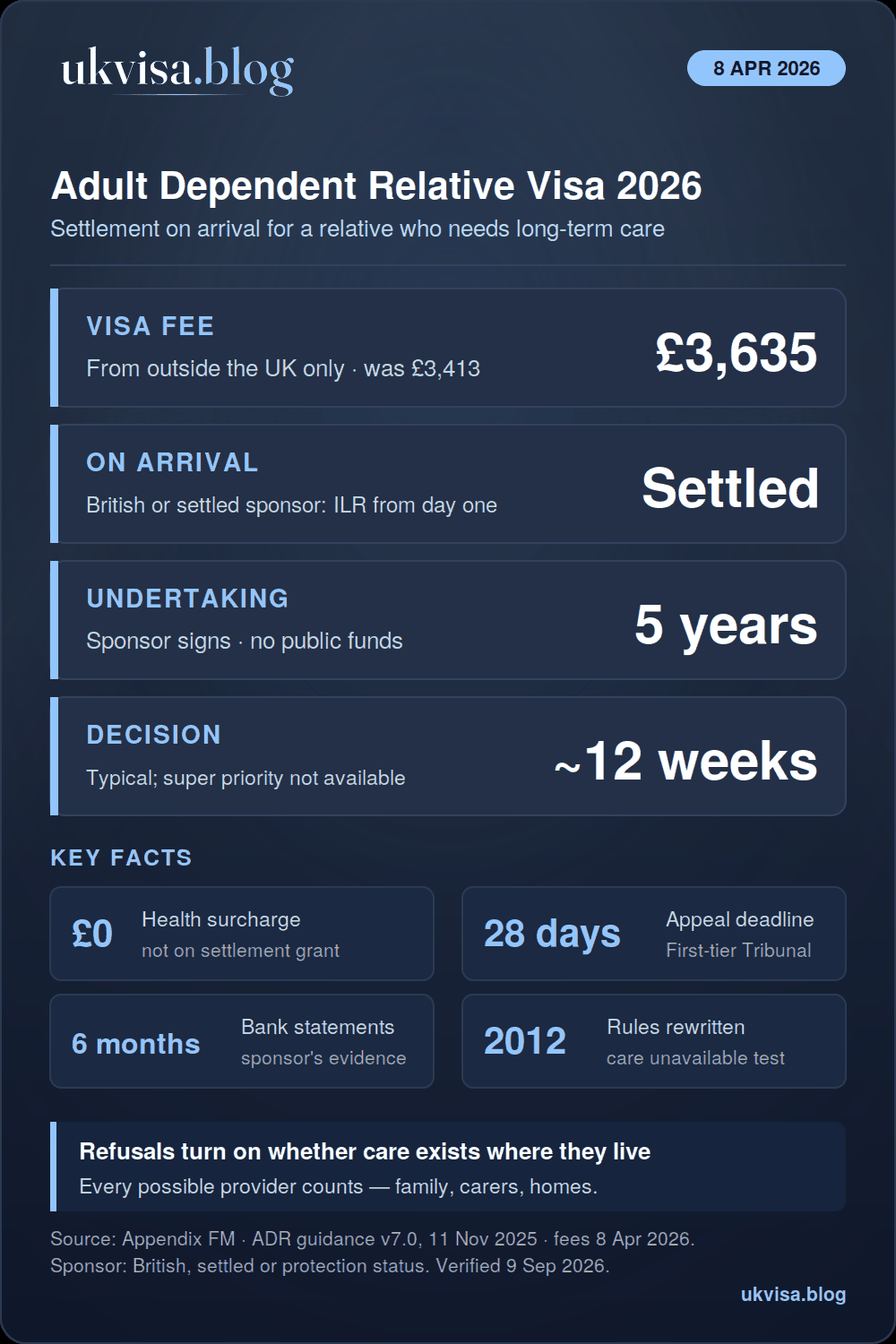
A settlement route under Appendix FM for a parent, grandparent, adult child or sibling who needs long-term personal care because of age, illness or disability, and cannot obtain that care where they live. Where the sponsor is British or settled, a successful applicant is granted indefinite leave to enter on arrival. The application must be made from outside the UK and costs £3,635.
Unlike every other family route, this one does not begin with limited permission. It ends where the partner route arrives after five years: indefinite leave from day one. That is why the evidential standard is set where it is.
Who Counts as a Dependent Relative
A parent, a grandparent, a brother or sister aged 18 or over, or a son or daughter aged 18 or over. The sponsor must be a British citizen, a settled person, someone with refugee status or humanitarian protection, or an EEA or Swiss national with pre-settled status under the EU Settlement Scheme.
The sponsor's status also determines what is granted. A British or settled sponsor produces settlement on arrival. A sponsor with limited permission produces permission aligned to theirs, with settlement following later when the sponsor's own status becomes settled.
The 2012 Rules Are the Whole Story
Before July 2012 this route was materially easier. The rules were rewritten with the express aim of reducing grants, and the current test — care unavailable or unaffordable even with the sponsor's help — is the mechanism. Everything difficult about an ADR application follows from that single change.
Adult Dependent Relative Requirements
The guidance on adult dependent relatives, version 7.0 of 11 November 2025, sets out what each limb requires. Every one must be satisfied; there is no balancing between them.
The Requirements and What Proves Them
| Requirement | What must be shown |
|---|---|
| Long-term personal care | Medical evidence that age, illness or disability prevents everyday tasks — washing, dressing, cooking |
| Care unavailable | Evidence from health authorities or professionals that no provider can reasonably supply it |
| Or care unaffordable | Records of what care has cost and why that support cannot continue |
| UK provision | The sponsor can maintain, accommodate and care for the applicant without public funds |
| Undertaking | A signed sponsorship undertaking covering five years from arrival |
| Health | A TB certificate where the applicant applies from a listed country |
Source: Appendix FM; adult dependent relatives guidance version 7.0, 11 November 2025.
The Care Test Considers Every Possible Provider
Not just professional care. The Home Office asks whether close family, extended family, friends, neighbours, home help, housekeepers, nurses, professional carers or a residential home could reasonably provide what is needed. If any of them could, the application fails — however strongly the family would prefer to provide the care here.
The requirement to maintain the relative in the UK without public funds and the requirement to show care abroad is unaffordable pull in opposite directions. A sponsor who demonstrates the means to support a parent here invites the conclusion that the same means could fund care where the parent lives. The two evidential strands have to be built together, with the local cost and the local unavailability documented, not asserted.
The Five-Year Undertaking
The sponsor signs a legally binding undertaking guaranteeing no recourse to public funds for five years from the applicant's arrival. Supporting it takes six months of bank statements, income documentation, proof of the accommodation, and a costed plan for the care that will actually be provided in the UK.
Why Most Applications Fail
Refusals rarely turn on whether the relative needs care. They turn on the second limb — whether the care could be obtained where they live. Our guide to UK visa refusal reasons covers the general grounds, but this route's pattern is narrow and specific.
- Care is available locally: the officer identifies a provider — family, a carer, a home — that could reasonably meet the need.
- The sponsor could fund it abroad: the means shown for UK maintenance are read as means to pay for care where the relative lives.
- Medical evidence too thin: a letter confirming a condition rather than a report setting out care needs and prognosis.
- Other relatives nearby: siblings or family in the same country who are not shown to be unable to help.
- No evidence on cost: unaffordability asserted without local prices, income and expenditure to test it against.
Appeals Are Where Article 8 Comes In
A refusal engages Article 8, so an appeal to the First-tier Tribunal is available — 28 days from an overseas refusal. The tribunal can weigh human rights arguments alongside the rules, which gives an ADR case more room on appeal than it had in the application. Our immigration appeal guide covers the procedure.
Bear in mind what the guidance on the exceptional-circumstances test says about the reach of Article 8: relationships between adult children and their parents are not automatically protected family life. Dependency beyond normal emotional ties has to be shown, and on this route the medical evidence is what shows it. Our guide to reapplying after refusal covers the alternative.
Fees and Processing
The fee is among the highest of any UK visa and is not refunded on refusal. Budget separately for the evidence, which on this route does most of the work: specialist medical reports and expert evidence on local care provision are effectively required, and neither is cheap.
ADR Costs from 8 April 2026
| Charge | Amount | Notes |
|---|---|---|
| Application, settled sponsor | £3,635 | Was £3,413; non-refundable |
| Application, protection-status sponsor | Reduced fee | Check the current fee table before paying |
| Health surcharge | £1,035 a year | Applies to limited-leave grants only, not to settlement on arrival |
| Super priority service | Not available | The adult dependent relative route is excluded |
Source: Home Office immigration and nationality fees, 8 April 2026.
Decisions typically take around 12 weeks, and complex medical or human rights material extends that. Wider fee context sits in our Home Office fees guide.
How to Apply
From outside the UK only. There is no switching into this route from within the country, whatever the circumstances of the relative's presence here. Our guide to the UK visa application form covers the mechanics.
- Medical evidence first: specialist reports on the condition, the care required and the prognosis.
- Care availability: evidence from health authorities or professionals in the relative's country, and an account of why any earlier private arrangement ended.
- Cost evidence: what care actually costs locally, and why it cannot be sustained.
- Relationship: birth and marriage certificates establishing the family connection — see our guide to the relationship evidence standard.
- Sponsor's position: six months of bank statements, income evidence, accommodation, and the planned care arrangements with their costs.
- Undertaking: the signed five-year sponsorship undertaking.
Alternatives to the ADR Route
None of these settles a relative in the UK, and it is better to be clear about that than to treat them as a stepping stone. Each meets a different practical need while the family considers whether an ADR application is realistic.
- Standard visitor visa: up to six months a visit — see our standard visitor visa guide.
- Long-term visitor visa: two, five or ten years of multiple entries, still six months maximum per visit — our long-term visitor visa guide covers it.
- Private medical treatment: for treatment paid for privately in the UK — see our UK medical visa guide.
- Article 8 application from inside the UK: possible where the relative is already here, and equally difficult.
The Limits of the Visitor Route
Visitors cannot use the NHS beyond emergency care, cannot claim public funds, and cannot treat the UK as their main home. A pattern of long, frequent visits attracts scrutiny precisely because it looks like residence, and refusal on a later visit is far more damaging than a refused ADR application.
Where the wider family's settlement planning is in play, our guides to the partner route to settlement and, where abuse is a factor, to settlement under the domestic abuse provisions may be relevant.
Sources: the adult dependent relative pages on GOV.UK; Appendix FM of the Immigration Rules; Home Office guidance on adult dependent relatives, version 7.0 of 11 November 2025; and the fee table of 8 April 2026. Figures verified 22 August 2026.
Frequently Asked
Questions about the Adult Dependent Relative Visa
A settlement route under Appendix FM for a parent, grandparent, adult child or sibling who needs long-term personal care because of age, illness or disability and cannot obtain it where they live. Where the sponsor is British or settled, a successful applicant receives indefinite leave to enter on arrival rather than limited permission.
Because of the second limb. It is not enough to need care — the care must be unavailable or unaffordable where the relative lives, even with the sponsor's financial help. The Home Office considers every possible provider, from close family and neighbours to home help and residential homes. The 2012 rewrite of the rules was intended to have exactly this effect.
£3,635 from 8 April 2026, up from £3,413, and not refunded if the application is refused. A reduced fee applies where the sponsor holds refugee status or humanitarian protection — check the current fee table. The health surcharge is payable only where limited leave is granted, not where settlement is given on arrival.
Around 12 weeks is typical, and cases with substantial medical or human rights material take longer. Super priority service is not available on this route — GOV.UK's fee information excludes the adult dependent relative route from it — so there is no way to buy a faster decision in the way other family applications can.
No. The route is available only from outside the UK, and there is no switching into it from within the country. A relative already here — on a visitor visa, for example — would have to apply on human rights grounds under Article 8 instead, which faces the same questions about care needs and care availability.
Evidence of the ability to maintain, accommodate and care for the relative without public funds — six months of bank statements, income documentation, proof of the accommodation, and a costed plan for the care to be provided here. The sponsor must also sign a legally binding undertaking covering five years from the relative's arrival.
You can appeal to the First-tier Tribunal within 28 days of an overseas refusal, and this is where Article 8 arguments can be developed alongside the rules. A fresh application is the alternative, at the full fee again. Address the specific finding about care availability, because that is almost always what the refusal turns on.
Yes. A standard visitor visa allows up to six months a visit, and long-term visitor visas allow multiple entries over two, five or ten years with the same six-month limit each time. Visitors cannot use the NHS beyond emergency care, claim public funds, or make the UK their main home, and a pattern resembling residence attracts refusal.
Where the sponsor is a British citizen or settled, indefinite leave to enter — settlement from the day of arrival, with no health surcharge and no further application. Where the sponsor holds refugee status, humanitarian protection or pre-settled status, permission is aligned to the sponsor's, and settlement follows once the sponsor's own status becomes settled.