
The Marriage Visitor visa is for people marrying or forming a civil partnership in the UK and then leaving. It is not a step towards settlement, cannot be extended and cannot be switched. Two rules catch people out: your partner’s name goes on the permission, and non-visa nationals cannot simply arrive and marry.
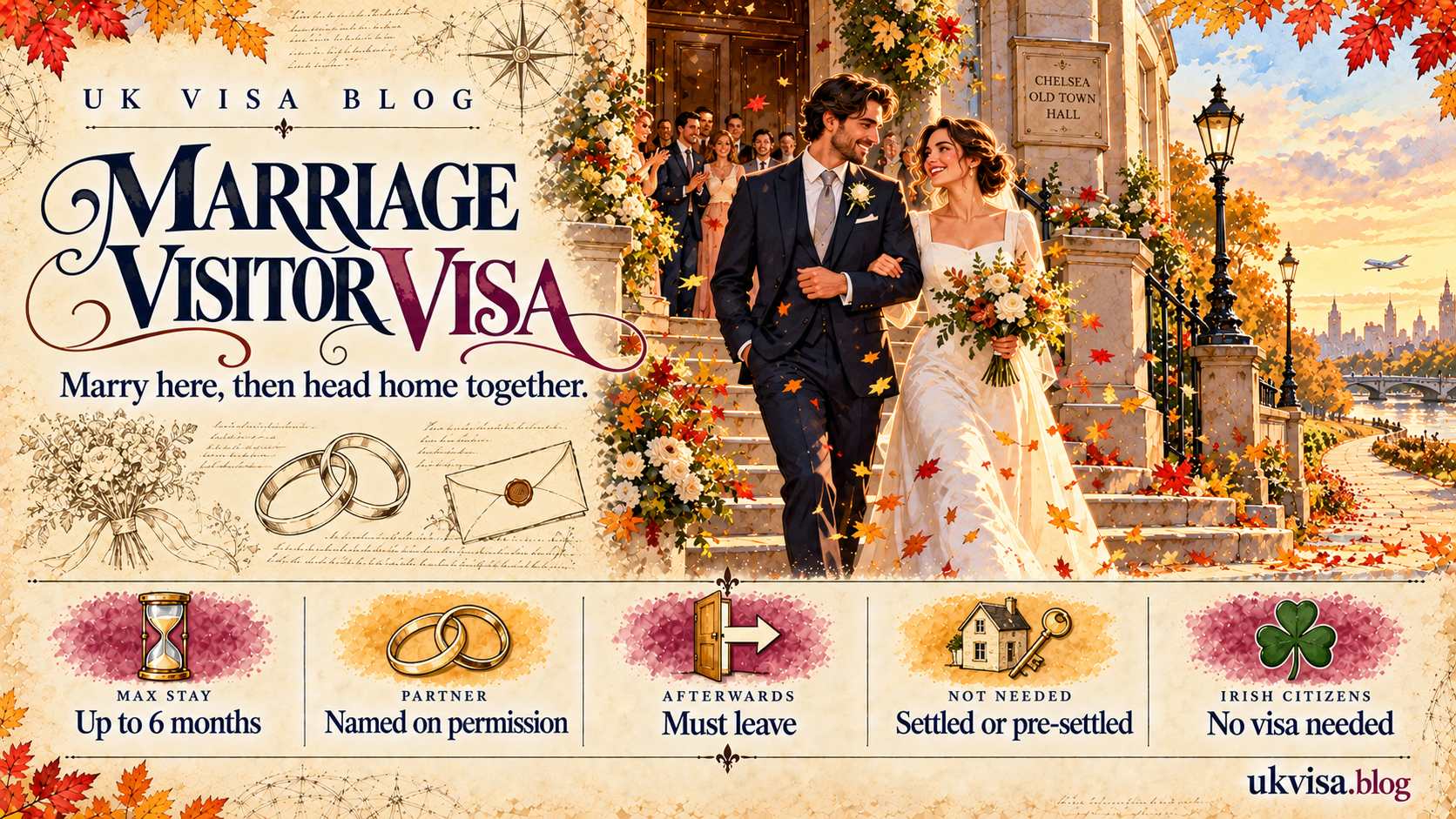
Marriage Visits
Marrying in the UK on a Marriage Visitor Visa in 2026
What the Route Covers
You need this visa if you are coming to marry, register a civil partnership, or give notice of either, and you will leave the UK afterwards. It costs £135 and permits a stay of up to six months. The ceremony must take place at a venue licensed for the purpose.
A Marriage Visitor visa costs £135, allows six months, and requires you to leave afterwards. Your fiancé or partner’s name is recorded on the permission. You do not need it if you hold settled or pre-settled status, have a pending EU Settlement Scheme application, or are an Irish citizen — and you cannot apply if you qualify for British citizenship.
When a Standard Visitor Visa Is the Right One Instead
- Converting a civil partnership to a marriage: a Standard Visitor visa covers it. The conversion is only possible where the partnership took place under the laws of England and Wales, or Scotland.
- A ceremony not recognised under UK law: a religious ceremony with no legal effect is a standard visit, not a marriage visit.
- Already holding an ordinary visit visa: that does not help. Anyone with a visit visa who now wants to marry must hold a Marriage or Civil Partnership visit visa specifically — the only exception being a civil partnership conversion.
Guidance is unambiguous: non-visa nationals seeking entry to marry, form a civil partnership, or give notice of either, who do not hold a Marriage or Civil Partnership visit visa, must be refused entry. Travelling visa-free and planning to sort the paperwork at a register office is not an option.
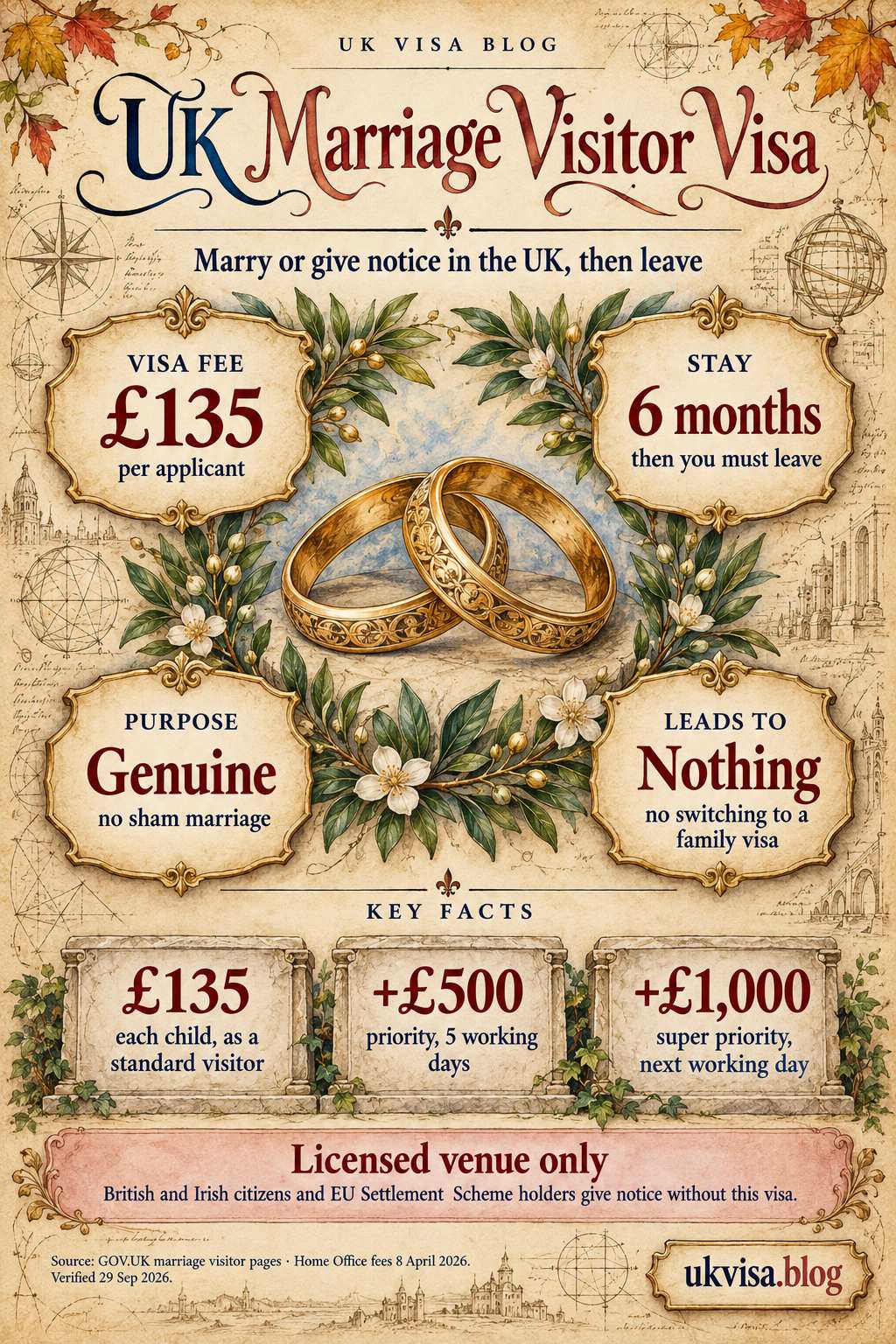
How Marrying in the UK Works
- Book the venue: a register office or a venue licensed for marriages or civil partnerships.
- Provisionally book to give notice: at the register office for the district you will be staying in.
- Apply for the visa: naming your partner and enclosing the booking evidence.
- Travel and give notice: after establishing the required residence in the district.
- Marry, then leave: within the six months your permission allows.
Civil and Religious Ceremonies
A civil ceremony at a register office or licensed venue is legally binding. A religious ceremony is legally binding only where the building is registered for marriages and an authorised person or registrar is present — Church of England weddings follow their own preliminaries. Where a ceremony has no legal effect in UK law, the marriage visa is not required.
What You Must Show
- Aged 18 or over: both parties.
- Free to marry: with a decree absolute or a death certificate where you were married before.
- A genuine relationship: evidenced, not asserted.
- Arrangements in place: to give notice, marry or form a civil partnership within six months of arrival.
- Intention to leave: and not to live here through frequent or successive visits.
- Funds: for the visit and the return journey, your own or a declared sponsor’s.
The Evidence That Matters Most
Guidance names it precisely. If you are coming to give notice, provide confirmation of a provisional advance booking to do so — an appointment card or email. If you are coming to marry, provide evidence the ceremony is arranged: a church or register office booking confirmation, or a receipt for payment to the venue. Vague intentions do not meet this.
How a Sham Marriage Is Assessed
Caseworkers consider the arrangements for the ceremony, the couple’s relationship, their future plans and their living arrangements, and must be satisfied the relationship is genuine. Where it is more likely than not that the applicant is or has been involved in a sham marriage, the application is refused under the suitability rules, with the reasons stated.
Practically, that means evidence of the relationship over time — communication, visits, photographs of you together over the relationship’s history, and any shared commitments — alongside the ceremony bookings. Documents are covered in our supporting documents guide; where someone funds your trip, see our page on sponsoring a visitor.
Giving Notice
Notice must be given at a register office before any marriage or civil partnership can take place. In England and Wales it must be given in person. In Scotland and Northern Ireland it can be given by post, which changes the practical timing considerably.
The Timing Rules in England and Wales
- Seven days’ residence: you must have lived in the registration district for the past seven days before giving notice.
- Twenty-nine days before the ceremony: notice must be given at least that far in advance. Notice on 1 May permits a ceremony from 30 May.
- Valid for twelve months: the ceremony must take place within twelve months of giving notice.
- Both parties give notice: each in the district where they have been living.
This is why six months is not as generous as it sounds. Seven days establishing residence, then twenty-nine days from notice, means roughly five weeks before the earliest possible ceremony date — and that assumes an available appointment. Book the notice appointment before applying for the visa, and use that booking as evidence.
Who Counts as a Relevant National
The visa requirement applies to all visitors who are not relevant nationals. Section 62 of the Immigration Act 2014 defines a relevant national as a British citizen, an Irish citizen, a person with settled or pre-settled status under the EU Settlement Scheme, or a person awaiting a decision on an EUSS application submitted before 1 July 2021.
This is about your own status, not your partner’s. Marrying a British citizen does not exempt you from needing the visa. If you are yourself a relevant national you do not need it — and if you are entitled to British citizenship you should apply for that rather than for a visa.
Applying
Apply online from outside the UK, no earlier than three months before you travel, then attend a visa application centre for biometrics. Our application form walkthrough covers the free-text fields. Documents not in English or Welsh need a certified translation.
Your partner applies separately and pays their own fee if they also need a visa. Children travel as standard visitors and need their own applications. You can complete an application on behalf of a partner or child who cannot do it themselves, but each must attend their own biometrics appointment.
Your Partner’s Name Goes on the Permission
Guidance requires the name of the fiancé, fiancée or civil partner to be included on the visitor permission. That has a practical consequence: the visa is issued for marrying a named person. It is not a general licence to marry in the UK, and a change of partner means a new application rather than a change of plan.
Cost and Processing
Marriage Visitor Costs from 8 April 2026
| Item | Fee | Notes |
|---|---|---|
| Marriage Visitor visa | £135 | Per applicant, up to 6 months |
| Partner’s visa | £135 | Separate application where also required |
| Children as standard visitors | £135 | Each, applied for separately |
| Priority service | £500 extra | Five working day target |
| Super priority service | £1,000 extra | Next working day target |
Source: Home Office visa fees table, checked 22 August 2026.
Decisions usually take around three weeks after biometrics. Ceremony dates are fixed and visas are not, so build in margin — see our pages on timelines after biometrics, priority services and delays. Costs are listed on our visitor visa fees.
Marriage Visitor, Fiancé or Spouse?
The choice turns on one question: are you staying afterwards? The marriage visitor route is for couples who will not. Choosing it because it is cheaper and faster, intending to remain, is a misrepresentation that undermines every later application.
- Marry here, then leave: the Marriage Visitor visa at £135.
- Marry here, then settle: the fiancé visa, which permits six months to marry and then a switch in-country.
- Already married, coming to live here: the spouse route, with its financial requirement.
- Circumstances that fit none of these: see our page on exceptional circumstances in family cases.
What the Visa Does and Does Not Allow
- You can: marry or form a civil partnership within six months, at a licensed venue.
- You can: transit the UK on the way to another country.
- You cannot: work, beyond permitted activities connected to employment overseas such as attending meetings.
- You cannot: study, access public funds, or bring dependants on your application.
- You cannot: extend the visa or switch to another route from inside the UK.
- You cannot: live here for extended periods through frequent visits.
The bar on switching is absolute in practice — see our page on switching from a visit visa, and on visit extensions for the narrow cases where more time is possible. Marry, then leave and apply from abroad on the correct route.
Sources: the GOV UK marriage visitor pages, the GOV UK guidance on giving notice of a marriage or civil partnership, and the Home Office visit caseworker guidance version 17.0 published 25 February 2026. Figures verified 22 August 2026.
Frequently Asked
Marriage Visitor Visa Questions
How much does a Marriage Visitor visa cost in 2026?
£135 per applicant from 8 April 2026, the same as a standard six-month visit. Your partner and any children apply and pay separately if they also need visas.
Can I get married in the UK on a tourist visa?
No. Anyone holding an ordinary visit visa who wants to marry or give notice must hold a Marriage or Civil Partnership visit visa specifically. The only exception is converting an existing civil partnership to a marriage.
I do not need a visa to visit the UK. Can I marry without one?
No. Non-visa nationals arriving to marry, form a civil partnership or give notice without a Marriage or Civil Partnership visit visa must be refused entry.
How long before the wedding must I give notice?
At least twenty-nine days in England and Wales, and you must have lived in the registration district for the previous seven days. The notice is valid for twelve months.
Do I need this visa to convert my civil partnership to a marriage?
No, a Standard Visitor visa covers it. Bring the original civil partnership certificate. Conversion is only possible where the partnership took place under the laws of England and Wales, or Scotland.
Can I stay after the wedding?
Only for the remainder of your six months, and then you must leave. The visa cannot be extended or switched. To settle, apply for the spouse route from outside the UK.
Does my partner’s name appear on the visa?
Yes. Guidance requires the fiancé, fiancée or civil partner’s name to be included on the visitor permission. The visa is issued for marrying that named person.
What if I have settled status or am an Irish citizen?
You do not need this visa. That covers settled and pre-settled status under the EU Settlement Scheme, a pending EUSS application, and Irish citizens. Anyone entitled to British citizenship should apply for that instead.
What evidence proves the wedding is real?
A venue or register office booking confirmation, or a receipt for payment towards the ceremony, plus evidence of the relationship over time. Caseworkers assess the arrangements, the relationship, future plans and living arrangements together.
What happens if my application is refused?
There is no right of appeal against a visit refusal. A fresh application addressing the refusal notice is the route — see our pages on refusal grounds and success rates.