
Further leave to remain is any extension applied for from inside the UK. Which application you make is decided by the basis of your claim, not by the visa you currently hold — and choosing wrongly can make the application invalid rather than merely misdirected, with the fee not refunded.
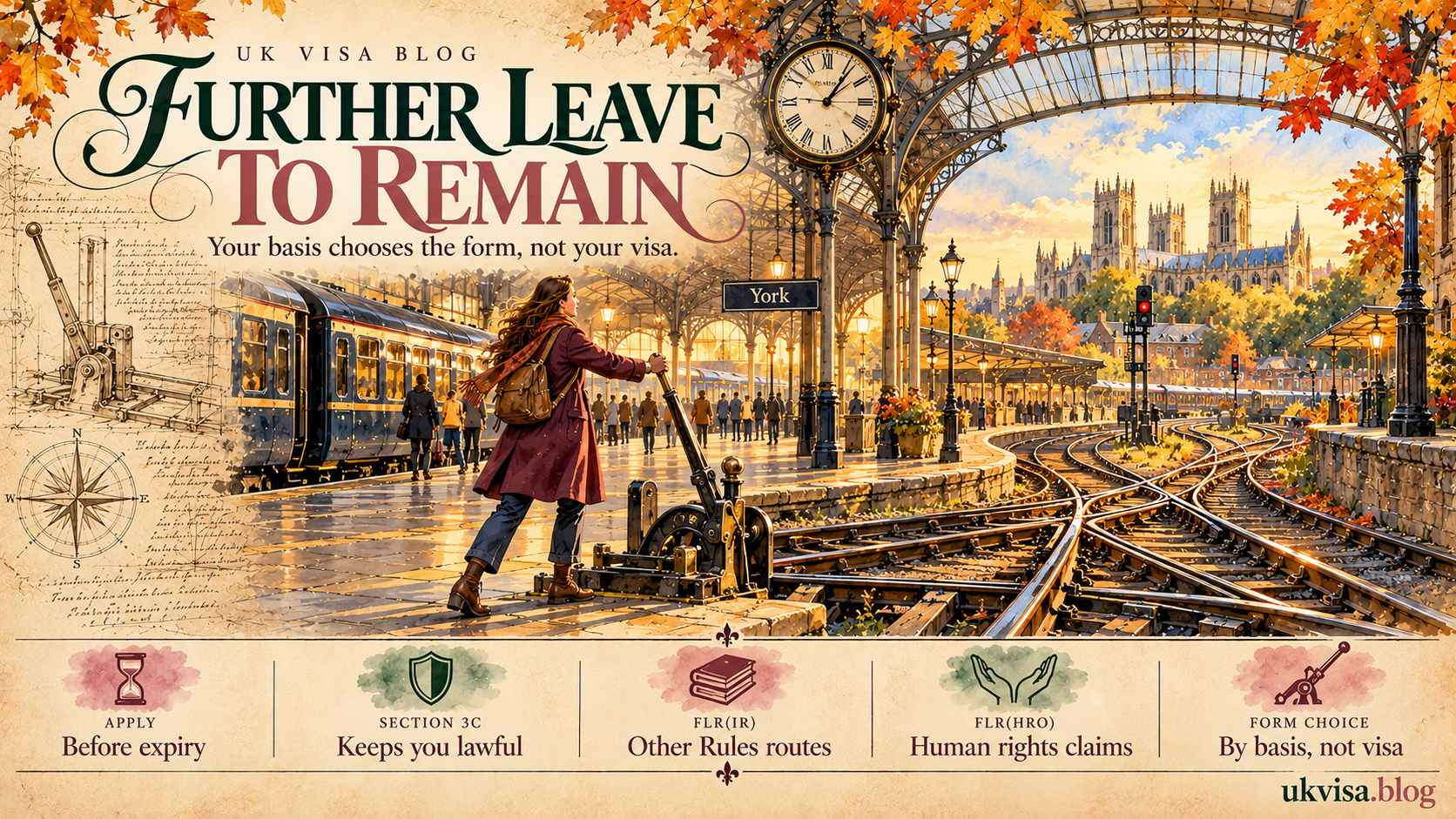
FLR Applications
Further Leave to Remain: Choosing the Right Application
What Further Leave to Remain Means
The phrase covers every in-country application to stay longer, whatever route you are on. It is worth separating from two things it is often confused with: entry clearance, which is applied for from abroad, and settlement, which ends the need to extend at all.
It is an application to vary the permission you already hold — to extend it, or to change its basis — made from inside the UK. The points-based routes have their own online journeys. The FLR forms cover what sits outside them: family life, private life, human rights, and a set of other routes.
Apply before your current permission expires and section 3C keeps you lawfully here on the same conditions until the decision. FLR(IR) covers other routes under the Immigration Rules, including visitors, UK Ancestry, domestic workers, parents of child students, dependant joiners and representatives of overseas businesses. FLR(HRO) covers human rights claims, leave outside the rules and routes no other form covers.
The Basis, Not the Visa
This is the point people get wrong. Someone currently on a work visa applying on the basis of family life uses the family application, not the work one. Someone on a family visa applying on human rights grounds outside the rules uses the human rights application. What you hold now is history; what you are claiming decides the form.

The Forms and What They Cover
Choosing by Basis of Application
| Your basis | Application |
|---|---|
| Partner, parent or child under the family rules | The family life application |
| Private life in the UK | The family and private life application |
| A human rights claim, or leave outside the rules | FLR(HRO) |
| Other routes under the Immigration Rules | FLR(IR) |
| A points-based work or study route | That route’s own online application |
Source: GOV.UK application form guidance. Checked 22 August 2026.
An application made on a form that does not cover your basis is not simply redirected. It can be treated as invalid, which means it never existed for section 3C purposes — so the protection you thought you had was never there. The fee is not refunded, and by the time you find out your permission has usually expired.
FLR(IR): Other Routes Under the Rules
FLR(IR) is the application to extend your stay for other routes under the Immigration Rules — the catch-all for categories that do not have their own journey. GOV.UK lists the categories it covers.
- Visitors: in the narrow cases where a visit can be extended.
- UK Ancestry: extensions on that route.
- Domestic workers: in a private household.
- Parents of child students: see our page on the parent of a child student route.
- Dependants joining a main applicant: in defined circumstances.
- Representatives of overseas businesses.
- Armed forces categories: including relevant civilian employees and certain dependants.
- S2 Healthcare Visitors.
Family Life Applications
This is the application for partners, parents and children applying under Appendix FM — the five-year route to settlement. It carries the financial requirement, the accommodation requirement and the English requirement at A2 for extension, rising to B1 at settlement and to B2 from 26 March 2027.
In-country partner applications meeting the income and English requirements are published at eight weeks. See our pages on the spouse route, extensions and the financial requirement.
Family and Private Life Applications
The private life route is for people whose claim rests on their life established in the UK rather than on meeting the family rules — length of residence, integration, and the position of children. It is the ten-year route rather than the five-year one.
These are the slowest in-country applications by a wide margin: partner applications on a private life basis, and parent applications, are published at twelve months. See our page on the private life route.
FLR(HRO): Human Rights and Leave Outside the Rules
FLR(HRO) covers human rights claims, leave outside the rules, and other routes not covered by other forms. It is the application for cases the Rules do not accommodate, where the argument is that refusing would breach a Convention right or that exceptional circumstances justify a grant.
It is also the route on which fee waivers most often arise, because it is the human rights context in which affordability is assessed. See our page on human rights applications.
Five-Year Route or Ten-Year Route
The choice between the family life and private life applications is not cosmetic. Appendix FM leads to settlement in five years; the private life route takes ten. Someone who could meet the family rules but applies on private life grounds doubles their route to settlement and pays for an extra round of extensions on the way.
Where the financial requirement cannot be met, the ten-year route may be the only realistic option — but it should be a decision made deliberately rather than by default. Take advice where the position is marginal, because switching between the two later is not straightforward and the years already spent do not transfer.
Exceptional Circumstances Inside the Family Rules
Appendix FM contains its own provision for cases where refusal would breach human rights, which is a different thing from applying outside the rules altogether. Identifying which you are relying on shapes both the application you make and the evidence it needs — see our page on exceptional circumstances in family cases.
What Every Application Needs
- An in-time application: made before your current permission expires.
- Valid identity documents: and biometrics enrolled or verified through the app.
- The fee and health surcharge: paid in full, for the correct period.
- Suitability: criminality, deception and immigration breaches all apply.
- The route’s own requirements: financial, relationship, accommodation or English as applicable.
- Consistent evidence: figures and dates matching across the form and the documents.
Dependants Apply Alongside You
A partner or child included in your household still makes their own application and pays their own fee and surcharge. Where the applications are linked and submitted together they are usually decided together, so the household moves at the pace of whichever case needs the most checking.
Fees and Timing
Leave to remain on the other category costs £1,407 from 8 April 2026, up from £1,321, plus the health surcharge at £1,035 a year or £776 for students, their dependants, Youth Mobility holders and under-18s, charged for the whole period granted.
Most in-country applications are published at eight weeks; private life and parent applications at twelve months. Super priority costs £1,000 per applicant for a next working day target and priority £500 for five working days — see our pages on extension processing times and priority services.
The Form Codes Are Legacy Labels
FLR(M), FLR(FP), FLR(IR) and FLR(HRO) are names from an era of paper forms. The paper process was withdrawn years ago and the applications are now online journeys, selected by answering questions about your circumstances rather than by picking a code from a list.
The codes still appear in Home Office guidance, in refusal notices and in adviser conversation, which is why they are worth recognising. But if you are trying to find “the FLR(M) form” on GOV.UK and cannot, that is why: start from the route and the basis of your claim, and the service directs you to the right application.
What Happens at the Identity Stage
- Book an appointment or use the app: whichever the service offers for your application.
- Upload documents: before or at the appointment, named clearly.
- Photograph originals: rather than copies, wherever possible.
- Provide certified translations: for anything not in English or Welsh.
- Keep the confirmations: submission, payment and appointment, for proving your status later.
Applying
Applications are made online. You complete the form, pay the fee and surcharge, then prove identity and provide documents — at a service point appointment or through the UK Immigration ID Check app. Super priority works with either, with the clock running from the appointment or from finishing the upload.
Apply inside the 28 days before expiry rather than months ahead: unused permission is only carried over up to that cap, so applying too early discards the surplus. Applying late is far worse, because section 3C depends on the application being made in time — see our page on 3C leave.
Getting the Surcharge Calculation Right
The system calculates the surcharge from the period you say you are applying for. Where the two diverge — you pay for two years and apply for three — the application can be treated as invalid rather than simply underpaid, with the same consequence for section 3C as using the wrong form. Check the period on the payment page against the period on the application before confirming.
If the Application Is Refused
Section 3C continues while an in-time appeal or administrative review is available or pending, which is often the decisive reason to use a formal remedy rather than leaving and reapplying. Once that window closes without a challenge, the protection ends and you are without permission.
Read the notice for the paragraph relied on before choosing anything. Evidential gaps are usually best fixed in a fresh application; legal errors point towards review or appeal. See our pages on refusal grounds and what to do after a refusal, and on settlement for where the route eventually leads.
Sources: the GOV UK FLR(IR) guidance, the FLR(HRO) guidance, Appendix FM and the Home Office fee table effective 8 April 2026. Figures verified 22 August 2026.
Frequently Asked
Further Leave to Remain Questions
Which form do I need?
The one matching the basis of your claim, not the visa you currently hold. Family life, private life, human rights and other Immigration Rules routes each have their own application.
What happens if I use the wrong one?
The application can be treated as invalid rather than redirected, which means section 3C never applied. The fee is not refunded.
What is FLR(IR) for?
Extending your stay on other routes under the Immigration Rules — including visitors, UK Ancestry, domestic workers, parents of child students, dependant joiners, representatives of overseas businesses and S2 Healthcare Visitors.
What is FLR(HRO) for?
Human rights claims, leave outside the rules, and other routes not covered by any other form.
How much does it cost?
Leave to remain on the other category is £1,407 from 8 April 2026, plus the health surcharge for the whole period granted.
How long does a decision take?
Eight weeks for most in-country applications. Private life partner applications and parent applications are published at twelve months.
When should I apply?
Inside the 28 days before expiry. Applying earlier discards unused permission beyond that cap; applying late loses section 3C entirely.
Can I work while it is pending?
On the same conditions as your existing permission. An application to switch does not give you the rights of the route applied for.
Can I get the fee waived?
Only in narrow circumstances, principally human rights based family and private life applications where you cannot afford it. Income, outgoings and savings all have to be evidenced.
I cannot find the FLR(M) form on GOV.UK. Where is it?
The paper forms were withdrawn and replaced by online journeys. Start from the route and the basis of your claim, and the service directs you to the right application.
Should I use the five-year or the ten-year family route?
Appendix FM leads to settlement in five years and the private life route in ten. Where the family rules can be met, meeting them is worth five years and a round of fees.
Does an extension count towards settlement?
Time on a qualifying route counts, subject to continuous residence. Check which appendix governs your route before assuming the 180-day cap applies.