
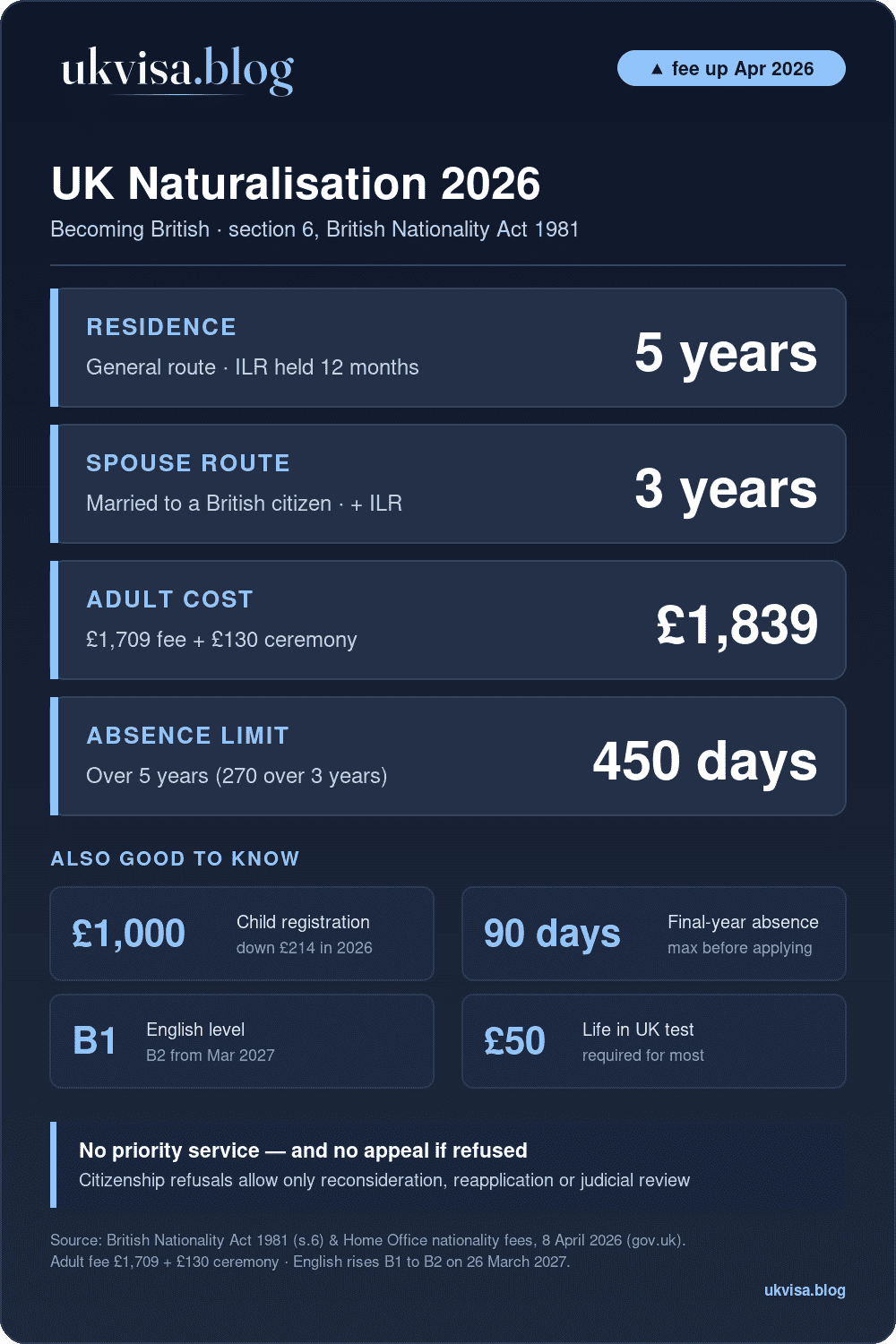
UK naturalisation requirements are the section 6 British Nationality Act 1981 criteria by which adult foreign nationals become British citizens. In 2026 applicants must be 18 or over, hold ILR or settled status, meet the residence requirement (5 years under section 6(1), or 3 years for spouses of British citizens under section 6(2)), stay within the absence limits, be of good character, demonstrate B1 English (B2 from 26 March 2027 under HC 1691), and pass the Life in the UK Test. The 8 April 2026 revision raised the adult fee to £1,709 — total £1,839 with ceremony. Child registration fell to £1,000 after PRCBC litigation.
Source: British Nationality Act 1981, sections 6(1) and 6(2); Home Office Nationality Policy guidance; Home Office 8 April 2026 fees order; HC 1691 Statement of Changes (5 March 2026)
The framework changed materially through 2025–2026. The 10 February 2025 good character update introduced a near-blanket bar on naturalisation for applicants who entered the UK irregularly (small boats, hidden in vehicles), even where entry occurred years earlier. The 8 April 2026 revision raised the adult fee to £1,709, total £1,839 with ceremony. Critically, the child registration fee fell £1,214 to £1,000 after PRCBC litigation. Looking ahead, HC 1691 raises the English requirement from B1 to B2 for applications submitted on or after 26 March 2027. Processing remains around 6 months.
- What is Naturalisation? British Citizenship Pathway Explained
- Section 6(1) vs Section 6(2) — General Applicants vs Spouse / Civil Partner Route
- Residence and Absence Requirements — 5 Year / 3 Year Calculations
- The Good Character Requirement — Including Feb 2025 Irregular Entry Policy
- English Language and Life in the UK Test Requirements
- How to Apply for UK Naturalisation — Form AN Procedure
- UK Citizenship Cost 2026 — Naturalisation Fee £1,709 + Ceremony
- UK Naturalisation Processing Time After Biometrics 2026
- Child Registration as a British Citizen — £1,000 Fee 2026
- Common Reasons for Naturalisation Refusal
- Dual Nationality and Effect on Existing Citizenship
- Frequently Asked Questions
UK Naturalisation Requirements 2026 — Becoming a British Citizen by Naturalisation
Naturalisation is the principal route by which adult foreign nationals acquire British citizenship after settled status. It sits under section 6 of the British Nationality Act 1981, with detailed criteria in Schedule 1, administered by the Home Office Nationality Caseworking Directorate. The Home Secretary's discretion is the final step — meeting the minimum requirements does not guarantee a grant. Most applicants arrive on a qualifying visa, hold it for the required period (typically 5 years), obtain Indefinite Leave to Remain, then wait 12 months (or apply immediately under the spouse route) before submitting Form AN. The journey typically takes 6 to 7 years generally, 5 years for spouses.
What is Naturalisation? British Citizenship Pathway Explained
Naturalisation is the legal process under section 6 of the British Nationality Act 1981 through which eligible foreign nationals acquire British citizenship. It is the most common route to citizenship for adults who came to the UK as economic migrants, family members, or refugees. Successful applicants gain full citizenship rights including a British passport, the right to vote, and permanent immigration status. Naturalisation is granted at the Home Secretary's discretion — meeting the minimum requirements does not automatically guarantee citizenship will be granted. The application is made on Form AN online via gov.uk, with a current adult fee of £1,709 plus £130 ceremony fee = £1,839 total from 8 April 2026.
Naturalisation vs Registration — Key Distinction
A common misunderstanding is that "naturalisation" covers all routes to British citizenship. In fact, naturalisation under section 6 applies only to adults (18 or over) who are not British nationals. The British Nationality Act 1981 sets out several other routes to citizenship that are technically "registration" rather than naturalisation:
- Children under 18: Register as British citizens under sections 1(3), 1(4), 3(1), 3(2), or 3(5) of the 1981 Act — fee £1,000 from 8 April 2026 (down from £1,214 following PRCBC litigation)
- British nationals (non-citizen): British Overseas Citizens, British Overseas Territories Citizens, and British Subjects can register as British citizens under various sections
- Stateless persons: Stateless children and adults can register under specific provisions
- British citizens by descent: Apply to register a future child for citizenship pre-departure
This guide focuses on the standard adult naturalisation route under sections 6(1) and 6(2) — the path used by the vast majority of foreign-national adult applicants. For the broader Home Office fees framework covering all citizenship and settlement applications, see our UK in-country Home Office fees guide.
Section 6(1) vs Section 6(2) — General Applicants vs Spouse / Civil Partner Route
UK naturalisation has two main routes. Section 6(1) — general applicants: requires 5 years' UK residence, ILR held for at least 12 months before application, and an intention to make the UK your home. Section 6(2) — spouse / civil partner of British citizen: requires only 3 years' UK residence and no minimum post-ILR waiting period, but requires the marriage or civil partnership to be subsisting at the date of application. Both routes share the same English language, Life in the UK Test, good character, and absence limit requirements. The faster section 6(2) route saves 2 years compared with the general route and is the most common path for non-British spouses of UK citizens.
| Requirement | Section 6(1) General Route | Section 6(2) Spouse / Civil Partner Route |
|---|---|---|
| Age | 18 or over at date of application | 18 or over at date of application |
| Immigration status | ILR, settled status, or permanent residence | ILR, settled status, or permanent residence |
| UK residence period | 5 years before application date | 3 years before application date |
| Post-ILR waiting period | 12 months minimum after grant of ILR | No waiting period — can apply immediately after ILR |
| Marriage / civil partnership | Not required | Must be married to or in civil partnership with a British citizen at the date of application |
| Max absences (qualifying period) | 450 days over 5 years | 270 days over 3 years |
| Max absences (final 12 months) | 90 days | 90 days |
| Good character | Required | Required |
| English language (2026) | B1 (B2 from 26 March 2027) | B1 (B2 from 26 March 2027) |
| Life in the UK Test | Required (£50) | Required (£50) |
| Future intention | Continue UK residence / Crown service / UK employer overseas | Not formally required (but reasonable inference assumed) |
| Application fee 2026 | £1,709 + £130 ceremony = £1,839 | £1,709 + £130 ceremony = £1,839 |
Which Route Applies to Me?
- Section 6(1) — general route: Skilled Worker sponsored employment, Health and Care Worker, UK Student route applications → Graduate, Global Talent, Innovator Founder, BN(O) Status Holder route, 10-year long residence, and most other settlement-leading routes — used by the great majority of adult naturalisation applicants
- Section 6(2) — spouse / civil partner route: Applicants whose qualifying UK residence was on the UK Spouse visa route and who are now married to or in civil partnership with a British citizen at the date of citizenship application — common for those who progressed Spouse visa → Spouse visa renewal → Spouse visa ILR → naturalisation
- Mixed cases: Applicants who arrived on a work or study visa but later married a British citizen can switch to the section 6(2) route — the 3-year residence calculation runs back from application date, regardless of which visa was held during that period
Residence and Absence Requirements — 5 Year / 3 Year Calculations
UK naturalisation residence requirements are measured backward from the date of the citizenship application. Section 6(1) general applicants must demonstrate 5 years' UK residence with no more than 450 days' absence in total across those 5 years, and no more than 90 days' absence in the final 12 months before the application. Section 6(2) spouse applicants must demonstrate 3 years' UK residence with no more than 270 days' absence in total, also with no more than 90 days' absence in the final 12 months. Both departure and arrival days count as days in the UK (not as absences). Exceeding the absence limits leads to refusal unless exceptional circumstances apply — Home Office discretion is available but not guaranteed.
How Absence Days Are Counted
- Departure and arrival days: Count as days in the UK — not as absences. A trip from 1 March to 7 March counts as 5 days absence (2, 3, 4, 5, 6 March) not 7
- Day of application: The 5-year (or 3-year) qualifying period ends on the day before the citizenship application is submitted, and runs back from that date
- Time before ILR counts: Time spent in the UK on a qualifying visa before ILR was granted counts toward the 5 / 3 year requirement — provided the immigration status was lawful
- Crown service: Time spent abroad on Crown service (HM Forces, Crown employee, designated international organisation) does not count as absence — treated as UK presence
- Excess absence discretion: The Home Office may exercise discretion to overlook excess absences for exceptional reasons (serious illness, bereavement, employment for a UK organisation overseas) — but there is no guarantee
The Good Character Requirement — Including Feb 2025 Irregular Entry Policy
The good character requirement is a discretionary Home Office assessment of an applicant's criminal record, immigration history, financial conduct, and general behaviour. From 10 February 2025, individuals who entered the UK irregularly (small boats, hidden in vehicles, false documents) will normally be refused British citizenship on good character grounds — regardless of how long ago the irregular entry occurred. Common refusal grounds also include unspent criminal convictions, deception in previous applications, persistent non-payment of tax or NHS surcharge, breach of immigration conditions, and association with extremist or criminal organisations. Custodial sentences of 4+ years are a near-permanent bar to citizenship.
The Criminal Conviction Waiting Periods
Criminal convictions — including overseas convictions disclosed via police certificates showing convictions — engage the good character requirement on a graduated scale based on sentence severity. The general framework also draws on the Part Suitability grounds refusals framework used in immigration contexts, though the citizenship good character test is independent and more discretionary.
| Sentence Imposed | Effect on Citizenship |
|---|---|
| 4 years or more imprisonment | Near-permanent bar — only granted in exceptional circumstances at Home Secretary discretion |
| 12 months to under 4 years | Refused unless 10 years have elapsed from end of sentence (including licence) |
| Under 12 months imprisonment | Refused unless 3 years have elapsed from end of sentence |
| Non-custodial sentence (fine, community order) | Refused unless 3 years have elapsed from date of conviction |
| Out-of-court disposals (cautions, warnings) | Considered relevant for the full 3-year period from disposal date |
| Civil penalties (e.g. working illegally fine) | Considered relevant for 3 years from payment |
Immigration-Related Good Character Issues
- Irregular entry from 10 February 2025: Near-blanket refusal — applies to anyone who entered the UK without leave to enter (small boats, hidden in vehicles, false documents) regardless of how long ago
- Deception in previous applications: False statements, forged documents, or fraudulent intent in any previous UK visa application — see 10-year deception ban framework for the wider consequences
- Overstaying: Period of overstaying after visa expiry typically requires 10 years from the end of the overstay before citizenship can be granted
- Breach of conditions: Working without permission, taking public funds when restricted, or other condition breaches
- Re-entry ban consequences: Previous removal or deportation may have a continuing impact — see UK re-entry ban framework for related context
- Police-recorded but unconvicted matters: Arrests, charges that did not lead to conviction, and ongoing investigations are considered
Financial Conduct and Tax Issues
- Tax evasion or non-payment: HMRC penalties for deliberate non-payment can lead to refusal — particularly where the applicant has not regularised their tax affairs
- Persistent NHS surcharge non-payment: Where the applicant or their dependants have unpaid NHS treatment debts over £500
- Bankruptcy: Undischarged bankrupts will normally be refused; discharged bankrupts may be granted citizenship subject to conduct since discharge
- Companies House and HMRC debts: Director-level debts to HMRC or companies struck off for non-compliance can engage good character concerns
English Language and Life in the UK Test Requirements
Adult naturalisation applicants must demonstrate English language proficiency at CEFR Level B1 in speaking and listening — through an approved Secure English Language Test (SELT), or by holding a degree taught in English (verified by Ecctis for overseas degrees), or by being a national of a majority English-speaking country. From 26 March 2027 under HC 1691, the English requirement rises to B2 for naturalisation applications submitted on or after that date. Applicants must also pass the Life in the UK Test (24 questions, 75% pass mark, £50 fee) at an approved test centre. Most applicants who already passed the English and Life in the UK requirements for ILR can reuse the same evidence for citizenship — no new test required.
English Language Requirement — B1 Until 25 March 2027, B2 From 26 March 2027
The English language requirement for naturalisation matches the requirement for ILR at the time of application:
- Citizenship applications submitted before 26 March 2027: CEFR Level B1 in speaking and listening
- Citizenship applications submitted on or after 26 March 2027: CEFR Level B2 in speaking and listening — under HC 1691 Statement of Changes
- SELT options at B1: IELTS Life Skills B1, Trinity GESE Grade 5, LanguageCert SELT B1, PSI Skills for English UKVI B1
- SELT options at B2 (from 26 March 2027): IELTS for UKVI B2, Trinity GESE Grade 6 or 7, LanguageCert SELT B2, PTE Academic UKVI B2 — note IELTS Life Skills does not currently offer B2
- Reusing prior SELT: Applicants who passed at B1 or higher for ILR (or any prior visa) can reuse the same certificate for citizenship — even after the 2-year validity has expired, provided the certificate has not been withdrawn
- Majority English-speaking country exemption: Nationals of USA, Canada, Australia, New Zealand, Ireland, Malta, and 14 Caribbean countries are exempt
- English-taught degree exemption: UK bachelor's degree (or higher) taught in English, or overseas degree taught in English with Ecctis verification
For the complete framework including all exemption categories and SELT provider details, see our CEFR framework and UKVI threshold certification guide.
Life in the UK Test
All adult naturalisation applicants must pass the Life in the UK Test — a computer-based test of UK history, geography, government, culture, and traditions:
- Format: 24 multiple-choice questions in 45 minutes
- Pass mark: 75% (18 out of 24 questions correct)
- Fee: £50 — payable when booking online at gov.uk
- Test centre: Must be taken at an approved Life in the UK Test centre in the UK (overseas options not available)
- Reusing prior pass: A Life in the UK Test passed for ILR is valid for citizenship — no need to retake
- Study material: The official handbook "Life in the United Kingdom: A Guide for New Residents" (currently 3rd edition) is the only authoritative source for test content
For test preparation strategy and the relationship between the Life in the UK Test and the wider settlement framework, see our Life in the UK settlement test guide.
How to Apply for UK Naturalisation — Form AN Procedure 2026
- Step 1 — Confirm eligibility: Check that you meet all requirements (age, ILR, residence, absences, good character, English, Life in the UK Test)
- Step 2 — Pass the Life in the UK Test: Book and pass the test at an approved centre (£50). Keep the pass notification letter — you will need it for Form AN
- Step 3 — Prepare English evidence: SELT certificate, degree certificate with Ecctis verification (if overseas), or passport (if from a majority English-speaking country)
- Step 4 — Find two referees: Both must be British citizens, have known you personally for 3+ years, and at least one must be a professional person (doctor, engineer, lawyer, accountant, civil servant, teacher, minister of religion, etc.)
- Step 5 — Gather documents: Current passport plus any previous passports showing travel history, ILR / settled status proof, Life in the UK Test pass letter, English language evidence, proof of UK address for the qualifying period
- Step 6 — Apply online at gov.uk: Complete Form AN through the Home Office portal — separate forms exist for section 6(1) and section 6(2) applicants
- Step 7 — Pay the fee: £1,709 application fee plus the £19.20 biometric enrolment fee (from 8 April 2026) — total £1,728.20 at submission
- Step 8 — Submit biometrics: Book and attend a UKVCAS appointment (or use the ID Check app if eligible) to enrol fingerprints and photograph
- Step 9 — Provide referee declarations: Both referees complete the online referee section as part of Form AN — they do not attend in person
- Step 10 — Wait for the decision: Standard processing is approximately 6 months from biometric enrolment
- Step 11 — Receive Approval Letter and book ceremony: Upon approval, book your citizenship ceremony at your local authority — must take place within 3 months of approval; £130 ceremony fee paid to the local authority
- Step 12 — Attend ceremony and receive Certificate of Naturalisation: Take the Oath / Affirmation of Allegiance and the Pledge of Loyalty; you become a British citizen on the date of the ceremony
- Step 13 — Apply for British passport: First British passport for an adult is £102 online standard / £166.50 fast track (8 April 2026 rates)
Form AN Referee Requirements 2026
Both referees must complete an online declaration as part of the applicant's Form AN. The requirements are strict:
- Both must be British citizens: Holding a British passport — not ILR holders, settled-status holders, or other non-British citizens
- Both must be 25 or over
- Both must have known the applicant personally for at least 3 years: Family relationships and casual acquaintances are not acceptable
- At least one must be of professional standing: The Home Office list includes minister of religion, civil servant, registered medical practitioner, officer of HM Armed Forces, police officer, lawyer, accountant, engineer, teacher, lecturer, and other recognised professions
- Cannot be related to applicant: Family members (spouse, parent, sibling, child, in-law) cannot serve as referees
- Cannot be the applicant's solicitor or immigration adviser
- Cannot have an unspent conviction
Proof of Freedom from Immigration Time Restrictions
Form AN requires the applicant to provide proof of "freedom from immigration time restrictions" — meaning ILR, settled status under the EU Settlement Scheme, or permanent residence. Acceptable evidence in 2026 includes:
- Biometric Residence Permit (BRP): Showing ILR endorsement — note that BRP cards have been replaced by a digital record you access through a UKVI account during 2025–2026
- eVisa status: Digital share code generated from the UKVI Account at gov.uk/view-prove-immigration-status
- EU Settlement Scheme settled status: Confirmed via the gov.uk view-and-prove service share code
- Passport with vignette: "Indefinite Leave to Enter" or "Indefinite Leave to Remain" stamp
- Pre-2003 Letters of Confirmation: For long-standing ILR holders whose status pre-dates BRP / eVisa
UK Citizenship Cost 2026 — Naturalisation Fee £1,709 + Ceremony
The total cost for UK adult naturalisation from 8 April 2026 is £1,839 — comprising the £1,709 Form AN application fee and the £130 citizenship ceremony fee. Additional costs are the Life in the UK Test (£50) and the SELT English test fee (£150–£250) if you do not qualify for an exemption. Children registering as British citizens pay £1,000 (down from £1,214 in April 2025 following PRCBC litigation). The Form AN application fee is non-refundable — even if the application is refused. There is no priority or fast-track service available for citizenship applications.
| Fee Type | Fee Before 8 April 2026 | Fee From 8 April 2026 | Change |
|---|---|---|---|
| Adult naturalisation (Form AN) | £1,605 | £1,709 | +£104 |
| Citizenship ceremony | £130 | £130 | Unchanged |
| Total adult cost | £1,735 | £1,839 | +£104 |
| Child registration as British citizen (MN1) | £1,214 | £1,000 | −£214 |
| British national → citizen registration (Form B(OS)) | £1,038 | £1,038 | Unchanged |
| Life in the UK Test | £50 | £50 | Unchanged |
| Biometric enrolment fee | £19.20 | £19.20 | Unchanged |
| SELT English test (if not exempt) | £150–£250 (provider-set) | £150–£250 | Provider-set |
Cost Comparison — Citizenship vs ILR vs Spouse Visa Settlement
For applicants planning their settlement and citizenship pathway, the cumulative cost picture from 8 April 2026 is:
- 5-year work route to citizenship: Work visa fees (3–5 grants) + IHS (£1,035 per year per person) + ILR application £3,226 + 12-month wait + naturalisation £1,839 = typically £15,000–£25,000 per person
- 5-year Spouse route to citizenship: Spouse entry £2,064 + IHS 33 months £3,105 + extension £1,407 + IHS 30 months £2,587.50 + ILR £3,226 + naturalisation £1,839 (no 12-month wait) = total £14,228.50 per spouse
- Family with 2 children, 5-year work route: Roughly £40,000–£60,000 cumulative across all immigration stages including child registration to citizenship
The full breakdown including in-country variation fees, IHS exemptions, and Sponsor Licence costs is in our dedicated UK in-country Home Office fees guide linked earlier, and the out-of-country entry clearance schedule is covered in our complete UK visa fees guide.
UK Naturalisation Processing Time After Biometrics 2026
UK naturalisation processing time after biometrics enrolment is typically approximately 6 months — the Home Office service standard for citizenship applications. Straightforward cases are sometimes decided within 3 to 4 months; complex cases involving additional good character or residency checks can extend to 12 months or longer. There is no priority or fast-track service available for citizenship applications — unlike work or family visa applications. Applicants requiring particularly urgent citizenship (typically for international employment or family events) cannot accelerate the process by paying additional fees. The processing clock starts from biometric enrolment (not from form submission), since the biometric step finalises the application's "ready for caseworking" status.
Naturalisation Processing Stages and Typical Durations
| Stage | Typical Duration |
|---|---|
| Form AN online submission to biometric enrolment | 2–4 weeks (depending on UKVCAS appointment availability) |
| Biometric enrolment to acknowledgment of receipt | 1–2 weeks |
| Acknowledgment to Decision Maker review | 3–4 months (variable) |
| Decision Maker review to approval / refusal | 1–2 months |
| Approval letter to ceremony invitation | 1–4 weeks |
| Ceremony booking to ceremony date | 4–12 weeks (local authority availability) |
| Total — Form AN to British citizenship | 6–9 months for straightforward cases; up to 12 months for complex cases |
Factors That Extend Naturalisation Processing
- Good character verification: Cases involving criminal records, immigration history concerns, or financial conduct queries take longer
- Excessive absence cases: Where absences exceed 450 / 270 / 90 day limits, the Home Office must consider whether to exercise discretion — adds 3–6 months
- Referee verification: Where referee declarations are queried or referees cannot be reached, processing extends
- Document verification: SELT English certificate authenticity checks with the test provider; degree certificate verification with awarding body
- Caseworker resource: Periods of high application volume (often following ILR fee increases or rule changes) extend timelines
- February 2025 irregular entry cases: Where the applicant's history engages the irregular entry policy, the case is escalated to senior caseworker — typically 9–12 months
For applicants whose case has exceeded the standard 6 month service target without communication, the recourse options mirror those available for delayed visa applications — see our framework on UK visa delay or NSF notification for the broader Home Office service standard escalation framework. MP correspondence is often the appropriate route after 9+ months of delay without progress.
Child Registration as a British Citizen — £1,000 Fee 2026
Children under 18 acquire British citizenship through registration rather than naturalisation. The application uses Form MN1 with a fee of £1,000 from 8 April 2026 — reduced from £1,214 following the Project for the Registration of Children as British Citizens (PRCBC) litigation, where the Supreme Court found the prior fee level unlawful on irrationality grounds. Children of British citizens born in the UK after the parent became British are usually automatic British citizens at birth (no application needed). Children born in the UK to settled (ILR) parents are also automatically British at birth. Other children — including those born abroad to British parents by descent, and children born in the UK to non-settled parents who later become settled — must apply for registration under various provisions of the British Nationality Act 1981.
When Children Need to Register (and When They Don't)
- Born in the UK to British parent or ILR-holding parent: Automatic British citizenship at birth — no application required
- Born abroad to British citizen "otherwise than by descent": Automatic British citizenship at birth — proof through birth certificate and parent's British passport
- Born in the UK after 1983 to non-settled parents who later become settled: Register under section 1(3) — fee £1,000
- Born in the UK and lived continuously for first 10 years: Register under section 1(4) — fee £1,000
- Born abroad to British parent "by descent": Register under section 3(2) or 3(5) where eligible — fee £1,000
- Discretionary registration: Register under section 3(1) where the Home Secretary considers it appropriate — fee £1,000
For details of long-residence routes to British citizenship by descent and the framework for British citizens living abroad, see our dedicated British citizens overseas guide linked earlier in this article.
Common Reasons for Naturalisation Refusal
UK naturalisation applications are most commonly refused on five grounds: excess absences (over 450 days in 5 years, 270 days in 3 years, or 90 days in the final 12 months); good character failures (criminal convictions, deception, tax evasion, irregular entry from February 2025); English language failure (no valid SELT, no qualifying degree, no exemption); Life in the UK Test failure or absence; and incomplete documentation (missing referee declarations, ILR proof, or supporting documents). Unlike visa refusals, naturalisation refusals do not carry administrative review or appeal rights — the only remedies are reapplication (with new fee) or judicial review where the decision was unlawful.
Most Common Naturalisation Refusal Grounds 2026
- Excess absences in the qualifying period: Most frequent refusal ground — applicants miscalculate absences or fail to account for time abroad before ILR
- February 2025 irregular entry policy: Now a major refusal ground for applicants with any history of irregular entry to the UK
- Unspent criminal convictions: Including out-of-court disposals, cautions, and civil penalties within the 3-year period
- Deception in previous applications: False information in visa, ILR, or earlier citizenship applications
- Tax evasion or persistent tax non-compliance: HMRC penalties, undeclared income, or director-level corporate tax issues
- NHS surcharge non-payment: Unpaid NHS treatment debts over £500
- English language failure: Non-SELT English test certificate, expired SELT not previously used, or Ecctis verification failure
- Life in the UK Test missed or failed: Not taken, not passed at 75%, or not used within validity
- Referee issues: Referees not eligible, not British citizens, related to applicant, or not contactable
- Application incomplete: Missing documents, missing referee declarations, or insufficient evidence of UK residence
What to Do If Refused — No AR or Appeal Right
Unlike visa refusals — many of which carry administrative review rights — naturalisation refusals do not carry administrative review or formal appeal rights. The recovery options are limited:
- Reconsideration request: Submit a written reconsideration request asking the Home Office to review the refusal where you believe it contains a clear error of fact or law. Free, but discretionary — no guaranteed response
- Reapplication with fresh fee: Submit a new Form AN addressing the original refusal grounds — pay the full £1,709 application fee again. Most common path
- Judicial review through the Upper Tribunal or High Court: Challenge the lawfulness of the refusal decision. Requires Pre-Action Protocol letter first. Strict 3-month deadline. Typically costs £5,000+ with solicitor and barrister fees
- Wait for changed circumstances: Where the refusal was on time-limited grounds (recent conviction, recent overstaying), wait until the relevant period has elapsed and reapply
For the wider reapplication and refusal recovery options framework — though noting that naturalisation refusals have a narrower remedy framework than visa refusals — see our dedicated guide.
Dual Nationality and Effect on Existing Citizenship
The UK permits dual (and multiple) nationality — becoming a British citizen by naturalisation does not require you to give up your existing citizenship from the UK side. However, many countries do not permit dual nationality — and acquiring British citizenship may automatically forfeit your original citizenship under your country of origin's nationality law. Countries where acquiring foreign citizenship typically results in loss of original citizenship include China, India, Japan, the Netherlands (with exceptions), Norway (since 2020 changes reduced restrictions), Saudi Arabia, Singapore, and the UAE. Applicants from these countries should check their country's nationality law before applying for British citizenship — particularly where they intend to maintain travel, property, inheritance, or business rights in the country of origin.
Major Countries With Dual Nationality Restrictions
| Country | Dual Nationality Allowed? | Practical Position |
|---|---|---|
| USA | Yes | Full dual citizenship permitted |
| Australia | Yes | Full dual citizenship permitted |
| Canada | Yes | Full dual citizenship permitted |
| India | No | Indian citizenship automatically lost; OCI card available for continued ties |
| China | No | Chinese citizenship automatically lost on acquiring foreign nationality |
| Japan | No (for adults) | Must choose between Japanese and other nationality before 22 |
| Pakistan | Yes | Dual citizenship with UK permitted |
| Singapore | No | Singaporean citizenship automatically lost on acquiring foreign nationality |
| Saudi Arabia | Generally no | Requires Royal Decree to retain Saudi citizenship |
| UAE | No (for citizens) | Emirati citizenship typically lost on naturalising abroad |
| Nigeria | Yes | Dual citizenship permitted |
| South Africa | Yes (with permission) | Letter of Retention required before naturalising as British citizen |
- UK naturalisation is the section 6 British Nationality Act 1981 route by which adult foreign nationals become British citizens
- Section 6(1) general route: 5 years' residence + ILR held for 12 months + good character + English + Life in the UK Test
- Section 6(2) spouse route: 3 years' residence + ILR + marriage to British citizen + same character / English / Life in UK requirements
- Absence limits: maximum 450 days over 5 years / 270 days over 3 years, AND no more than 90 days in the final 12 months
- Adult naturalisation fee from 8 April 2026: £1,709 application + £130 ceremony = £1,839 total (was £1,735)
- Child registration as British citizen from 8 April 2026: £1,000 (down from £1,214 — PRCBC litigation outcome)
- HC 1691 raises citizenship English from B1 to B2 for applications submitted on or after 26 March 2027
- 10 February 2025 irregular entry policy: near-blanket bar on naturalisation for those who entered the UK irregularly — applies regardless of how long ago
- Standard processing approximately 6 months from biometric enrolment; no priority service available
- Naturalisation refusals do not carry administrative review or formal appeal rights — only reconsideration, reapplication, or judicial review
- UK permits dual nationality from the UK side — but applicants must check their country of origin's nationality law to assess whether existing citizenship would be lost
Frequently Asked Questions about UK Naturalisation Requirements
The UK naturalisation requirements in 2026 are: being 18 or over at the date of application; holding ILR, settled status, or permanent residence; living in the UK for 5 years (section 6(1) general route) or 3 years (section 6(2) spouse / civil partner route); holding ILR for at least 12 months (general route only); satisfying the absence limits (450 days over 5 years / 270 days over 3 years, and no more than 90 days in the final 12 months); meeting the good character requirement; demonstrating English language proficiency at CEFR Level B1 (rising to B2 from 26 March 2027 under HC 1691); and passing the Life in the UK Test. The 8 April 2026 fee revision raised the application fee to £1,709.
UK citizenship cost in 2026 is £1,839 in total for adult naturalisation — comprising the £1,709 Form AN application fee (raised from £1,605 on 8 April 2026) and the £130 citizenship ceremony fee (paid to the local authority). Additional costs include the Life in the UK Test (£50), and the SELT English language test (£150–£250) if no exemption applies. The Form AN application fee is non-refundable even if the application is refused. Children registering as British citizens pay £1,000 in 2026, reduced from £1,214 following the Project for the Registration of Children as British Citizens litigation that successfully challenged the prior fee level.
UK naturalisation processing time in 2026 is approximately 6 months from biometric enrolment — the Home Office service standard for citizenship applications. Straightforward cases can be decided within 3 to 4 months; complex cases involving additional good character or residency checks can extend to 12 months or longer. There is no priority or fast-track service available for citizenship applications. After approval, the citizenship ceremony must be booked and attended within 3 months — typically 4 to 12 weeks based on local authority availability. The total Form AN-to-British-citizen timeline is typically 6 to 9 months for straightforward cases.
If you are married to or in a civil partnership with a British citizen (section 6(2) route), you can apply for naturalisation immediately after receiving Indefinite Leave to Remain — there is no minimum post-ILR waiting period. If you are not married to a British citizen (section 6(1) general route), you must hold ILR for at least 12 months before applying. Both routes still require you to satisfy all other eligibility criteria — including the 5-year (or 3-year) residence requirement and the absence limits — calculated backward from the citizenship application date, not from the date of ILR.
For the section 6(1) general route, you can be absent from the UK for a maximum of 450 days over the 5-year qualifying period, and no more than 90 days in the final 12 months before the application. For the section 6(2) spouse / civil partner route, the limit is 270 days over the 3-year qualifying period, also with no more than 90 days in the final 12 months. Both departure and arrival days count as days in the UK, not as absences. The Home Office may exercise discretion to overlook excess absences for exceptional reasons (serious illness, bereavement, employment for a UK organisation overseas) but this is not guaranteed and must be supported by detailed evidence.
The good character requirement is a discretionary Home Office assessment of an applicant's criminal record, immigration history, financial conduct, and general behaviour. From 10 February 2025, individuals who entered the UK irregularly (small boats, hidden in vehicles, false documents) will normally be refused British citizenship on good character grounds, regardless of how long ago the entry occurred. Other refusal grounds include unspent criminal convictions (custodial sentences of 4+ years create a near-permanent bar), deception in previous applications, persistent tax non-compliance, NHS surcharge non-payment, and association with extremist or criminal organisations. The criminal conviction waiting periods are: 4+ years' imprisonment near-permanent bar; 12 months to under 4 years 10-year wait; under 12 months 3-year wait; non-custodial 3-year wait from conviction.
The UK permits dual and multiple nationality — becoming a British citizen by naturalisation does not require you to give up your existing citizenship under UK law. However, many countries do not permit dual nationality under their own nationality law — and acquiring British citizenship may automatically forfeit your original citizenship under your country of origin's law. Countries with significant dual nationality restrictions include China, India, Japan, Singapore, Saudi Arabia, UAE, and (with limitations) the Netherlands. South African nationals must obtain a Letter of Retention from the Department of Home Affairs before naturalising as British, to keep South African citizenship. Always check your country of origin's nationality law before applying — the Home Office does not advise on this question.
Children under 18 acquire British citizenship through registration rather than naturalisation. Children born in the UK to ILR-holding parents are automatically British citizens at birth — no application needed. Children born in the UK before the parent obtained ILR can register as British citizens once the parent has settled status, using Form MN1 with a fee of £1,000 from 8 April 2026 (reduced from £1,214 following PRCBC litigation). Children born abroad to a British citizen "by descent" can register under section 3(2) or 3(5). The Home Secretary also has discretionary registration power under section 3(1) for children with strong UK connections. The fee applies per child — not per family — and is non-refundable even if the application is refused.
Unlike most visa refusals, naturalisation refusals do not carry administrative review rights or formal appeal rights. Your recovery options are limited to: submitting a reconsideration request asking the Home Office to review the refusal (free but discretionary — no guaranteed response); reapplying with a fresh Form AN addressing the refusal grounds and paying the full £1,709 fee again; or pursuing judicial review at the Upper Tribunal or High Court where the decision was unlawful (strict 3-month deadline, typically costs £5,000+ with solicitor and barrister fees, requires Pre-Action Protocol letter first). The £1,709 application fee is not refunded on refusal — it covers the cost of considering the application, not the outcome.
Form AN requires two referees, both of whom must: be British citizens (holding a British passport — not ILR or settled status); be 25 or over; have known the applicant personally for at least 3 years; not be related to the applicant by blood, marriage, or civil partnership; not be the applicant's solicitor or immigration adviser; and not have any unspent criminal conviction. At least one referee must be a "professional person" — the recognised list includes minister of religion, civil servant, registered medical practitioner, officer of HM Armed Forces, police officer, lawyer, accountant, chartered engineer, teacher, lecturer, dentist, and many other recognised professions. Both referees complete an online declaration as part of the applicant's Form AN — they do not need to attend in person.
For the official statutory framework, see the British Nationality Act 1981 on legislation.gov.uk. For the published Home Office caseworker guidance on naturalisation decision-making, see the naturalisation as a British citizen by discretion guidance. For the good character policy including the 10 February 2025 irregular entry update, see the Home Office Nationality Policy: Good Character document. To submit Form AN, use the gov.uk portal at apply for British citizenship by naturalisation.