
A UK work visa interview — formally a Genuineness or credibility interview — can decide your Skilled Worker visa application. UKVI conducts these interviews when caseworkers need to verify your job offer, salary, employer legitimacy, qualifications, or immigration history. This 2026 guide covers the most common Home Office interview questions for Skilled Worker visa applicants, complete sample answers, the credibility assessment criteria officers apply, and the preparation strategies that move applications from refusal to grant. From the £41,700 salary threshold to the Genuine Employment Requirement under Appendix Skilled Worker, every question is designed to test whether your application is genuine. Full caseworker mechanics live in official Home Office genuineness and credibility guidance.
A UK Skilled Worker visa interview tests credibility against the Genuine Employment Requirement. Officers cover five question categories: job role and daily duties, salary and working conditions, employer knowledge, qualifications and suitability, and immigration history. Interviews last 20–45 minutes and run by telephone, video call, or in person at a Visa Application Centre. Not every applicant is interviewed — UKVI uses risk-based selection focusing on newly licensed sponsors, salary-threshold applications, qualification mismatches, and switchers from Student or Graduate visas. The £41,700 salary threshold from 22 July 2025 and the B2 English standard from 8 January 2026 are the two most common knowledge tests during interviews.
UK Skilled Worker Visa Interview Questions and Answers 2026: Complete Preparation Guide
A UK work visa interview — also called a Genuineness or credibility interview — is a structured assessment carried out by UKVI to verify that you genuinely intend to work in the UK for your sponsoring employer in the role specified on the Certificate of Sponsorship. The interview tests the Genuine Employment Requirement set out in Appendix Skilled Worker of the Immigration Rules. Officers cross-check your verbal answers against the documentary application, looking for inconsistencies that indicate the sponsorship is not genuine or the role does not exist as described. Full eligibility mechanics live in our main UK sponsored work permission guide.
Two specific thresholds dominate Home Office interview questioning in 2026. First, the £41,700 general salary floor took effect on 22 July 2025 — applicants must know their exact salary and how it relates to this floor and to the SOC code going rate. Reduced floors apply to new entrants (£33,400), relevant PhD holders (£37,500), Immigration Salary List roles (£33,400), and Health and Care visa applicants (£25,000 on national pay scales). Second, the B2 English standard applied from 8 January 2026 — first-time applicants must demonstrate B2 across all four components (up from B1). Incorrect salary or English-standard knowledge is a leading credibility trigger.
What is a UK Skilled Worker Visa Interview?
A UK Skilled Worker visa interview is a formal credibility assessment where UKVI officers verify that you have a genuine job offer, meet the £41,700 salary threshold (or the going rate for your SOC code), hold appropriate qualifications, and that your sponsor is a compliant UK employer. Interviews last 20–45 minutes and may be conducted by telephone, video call, or in person at a Visa Application Centre. The Home Office uses interviews on a risk-based selection — not every applicant is called.
The interview is the applicant's opportunity to demonstrate genuineness. The Home Office uses a credibility assessment framework that weighs the applicant's verbal answers against the documentary application package — including the Certificate of Sponsorship, supporting required UKVI document checklist, contract of employment, and supporting financial evidence. Where the verbal answers contradict the documents, the application is likely to be refused under the Genuineness ground in paragraph SUI 9.1.2 of the Immigration Rules.
Who Gets Called for a UK Work Visa Interview?
UKVI selects applicants for interview on a risk-based basis. The most common triggers are: applying from a country with elevated refusal rates, having a newly licensed sponsor with limited sponsorship history, salary at or just above the minimum threshold, qualifications that don't clearly match the job role, switching from a Student or Graduate visa, previous UK or overseas visa refusals, or working for a sponsor with compliance issues or recent licence downgrades. Straightforward applications from well-established sponsors are rarely interviewed.
UKVI does not interview every Skilled Worker applicant — it uses risk-based selection algorithms combined with caseworker discretion to identify applications that need additional scrutiny. Understanding the triggers helps applicants prepare a stronger documentary application and anticipate potential questions even if the interview never materialises.
Common Interview Triggers
- Newly licensed sponsor: Employers with limited sponsorship history or fewer than 5 historical CoS assignments
- High-refusal-rate nationality: Applicants from countries with elevated UK visa refusal or overstay rates
- Salary close to threshold: Salaries at or just above the £41,700 floor (or relevant reduced floor)
- Qualification mismatch: Your degree, certifications, or experience does not clearly align with the SOC code
- Visa switching: In-country switches from Student or Graduate visa — common scrutiny point
- Previous refusals: Any prior UK or third-country visa refusal triggers additional checks
- Sponsor compliance: Employer with a B-rated licence, recent downgrade, or open Home Office compliance investigation
- CoS-document inconsistencies: Job title, salary, or duties differing between the CoS and supporting evidence
Work Visa Routes Where Credibility Interviews May Apply
Credibility interviews are most common on the Skilled Worker route but apply across the wider sponsored work category:
- Skilled Worker visa: The dominant route subject to credibility interviewing
- Health and Care visa: NHS Health and Care visa concession applications receive additional scrutiny post-July 2025 due to closed care worker routes and sector compliance concerns
- Scale-up Worker visa: High-growth company sponsorship route — interview triggers focused on company growth verification
- Senior or Specialist Worker visa: Global Business Mobility intra-company transfer route — interview tests overseas employment history
- UK Expansion Worker visa: overseas business UK presence establishment route — heavy scrutiny on UK entity legitimacy
- International Sportsperson visa: elite athletes and coaches route — endorsement verification central to interview
Endorsement-based routes such as Global Talent and Innovator Founder are rarely subject to UKVI credibility interviewing because the endorsing body has already assessed the applicant's genuine intent. Interview risk concentrates on sponsorship-based routes.
Home Office Interview Questions for Skilled Worker Visa
Home Office interview questions cluster in five categories: (1) job role and daily duties, (2) salary and working conditions, (3) employer knowledge and sponsorship details, (4) qualifications and suitability, and (5) immigration history and future intentions. Every answer must align with the Certificate of Sponsorship. The most common single trigger for refusal is salary-threshold confusion — applicants who cannot state their exact salary or how it relates to the SOC going rate.
Question Category Matrix
| Question Category | What UKVI Assesses | Key Documents to Review |
|---|---|---|
| Job role and duties | Genuine understanding of daily responsibilities and SOC alignment | Job description, CoS, contract, SOC code reference |
| Salary and hours | Meets £41,700 floor or relevant reduced floor plus going rate | CoS, offer letter, SOC going-rate publication |
| Employer details | Sponsor legitimacy, business operations, A-rated licence status | Company research, sponsor register, licence status |
| Qualifications | Skills, degrees, and experience genuinely match the job | Certificates, CV, professional registrations, UK ENIC if applicable |
| Immigration history | Compliance, genuine intent, lawful previous travel | Passport, previous visas, travel records |
Most Common Home Office Questions
Based on UKVI interview transcripts and caseworker guidance, these are the most frequently asked Skilled Worker credibility questions:
- What is your job title and what will your daily duties involve?
- What is your annual salary and how many hours will you work per week?
- What do you know about your sponsoring employer's business?
- How did you find and apply for this job?
- What qualifications or skills make you suitable for this role?
- How does your previous experience relate to this position?
- Have you ever been refused a UK or other country visa?
- Do you intend to apply for settlement after 5 years?
- What is the minimum salary threshold for the Skilled Worker route?
- What level of English is required for your application?
UK Work Visa Interview Questions and Answers — Sample Answers
Interview answers must be specific, consistent with the Certificate of Sponsorship, and demonstrate genuine knowledge of the job role and employer. Avoid vague generalisations ("I'll be doing IT work"), avoid memorised scripts (UKVI officers detect rehearsed answers), and avoid volunteering information beyond what was asked. The sample answers below illustrate the right depth and specificity for each question category.
Job Role and Responsibilities Questions
Q: What is your job title and what will your daily duties involve?
Sample answer: "I've accepted a Software Engineer role at ABC Technology Ltd in Manchester. My daily duties include developing back-end services in Python, writing and reviewing pull requests, participating in twice-weekly sprint planning, collaborating with the product team on feature specifications, and maintaining existing payment-processing microservices. The role sits under SOC 2136 — programmers and software development professionals — which matches my background."
Why this works: Specific job title, named employer, named city, specific technical detail, named SOC code, and explicit alignment with prior background. The answer demonstrates genuine role knowledge rather than vague generalisations that could apply to any software job.
Q: How does your past experience relate to this position?
Sample answer: "I've worked as a Junior Developer for four years at a fintech company in [city], where I built payment APIs in Python and worked on PCI-DSS compliance. My BSc in Computer Science from [university] and my AWS Solutions Architect Associate certification both directly support the technical requirements specified in the job description. The new role represents a senior progression of work I've been doing since 2022."
Salary and Working Conditions Questions
Q: What is your salary and how many hours will you work each week?
Sample answer: "My annual salary is £48,000 for 37.5 hours per week, Monday to Friday. This matches exactly what's on my Certificate of Sponsorship. My salary exceeds the general £41,700 Skilled Worker floor from 22 July 2025 and also exceeds the SOC 2136 going rate of [rate from going rates publication]."
Q: Do you understand the minimum salary requirement for your visa route?
Sample answer: "Yes. The general Skilled Worker floor is £41,700 since 22 July 2025. My role at £48,000 clears that floor, and also clears the going rate for SOC 2136 published in Appendix Skilled Occupations. I'm not claiming any of the reduced floors — new entrant, PhD, or Immigration Salary List — because my offer is well above the general threshold."
From 22 July 2025 the standard Skilled Worker minimum salary is £41,700 per year (or £17.13 per hour) or the going rate for your SOC code, whichever is higher. Reduced thresholds apply for new entrants under 26 or switching from Student/Graduate (£33,400 plus 70% going rate), relevant PhD holders (£37,500 plus 90%), Immigration Salary List roles (£33,400), and Health and Care Visa applicants on national pay scales (£25,000). Incorrect salary knowledge is one of the most frequent causes of work visa credibility refusals. Full salary mechanics in our Skilled Worker pay threshold guide.
Employer and Sponsorship Questions
Q: What do you know about your employer?
Sample answer: "ABC Technology Ltd is a Home Office-licensed sponsor under registration [number] with A-rated worker status. They're a Manchester-based software company with approximately 120 employees, specialising in enterprise solutions for healthcare and financial services clients. The company has been trading since 2015 and their CoS history shows they've sponsored international engineers consistently over the past several years."
Q: How did you apply for the job?
Sample answer: "I found the vacancy on LinkedIn in [month] and applied through the company's careers portal. The recruitment process included an initial screening call with the HR team, a technical coding assessment over 48 hours, two technical interviews — one with the engineering lead and one with the head of product — and a final culture-fit interview with the founders. I received the formal offer approximately three weeks after my final interview, and the CoS was assigned [date]."
For applicants concerned about sponsor compliance and CoS validity, see our standalone UK employer compliance and licensing framework guide.
Qualifications and Suitability Questions
Q: What qualifications or skills make you suitable for this role?
Sample answer: "I hold a BSc in Computer Science from [university] graduated in 2021. I'm proficient in Python, JavaScript, React, SQL, and Docker — all explicitly listed in the job description. I also hold AWS Cloud Practitioner certification and have four years of professional development experience. The SOC 2136 role is at RQF Level 6, which matches my degree-level qualification, so I clear the RQF Level 6 skill threshold rules."
Immigration History and Intent Questions
Q: Have you ever been to the UK before?
Sample answer (if yes): "Yes — I visited in [year] on a Standard Visitor visa for a two-week holiday. I departed before the visa expired and complied with all visa conditions. I've also travelled to Germany and Singapore for work conferences. I have no UK or other-country visa refusals on my record."
Sample answer (if no): "No, this will be my first time in the UK. I've travelled to the UAE and Singapore for business and to Spain for personal travel. I have no UK or other-country visa refusals on my record."
Q: Do you intend to stay in the UK permanently?
Sample answer: "My immediate focus is to work for my sponsor and develop my career in software engineering. I'm aware the Skilled Worker route can lead to Indefinite Leave to Remain after 5 years of continuous residence — see Skilled Worker route to ILR mechanics — and that's a longer-term option I'd consider if my career goes well in the UK. My current focus is delivering for my employer."
Avoid both extremes when asked about long-term intent. Saying "Yes, I want to settle permanently" too directly can raise concerns that work is a backdoor to immigration. Saying "No, I'll return home after 5 years" can contradict the standard ILR pathway and seem evasive. The balanced answer acknowledges the lawful 5-year ILR route while emphasising current focus on the sponsored employment. The May 2025 White Paper proposes extending most routes to 10 years; current 5-year rules remain in force pending final implementation.
Credibility Assessment Criteria for UK Skilled Worker Visa Interview
The Home Office credibility assessment evaluates seven factors: immigration history and previous compliance, educational qualifications and skill alignment with the SOC code, employer legitimacy and sponsor licence health, salary at or above the relevant threshold and going rate, financial stability, country-specific risk factors, and applicant understanding of UK employment conditions. All factors must align with the documentary application package.
Immigration History and Compliance
Past visa compliance and travel history materially impact credibility. Previous overstaying, refusals on the grounds of false representations, or 10-year re-entry bans under Part Suitability all weigh heavily. Applicants who have consistently respected visa conditions across multiple historical applications demonstrate compliance — officers note this positively. Previous refusals do not automatically defeat an application, but they must be disclosed and explained.
Qualification and Experience Alignment
Qualifications and past work experience must logically map to the offered role. A Computer Science graduate applying for a Software Engineer role at SOC 2136 makes immediate sense. A History graduate applying for a Data Analyst role without bridging experience or training raises questions. Since 22 July 2025, almost all Skilled Worker roles must sit at RQF Level 6 (degree-equivalent) unless on the Immigration Salary List or Temporary Shortage List.
Employer and Sponsorship Legitimacy
Officers cross-check the sponsor's licence history, compliance record, and operational legitimacy. Red flags include newly registered sponsors without operational history, employers with poor compliance records or previous licence revocations, and companies whose registered business activity does not match the role being offered. A-rated sponsor licence is the baseline expectation.
Salary and SOC Code Requirements
The job role must match the SOC code on the CoS, and the salary must meet the £41,700 floor (or the relevant reduced floor) and the SOC code going rate. Common rejection reasons include job descriptions that differ between the CoS and interview answers, salaries below the required threshold, and SOC codes that don't fit the actual duties described.
UK Skilled Worker Visa Interview Process and Outcomes
The interview process differs between in-country and overseas applications. In-country interviews are referred by UKVI caseworkers reviewing the application file. Overseas interviews require Entry Clearance Officer authorisation and Entry Clearance Manager approval before they proceed. All interview formats — telephone, video call, in-person — last 20 to 45 minutes. Post-interview, satisfied caseworkers send the application for final decision within 1–3 weeks. Failure to attend the scheduled interview without valid reason triggers refusal under paragraph SUI 14.1 of Part Suitability.
In-Country Applications (Within the UK)
If switching to or extending a Skilled Worker visa from inside the UK, the application may be flagged for interview where gaps appear in employment history, the sponsor is newly licensed, the salary is close to the threshold, the role doesn't clearly align with past experience, or the SOC code differs from the previous role. Once flagged, a UKVI caseworker refers the file for credibility assessment. Email or letter notification arrives with the scheduled interview date.
Overseas Applications (Outside the UK)
Entry Clearance Officers reviewing overseas Skilled Worker files may request a credibility interview where the employer is newly licensed, qualifications don't clearly match, the country of application has elevated refusal rates, or the CoS-document evidence is inconsistent. The Entry Clearance Manager must approve before the interview proceeds. Overseas interviews typically take place at a UK Visa Application Centre or remotely via video call. Standard decision timelines after biometric enrolment are extended by 2–6 weeks when an interview is added to the file.
Interview Format Options
| Format | When Used | Typical Duration |
|---|---|---|
| Telephone | Most common for overseas applicants | 20–30 minutes |
| Video call (Skype / MS Teams) | Remote interviews — increasingly used post-2020 | 20–45 minutes |
| In-person | VAC or UKVI office appointments — used for complex cases | 30–45 minutes |
Post-Interview Outcomes
If the officer is satisfied, the application moves to final processing and a decision typically issues within 1–3 weeks. If concerns persist, the case may be escalated to a senior officer, additional sponsor checks may be conducted (including unannounced workplace compliance visits), or the visa may be refused. Refusal letters often include a typed transcript of the interview with the problematic responses highlighted — this transcript is the foundation for any Administrative Review request. Applicants whose visa is refused can review the reapplication chances after refusal guide and consider remedying the identified concerns in a fresh application.
UK Skilled Worker Visa Interview Success Tips
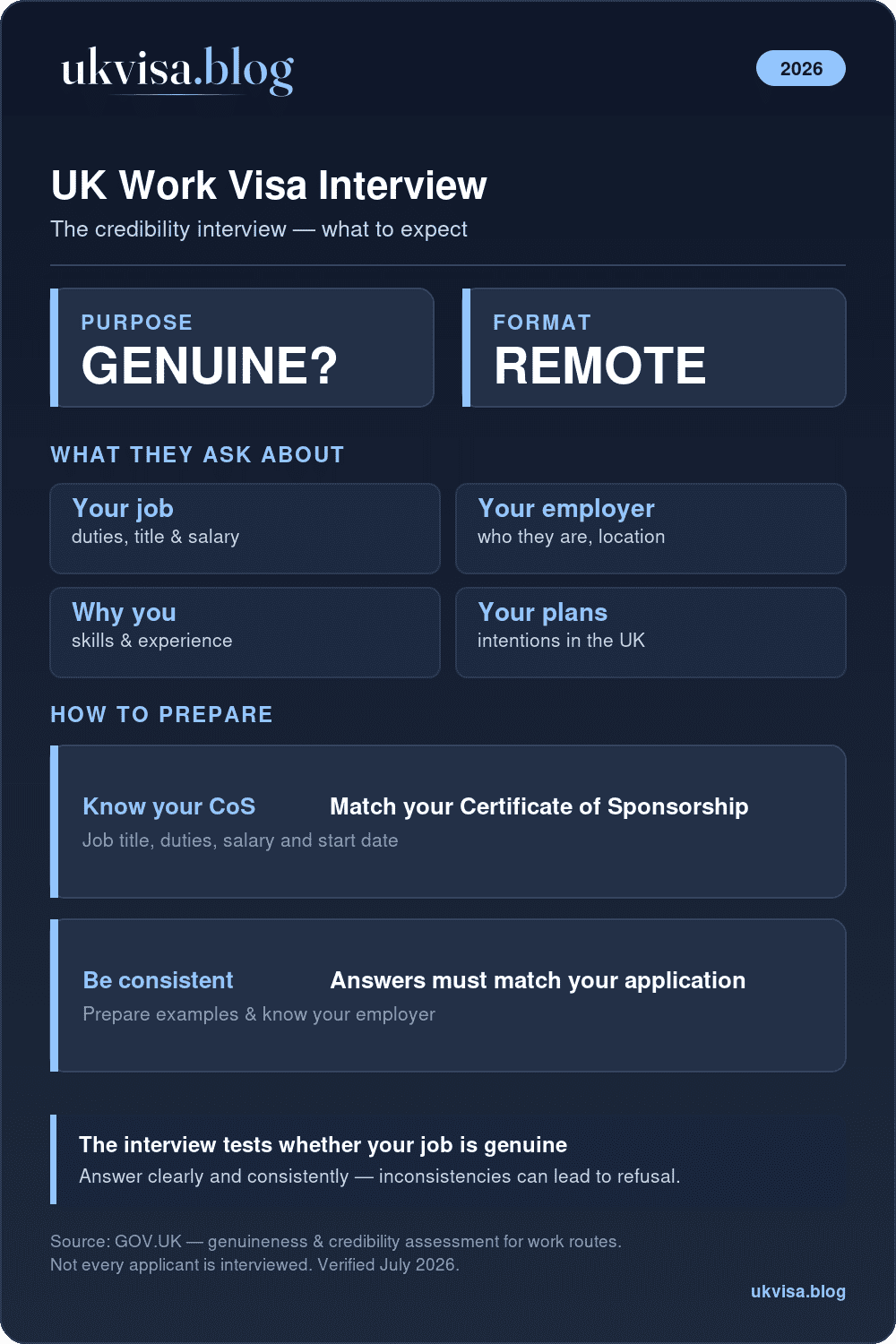
Success requires thorough preparation across three pillars: (1) document mastery — review the CoS, job description, contract, and sponsor licence details; (2) answer discipline — be specific, stay consistent with documents, and answer only what is asked; (3) professional delivery — speak with calm confidence, dress appropriately for video or in-person interviews, and test technology in advance for remote formats. Memorised scripts sound rehearsed; natural specific answers sound credible.
- Review CoS: Memorise CoS reference number, exact salary, job title, SOC code, start date, sponsor name and address
- Know your numbers: Salary, weekly hours, hourly rate equivalent, SOC going rate
- Research your sponsor: Business model, headcount, locations, industry, licence rating, year founded
- Prepare duty examples: Be ready to describe 3–5 concrete daily duties with technical specificity
- Document review: Have job description, contract, CoS, qualifications, and previous passports accessible
- Immigration history: Know dates of all prior UK and overseas travel; have explanations for any refusals
- Dress appropriately: Business casual minimum for video or in-person interviews
- Test technology: For video calls, test camera, microphone, internet stability before the appointment
What to Avoid During the Interview
- Vague generalisations: "I'll be doing some IT work" — replace with specific duties and named technologies
- CoS inconsistencies: Contradicting any detail on the Certificate of Sponsorship suggests dishonesty or poor preparation
- Over-explaining: Answer only what is asked — volunteering extra detail creates new lines of questioning
- Memorised scripts: Officers detect rehearsed answers; natural delivery sounds authentic
- Incorrect salary or threshold knowledge: Failing to recall the £41,700 floor or your exact salary is a red flag
- Poor employer knowledge: Unable to describe what the sponsoring company does or its industry
- Hidden refusal history: Concealing previous refusals — officers cross-check international databases
- Interview is a credibility test under the Genuine Employment Requirement — not every applicant is called
- Five question categories: job role, salary, employer, qualifications, immigration history
- Interview duration 20 to 45 minutes — telephone, video, or in-person
- Know the £41,700 Skilled Worker floor from 22 July 2025 and the going rate for your SOC code
- B2 English standard for first-time applicants from 8 January 2026
- All verbal answers must match the Certificate of Sponsorship and supporting documents
- Avoid vague answers, memorised scripts, and CoS contradictions — these are top refusal triggers
- Failure to attend without valid reason triggers refusal under paragraph SUI 14.1 of Part Suitability
- Refusal letters often include the typed interview transcript — the foundation for Administrative Review
For the canonical sponsor-side mechanics, see Workers and Temporary Workers Sponsor Guidance Part 2 on gov.uk. For applicants exploring related interview routes for partners or students, see the UK partner visa interview preparation and Student visa credibility interview guides.
Frequently Asked Questions about UK Skilled Worker Visa Interviews
No. UKVI uses risk-based selection rather than universal interviewing. Most straightforward applications from well-established sponsors are decided without interview. Interviews concentrate on higher-risk applications: newly licensed sponsors, salary close to the threshold, qualification-role mismatches, applicants switching from Student or Graduate visas, applicants with previous refusals, and applicants from countries with elevated refusal rates. Many Skilled Worker visas are granted with no interview at all.
The standard minimum salary threshold from 22 July 2025 is £41,700 per year (or £17.13 per hour), or the going rate for the SOC code — whichever is higher. Reduced thresholds apply: new entrants under 26 or switching from Student/Graduate at £33,400 plus 70% going rate; relevant PhD holders at £37,500 plus 90% going rate; STEM PhD or Immigration Salary List roles at £33,400; Health and Care Visa applicants on national pay scales at £25,000. Knowing the exact threshold for your SOC code is essential to clearing the credibility interview.
The interview typically lasts 20 to 45 minutes depending on the complexity of the application and the number of issues requiring clarification. Telephone interviews tend to run shorter (20–30 minutes) while in-person interviews at a Visa Application Centre may take up to 45 minutes. Allow up to 60 minutes from the scheduled start to account for late starts and follow-up questions. The interview can be reconvened on a different date if the officer needs further evidence after the initial session.
Bring copies of: Certificate of Sponsorship reference; job contract and offer letter; full job description; educational certificates and professional qualifications; previous passports showing travel history; financial evidence (bank statements) if relevant to maintenance funds; English language test certificate (SELT); and an ACRO police clearance certificate where required for the role. Organised documents demonstrate thorough preparation and reduce the risk of follow-up questioning where memory fails.
If UKVI finds inconsistencies in interview answers or doubts the genuineness of the employment, the visa is refused. The refusal letter typically includes a typed transcript of the interview with the problematic responses highlighted. You can request Administrative Review within 14 days if you believe the decision contains a casework error, or submit a fresh application addressing the identified concerns. Refusal does not trigger an automatic re-entry ban unless deception was alleged. Most Genuineness refusals stem from inadequate preparation rather than fundamental ineligibility.
Yes — UKVI may contact the sponsoring employer directly to verify job details, salary, sponsorship compliance, and the legitimacy of the role. Officers may also conduct unannounced workplace compliance visits at the sponsor's premises. Brief the sponsor's HR team that they may be contacted, ensure their records align with the application, and confirm the named contact person on the CoS is reachable. Sponsor inconsistency with the applicant's answers is a common refusal trigger.
Yes, but only with a fresh Certificate of Sponsorship from the new sponsoring employer and a new Skilled Worker visa application before starting the new role. Skilled Worker permission is tied to the specific sponsor on the original CoS — there is no automatic right to work for a different sponsor. The new application can be submitted from inside the UK and the worker has a 60-day grace period between visas to find new sponsorship before facing curtailment.
Yes. The interview is conducted in English and applicants are expected to communicate fluently. This itself demonstrates suitability for a skilled UK job. From 8 January 2026, new Skilled Worker applicants must meet B2 English (IELTS 5.5 in each component) — up from B1. Interpreters are not routinely provided. Applicants who cannot communicate clearly enough to answer credibility questions in English face refusal both on the English standard and on the Genuineness ground. Full English-route mechanics in our CEFR test routes and exemptions for UK visas guide.
Answer honestly while focusing on your current sponsored role. Acknowledging the lawful 5-year ILR pathway is reasonable — that's how the route is designed to work. Avoid statements that suggest you view work as a backdoor to permanent immigration ("Yes, I want to settle and bring my whole family") or evasive responses that contradict the standard pathway ("No, I'll definitely return home after 5 years"). The May 2025 White Paper proposes extending the qualifying period to 10 years for most routes — current 5-year rules remain in force until the Statement of Changes is laid. Note that some applicants are not asked this question at all.