
Indefinite leave to remain is permission to stay without a time limit. It costs £3,226 per person from 8 April 2026, carries no health surcharge, and requires B1 English plus the Life in the UK test on most routes. The qualifying period runs from five years to ten depending on how you got here.
Settlement
Indefinite Leave to Remain in the UK
What Indefinite Leave to Remain Is
Permission to live, work and study in the UK with no expiry date and no conditions attached to employment. It is the end of the immigration route you came in on, and the point at which the Home Office stops being part of your ordinary life. It is not citizenship.
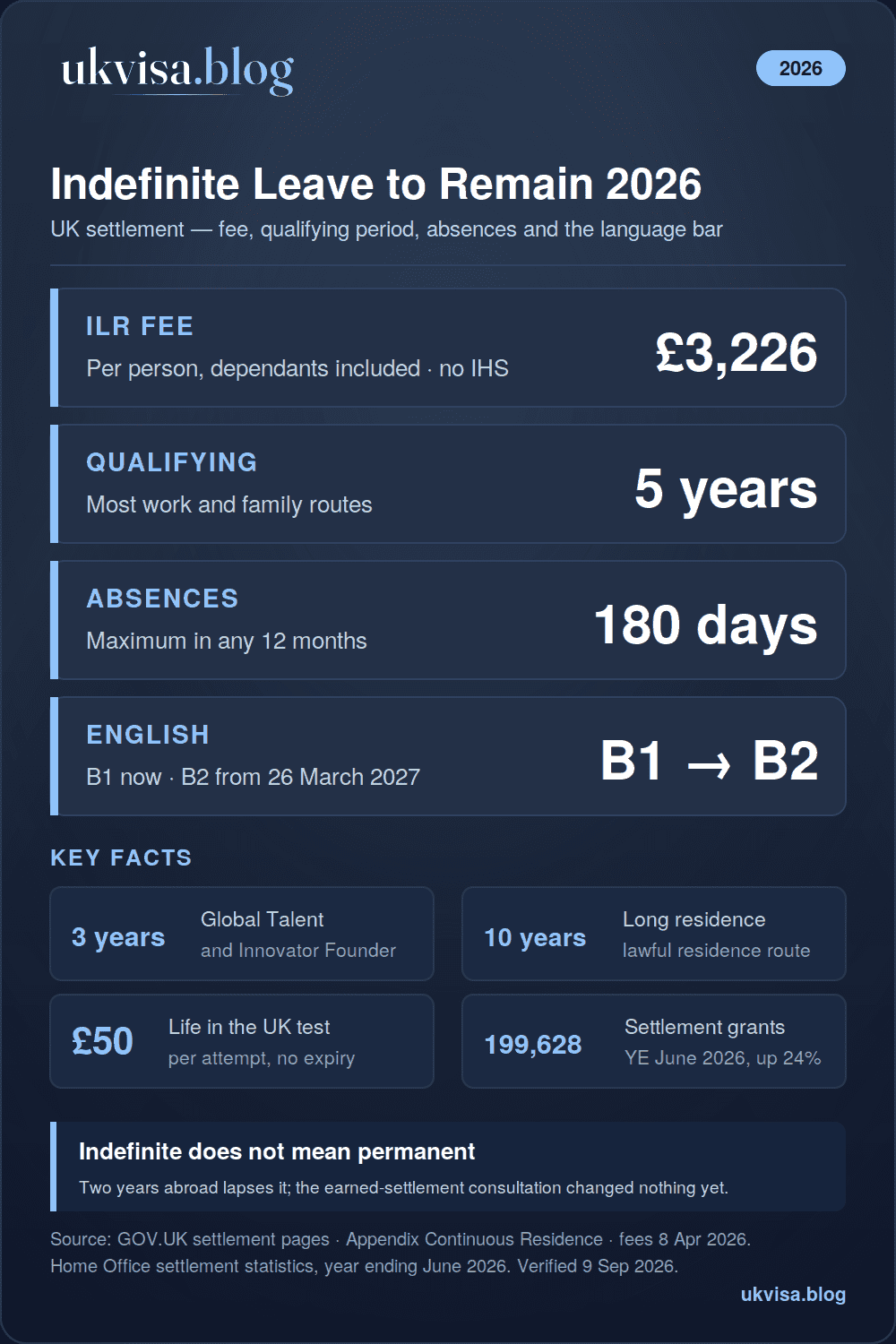
Most work routes qualify after five years; Global Talent and Innovator Founder can be three. Long residence is ten years. The fee is £3,226 per person, with no health surcharge. You need B1 English and a pass in the Life in the UK test, which costs £50. Settlement can be lost by two years' continuous absence from the UK.
The Word "Indefinite" Does Not Mean Permanent
It means no end date, not no conditions. Settlement can lapse through absence and can be revoked on suitability grounds, so it is better understood as permission that does not expire on a date than as a status nothing can touch. Citizenship is the only status that removes that residual exposure entirely.
Settled Status Is a Different Thing
EU Settlement Scheme settled status gives an equivalent position but comes from a separate scheme with its own rules and its own absence provisions. Pre-settled status is limited leave rather than settlement. Holders of any of them prove status digitally — see our page on the eVisa and UKVI accounts.
Routes and Qualifying Periods
Qualifying Period by Route
| Route | Qualifying period |
|---|---|
| Skilled Worker and most work routes | 5 years |
| Global Talent | 3 years |
| Innovator Founder | 3 years |
| Legacy Tier 1 categories | 2 or 3 years |
| UK Ancestry | 5 years |
| British National (Overseas) | 5 years |
| Partner of a British or settled person | 5 years |
| Long residence | 10 years |
Source: GOV.UK settlement pages and the route appendices. Checked 22 August 2026.
What Every Route Requires
- The qualifying period completed: on a route that counts towards settlement.
- Continuous residence: within the absence limits for your route.
- Knowledge of English: normally B1, with exemptions — see our page on English requirements.
- The Life in the UK test: £50 per attempt — see our page on the Life in the UK test.
- Suitability: criminality, deception and immigration breaches all apply — see our page on Part Suitability grounds.
- The route's own conditions: continuing employment, a continuing relationship, or the relevant business criteria.
Route-specific requirements sit on our pages for Skilled Worker settlement, settlement as a partner, the ten-year family life route, bereaved partners, former entrepreneur routes and the ECAA route.
The 180-Day Absence Rule
Appendix Continuous Residence governs absences on the routes it covers, and the limit is 180 days in any rolling twelve-month period. Exceeding it breaks continuous residence and, unless an exception applies, restarts the qualifying period.
Appendix Continuous Residence does not list Appendix FM, so the 180-day cap does not govern the five-year partner or parent routes. It does apply to the ten-year family life route under Appendix Settlement Family Life. Check which appendix governs your own route before counting days — see our page on the continuous residence requirement.
How the Count Works
It is a rolling window, not a calendar year. Any twelve-month period ending during the qualifying period is tested, so a long trip spanning a year boundary can breach the limit even though neither calendar year alone exceeds 180 days. Reconstruct absences from passport stamps and boarding passes before applying.
Exceptions
Absences can be disregarded in defined circumstances, including assisting with a national or international humanitarian or environmental crisis, and absences for reasons connected with the applicant's employment where the route allows it. These are specific provisions rather than a general discretion, so check the appendix rather than assuming.
Applying
- Confirm the qualifying period: and that every part of it counts.
- Count absences: against the limit for your route.
- Sit the tests: Life in the UK and English, unless exempt.
- Choose the right form: see our SET form guide.
- Apply online and pay £3,226: per applicant, with no health surcharge.
- Prove identity and enrol biometrics: at an appointment or through the app.
Priority services are available on settlement applications across a broad list of categories. Our pages on settlement decision times, priority services and processing after biometrics cover the timing, and our in-country fee page the costs.
No Health Surcharge
Applications for indefinite leave to enter or remain are exempt from the immigration health surcharge. That is worth noting when budgeting, because it is the only major application on most routes where the surcharge does not apply — see our page on the health surcharge.
Where Settlement Applications Actually Fail
- Absences over the limit: counted on a rolling twelve-month basis, not by calendar year.
- A gap in the qualifying period: a period without permission, or on a route that does not count towards settlement.
- The wrong form: which can make the application invalid rather than merely wrong.
- The wrong English qualification: the wrong level, the wrong components, or an unapproved provider.
- No Life in the UK pass: or a pass certificate that cannot be verified.
- Suitability: convictions, immigration breaches, unpaid tax or an NHS debt.
- Route conditions not met at the date of application: employment ended, or a relationship that has broken down.
Every one of those is checkable before the £3,226 is spent, and none of them is refunded afterwards. The single most useful preparation is reconstructing the absence record from passport stamps and boarding passes, because it is the failure applicants most often discover only in the refusal notice.
Timing the Application
You can normally apply up to 28 days before the qualifying period completes. Applying earlier than that risks a refusal for applying too soon, and the fee is not returned. Applying late is not penalised in itself, but it delays the twelve-month clock towards naturalisation on the general route.
Settlement or Citizenship
Settlement removes the time limit. Citizenship removes the immigration system altogether, and gives a British passport, the vote, and freedom from any absence rule. Most people take both, in that order, because settlement is a precondition for naturalisation on the ordinary route.
The general route requires twelve months holding settlement before naturalising. Spouses of British citizens can apply as soon as they hold it. See our page on naturalisation requirements.
Dependants Settle in Their Own Right
A partner or child on a dependant visa does not settle automatically when the main applicant does. Each makes their own application, meets the requirements that apply to them, and pays their own £3,226. Children under 18 are generally exempt from the English and Life in the UK requirements; adult dependants are not.
Timing rarely lines up neatly. A dependant who joined the household two years into the main applicant's route reaches their own qualifying point later, and may need one further extension while the main applicant settles. Plan the sequence rather than assuming a single family application — see our page on dependants and, where a relationship has changed, our page on relationship changes on a partner visa.
After Settlement
- No time limit and no work conditions: any employment or self-employment.
- Access to public funds: subject to the ordinary eligibility rules.
- Home fee status for study: subject to the relevant residence conditions.
- The ability to sponsor family: as a settled person — see our spouse route page and our page on dependants.
- A route to citizenship: after the qualifying period.
How Settlement Is Lost
Two continuous years outside the UK ends it. That is the most common way it goes, and it goes quietly — there is no notification, and people discover it when they try to return. Anyone planning an extended period abroad should take advice before leaving rather than after.
It can also be revoked on suitability grounds, including where deception is found, and it lapses on deportation. Our page on administrative review (AR) covers what can be challenged where a settlement application is refused.
Returning Residents
Where settlement has lapsed through absence, a returning resident application is the route back, and it is discretionary rather than automatic. It asks about your ties to the UK, the reason for the absence, and whether you intended to make the UK your permanent home. Two years abroad with strong continuing ties is a very different application from five years abroad with none.
Proposed Changes to Settlement
The government consulted on an earned settlement model, and the consultation closed on 12 February 2026. The proposals would change qualifying periods for some routes, with contribution-based factors affecting how quickly settlement is reached.
Nothing has been laid in the Rules. The current qualifying periods apply until they are. One protection was stated in the consultation material: partners, parents and children of British citizens who hold that status throughout the qualifying period would keep five years. Treat everything else as proposal rather than requirement until a statement of changes appears.
Sources: the GOV UK settlement pages, Appendix Continuous Residence, the Life in the UK test pages, the Home Office fee table effective 8 April 2026 and the earned settlement consultation. Figures verified 22 August 2026.
Frequently Asked
Settlement Questions
How long before I can apply for settlement?
Five years on most work routes and the partner route, three on Global Talent and Innovator Founder, and ten on long residence. Legacy Tier 1 categories can be two or three.
How much does it cost?
£3,226 per applicant from 8 April 2026, up from £3,029. There is no health surcharge on a settlement application.
What is the 180-day rule?
Under Appendix Continuous Residence, no more than 180 days outside the UK in any rolling twelve-month period. It applies to the routes that appendix governs.
Does the 180-day rule apply to the spouse route?
Appendix Continuous Residence does not list Appendix FM, so it does not govern the five-year partner or parent routes. It does apply to the ten-year family life route. Check which appendix governs yours.
Do I need the Life in the UK test?
Yes on most routes, at £50 per attempt, alongside B1 English. Exemptions apply at 65 and over and for long-term physical or mental conditions.
Is settlement the same as citizenship?
No. Settlement removes the time limit on your stay. Citizenship gives a British passport and the vote, and is applied for separately, usually twelve months after settlement.
Can I lose settlement?
Yes. Two continuous years outside the UK ends it, and it can be revoked on suitability grounds or lapse on deportation. There is no warning when it lapses through absence.
Can I pay for a faster decision?
Priority services are available across a broad list of settlement categories, though some carry channel restrictions. Check the position for your own route before paying.
Will the earned settlement proposals change my qualifying period?
Nothing has been laid in the Rules, so the current periods apply. Partners, parents and children of British citizens holding that status throughout were stated to keep five years.
Can I apply early?
Normally up to 28 days before the qualifying period completes. Applying earlier than that risks refusal for applying too soon, and the fee is not returned.
What if my settlement lapsed while I was abroad?
A returning resident application is the route back. It is discretionary and turns on your ties to the UK, the reason for the absence, and whether you intended the UK to remain your permanent home.
Does my settlement application cover my family?
No. Each person applies and pays separately at £3,226, which is why settlement is the largest single bill most families meet.