
A UK long term visitor visa lets you visit the United Kingdom multiple times over 2, 5, or 10 years without applying for a new visa for each trip. Whether you're visiting family, attending recurring business meetings, or planning regular UK holidays, choosing the right validity tier saves you hundreds of pounds and weeks of repeated application admin. This guide compares the 2-year (£506), 5-year (£903), and 10-year (£1,128) options under the 8 April 2026 fee structure, explains who qualifies for each tier, and covers the first-time applicant warnings that determine whether to start with 6 months or aim higher straight away.
A 10-year visa works out to £112.80 per year, compared with £270/year for two 6-month visas. If you'll visit the UK at least once annually over 5+ years and your circumstances are stable, the 10-year option saves hundreds of pounds over the period — and removes the repeated application cycles.
- What Is a Long Term Visitor Visa?
- UK Long Term Visitor Visa Fees 2026
- 2 Year Visitor Visa UK Requirements
- 5 Year UK Visitor Visa Eligibility
- 10 Year UK Visa Requirements
- First-Time Applicants: Should You Aim Long?
- How to Apply for a Long Term UK Visitor Visa
- Long Term Visitor Visa for Parents and Grandparents
- Renewal, Expiry and Reapplication
- Frequently Asked Questions
UK Long Term Visitor Visa Tiers Compared (2026)
The long term visitor visa — officially the Long-Term Standard Visitor Visa under Appendix V of the Immigration Rules — is the same standard visitor visa most tourists hold, but with extended validity. The 2-year, 5-year, and 10-year tiers all allow the same activities and the same 180-day maximum stay per visit. The only thing that changes between tiers is how long the visa remains usable before you must reapply.
UKVI caseworker guidance explicitly acknowledges long-term visitors: "where a visitor holds a long-term, multiple entry visit visa valid for 2, 5 or 10 years, it is likely that their reason for visiting will differ over time." This is taken from the Visit caseworker guidance, the internal manual decision-makers use when granting these visas — and it confirms that legitimate long-term holders are expected to come for varied permitted activities (tourism one trip, family visit the next, business meeting later) rather than a single fixed purpose.
What Is a Long Term Visitor Visa?
A UK long term visitor visa is a Standard Visitor visa issued for 2, 5, or 10 years validity instead of the default 6 months. It allows multiple visits within that period, each capped at 180 days. You can use it for tourism, family visits, business meetings, and other permitted activities — but you cannot work, study long-term, or access public funds. Designed for people with ongoing, credible reasons for frequent UK travel.
The Long-Term Standard Visitor Visa carries exactly the same conditions as a 6-month Standard Visitor Visa: no employment, no recourse to public funds, no long-term study, and no marriage (without a separate Marriage Visitor Visa). What you get for the higher upfront fee is convenience — multiple trips over years without repeatedly compiling supporting documents, paying biometric appointment fees, and waiting 3 weeks for each decision.
Who Should Apply for a Long Term Visitor Visa?
Long term visitor visas suit people with genuine, ongoing reasons to visit the UK repeatedly over years. UKVI assesses whether your need for frequent travel is credible — applying for a 10-year visa simply because you want a long visa is unlikely to succeed without supporting evidence.
- Parents and grandparents of UK residents: regular trips to see family, school events, and grandchildren
- Business professionals: recurring client meetings, conferences, or commercial relationships requiring multiple UK trips per year
- Property owners: managing UK property, holiday homes, or buy-to-let portfolios in person
- Established frequent tourists: demonstrated pattern of repeat UK tourism with clear ongoing interest
- Cultural and alumni connections: attending recurring conferences, university alumni events, or professional association meetings
Some purposes are better served by specific visa categories rather than a long-term visitor visa. Recurring medical treatment fits the UK medical visa; getting married in the UK requires a Marriage Visitor Visa; and bringing close family on regular trips often pairs with the Family Visitor Visa route. Choose the visa that matches your actual intended activities — applying for the wrong category is one of the most common UK visa refusal reasons.
UK Long Term Visitor Visa Fees 2026
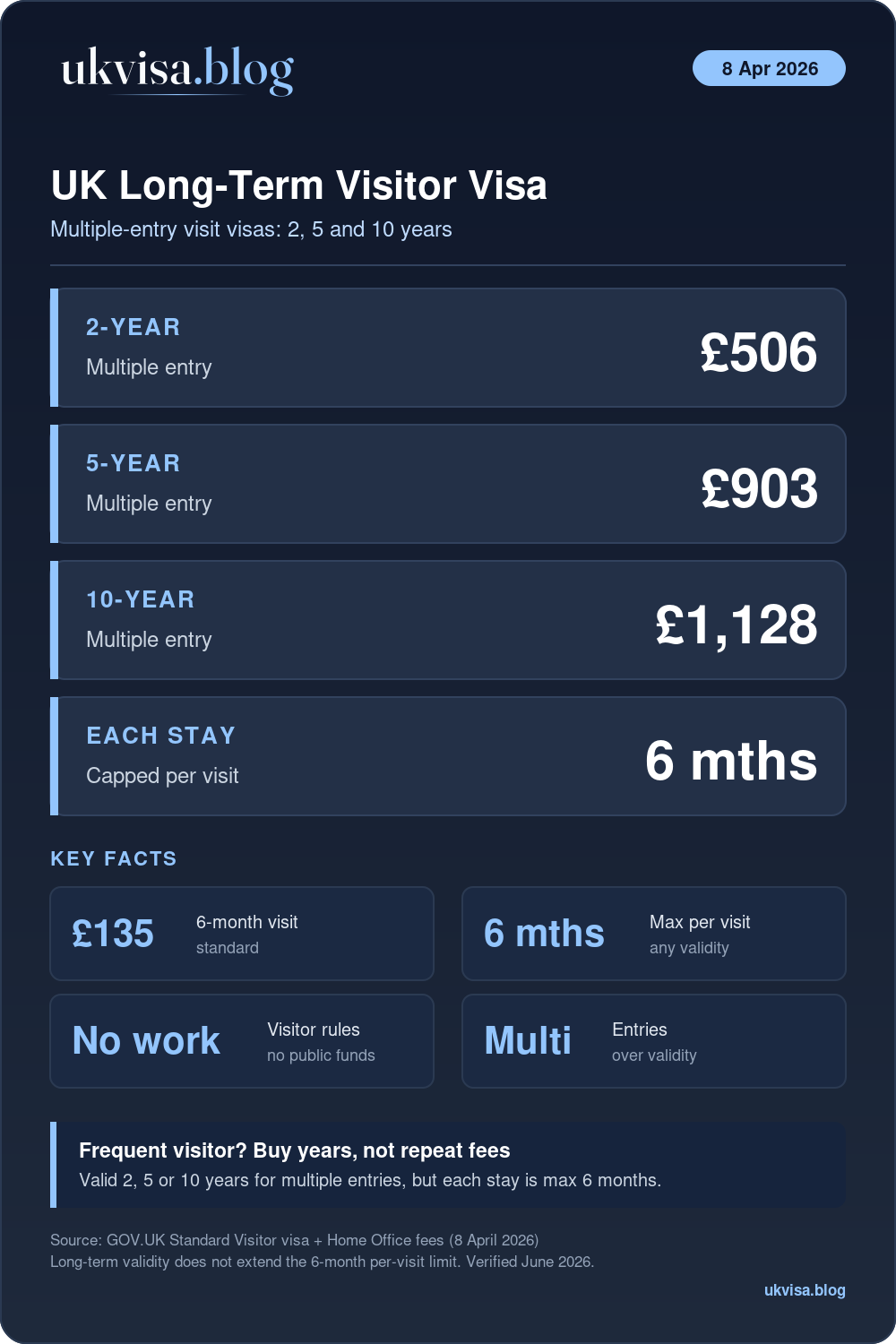
UK long term visitor visa fees from 8 April 2026: 2-year visa £506, 5-year visa £903, 10-year visa £1,128. Compare against £135 for a 6-month visa. Optional priority service costs £500 extra (5-day decision), and super priority costs £1,000 extra (next-day decision) where available. Fees increased 6-7% from the previous rates on 8 April 2026.
The official UK visitor visa fees rise with validity length, but per-year cost drops significantly. A 10-year visa works out to roughly £113 per year — less than half the per-year cost of the 6-month visa. The catch is the higher upfront commitment: visa fees are non-refundable, so if your circumstances change before you've used the validity period, you can't recover the difference. Current rates are published in the Home Office's immigration and nationality fees schedule.
| Visa Validity | Fee (from 8 April 2026) | Cost Per Year | Saves vs Buying 6-Month Visas |
|---|---|---|---|
| 6 months | £135 | £270 per year | Baseline |
| 2 years | £506 | £253 per year | £34 if you'd buy 2 × 6mo per year |
| 5 years | £903 | £180.60 per year | £447 over 5 years |
| 10 years | £1,128 | £112.80 per year | £1,572 over 10 years |
For applicants needing faster processing, UK priority visa services are available at additional cost. Priority service did NOT change on 8 April 2026 — only the base visa fees increased, so priority remains £500 and super priority remains £1,000.
Visa Fee + Total Application Costs Breakdown
Beyond the Home Office fee, total application cost includes biometric appointment charges (varies by country, typically £0–£50), optional extras like document scanning (£5–£15), and translation costs if documents aren't in English. For most applicants, the realistic total is £20–£75 above the headline fee. Visit visa holders do not pay the Immigration Health Surcharge — that only applies to applicants staying more than 6 months on a single visa, which never applies to visit visa stays regardless of validity tier.
2 Year Visitor Visa UK Requirements
A 2-year UK visitor visa costs £506 and is the entry-level long-term tier. It suits applicants with 1-2 previous compliant UK visits, or first-time applicants with very strong evidence of an ongoing reason to visit (e.g., adult children settled in the UK). The 2-year tier is achievable for first-time applicants but requires substantially stronger evidence than a 6-month application.
The 2-year visa is the most commonly granted long-term tier. UKVI sees applications for 2-year validity from a wide range of applicants — both established UK visitors stepping up from repeated 6-month visas, and newer applicants with clear reasons (such as a child who has recently moved to the UK) that justify ongoing travel over the medium term.
What Makes a Strong 2-Year Application?
- Specific, ongoing purpose: "My daughter started her PhD at Imperial College in 2025 and the programme runs to 2028 — I want to visit her twice a year"
- 1-2 previous UK trips: evidence of compliant visits demonstrates you follow the rules
- Stable home country position: ongoing employment, property ownership, dependent family members
- Consistent finances: 6 months of bank statements showing salary deposits and balance above £3,000–£5,000
- Travel history elsewhere: previous compliant trips to Schengen countries, USA, Canada, or Australia all demonstrate immigration compliance
5 Year UK Visitor Visa Eligibility
A 5-year UK visitor visa costs £903 (£180.60 per year). It typically suits applicants with 3-4 previous compliant visits over 2+ years, plus stable home country circumstances unlikely to change over the medium term. The 5-year tier is the sweet spot for established frequent business travellers and parents of UK-settled adult children.
UKVI grants 5-year visas where the case for ongoing UK travel is well-evidenced and the applicant's stability over the period is reasonably predictable. Caseworkers must be confident your circumstances — employment, family, financial position — will remain consistent with genuine visitor status throughout the validity window.
| Profile Element | What Strengthens a 5-Year Application |
|---|---|
| Travel history | 3-4 previous UK visits over 2+ years, all under 180 days, with timely departure |
| Employment | Long-term employment (3+ years with current employer) or established business ownership |
| Financial stability | Consistent income, savings of £8,000+, no recent large unexplained deposits |
| Ties to home country | Property ownership, dependent family, ongoing professional commitments |
| Reason for UK visits | Specific, durable purpose: family ties, recurring business, established cultural activities |
10 Year UK Visa Requirements
A 10-year UK visitor visa costs £1,128 (£112.80 per year — the best per-year value of any visa tier). UKVI typically grants 10-year visas to applicants with extensive UK travel history (5+ previous visits), very stable circumstances, and compelling ongoing reasons such as retirement-age parents of British citizens or long-established business travellers. First-time applicants almost never succeed at this tier.
The 10-year visa carries the highest evidentiary bar of the long-term tiers because UKVI must be confident your circumstances will remain stable for an entire decade. Realistic profiles include retired parents of UK-settled adult children (pension income, no career uncertainty, established family pattern) and senior business professionals with decade-long UK commercial relationships.
How Much Time Can You Spend in the UK With a 10-Year Visa?
A 10-year visa does not mean 10 years of UK residence. Each individual visit is capped at 180 days, exactly the same as a 6-month visa. The 10-year tier is about validity (how long the visa remains usable) — it does not change your maximum permitted stay per trip.
More importantly, Appendix V paragraph 4.2(a) prohibits visitors from "living in the UK for extended periods through frequent or successive visits." Even with a 10-year visa, spending more time in the UK than in your home country over a sustained period will trigger questioning at the border and can lead to entry refusal or visa cancellation. The 180-day-per-visit cap is a ceiling, not a target.
First-Time Applicants: Should You Aim Long?
First-time UK visitor visa applicants CAN apply for any long-term tier, but approval depends on the strength of the case. A 2-year visa is realistic for first-time applicants with compelling circumstances. 5-year approval is harder. 10-year approval for first-timers is rare and typically reserved for very exceptional cases. The safer strategy is often: start with 6 months, build a compliant travel history, then upgrade on the next application.
There's no rule preventing first-time applicants from requesting any validity period. However, UKVI assesses whether you'll comply with visa conditions across the entire validity window — and without prior UK visits to demonstrate compliance, caseworkers have less basis for that confidence at the longer tiers.
Recommended Staged Strategy
- Year 1: Apply for 6-month visa, complete one or two compliant trips well under 180 days
- Year 2: Apply for 2-year visa with evidence of compliant first visit(s)
- Year 3-4: Use the 2-year visa for 2-3 more compliant trips
- Year 5 onwards: Apply for 5-year or 10-year tier with strong compliance history
This costs slightly more in cumulative fees than a successful first-time 10-year application (£135 + £506 + £903 = £1,544 vs £1,128 single-shot), but the refusal risk is dramatically lower. For applicants from countries with lower visa success rates, the staged approach often becomes the only realistic path to a 10-year visa.
How to Apply for a Long Term UK Visitor Visa
Apply online via GOV.UK, select your preferred visa duration (2, 5, or 10 years), pay the fee, attend a biometric appointment, and submit supporting documents. The process is identical to a 6-month standard visitor visa — you simply choose the longer validity at the application stage. Standard processing is approximately 3 weeks (15 working days) from biometric appointment.
Application steps for any validity tier are the same. The UK visa application form asks you to select your preferred validity at the start — UKVI will not unilaterally award a longer visa than you requested, so this choice matters. If your evidence supports 5 years but you only applied for 2 years, you'll get 2 years.
- Valid passport with validity covering the requested visa period
- Previous passports (if any) showing UK and international travel history
- Bank statements for the past 6 months (minimum)
- Employment letter or business registration documents
- Property ownership documents or long-term tenancy agreements
- Evidence of family ties in your home country
- Written explanation of your ongoing reason for repeated UK visits over the requested period
- Invitation letter (if visiting family or business contacts in the UK)
- Travel itinerary or planned visit dates for the first trip
For comprehensive document preparation, see our UK visa supporting documents checklist. If someone in the UK is hosting your visits, they should review the UK visitor visa sponsor requirements and provide appropriate documentation.
Processing Time and Priority Options
UK visa processing time after biometrics is approximately 3 weeks (15 working days) for long-term visas — the same as 6-month applications. Longer validity does not mean longer processing. If your application stretches beyond the standard timeline, our guide on UK visa delay covers what to do when an NSF email arrives. Priority service (£500 extra) typically delivers a decision within 5 working days; super priority (£1,000 extra) targets next-working-day where available.
Long Term Visitor Visa for Parents and Grandparents
Parents and grandparents of UK residents are the strongest applicant profile for long-term visitor visas. The family relationship provides an obvious, durable reason for repeated UK visits. Applications should include proof of relationship, the UK-based child's immigration status, evidence the parent will return home after each visit, and financial evidence (pension, savings, or sponsorship undertaking).
Parents visiting adult children settled in the UK make up a large share of successful long-term visitor visa applications. The case writes itself: grandchildren grow up, school events, birthdays, holidays, and family milestones provide a clear stream of legitimate visiting reasons that won't disappear over a 5 or 10-year window.
Key Documents for Parent Long-Term Visa Applications
- Proof of relationship: birth certificate linking parent to UK-resident child
- Child's UK immigration status: British passport copy, ILR documentation, or current visa
- Invitation letter: from child detailing accommodation, visit purposes, and confirmation of return arrangements
- Parent's financial evidence: pension statements, savings, investments, or child's signed sponsorship undertaking
- Home country ties: property ownership, other family members in home country, community involvement, ongoing healthcare arrangements
Retired parents often have the strongest profile: pension income continues regardless of travel, property ownership is established, healthcare arrangements are settled, and visiting grandchildren is a reason that endures across the full visa validity. The 10-year tier is realistically achievable for retired parents with British grandchildren.
Sponsoring a Parent's Long-Term Visa: Income and Accommodation
UK-based children sponsoring a parent's visit visa application don't need to meet the rigid income thresholds that apply to spouse visas. The standard is "adequate maintenance and accommodation" — typically demonstrated through bank statements showing the sponsor can cover the parent's stay without recourse to public funds. UKVI caseworker guidance allows third-party financial support including from family members, provided the relationship is genuine and the sponsor is not in breach of UK immigration law.
Renewal, Expiry and Reapplication
UK long term visitor visas cannot be renewed — when validity expires, you must submit a fresh application from outside the UK. There's no in-country extension to a long-term tier. You can reapply at any time, including immediately after expiry, and your previous compliant use of the visa strengthens the new application. Applying 3-6 months before existing visa expires is sensible if you have planned trips.
The "renewal" concept doesn't really exist for visitor visas — it's always a fresh application, treated independently of your prior visa. The good news: a clean history of compliant use across a previous 2-year or 5-year visa is one of the strongest pieces of evidence for the next tier up. Many applicants follow a natural progression: 6-month → 2-year → 5-year → 10-year.
What If My Visa Expires While I'm in the UK?
If you're in the UK when your visa validity expires, you can stay until the end of your current 180-day permitted period of entry. For example: enter on 1st March on a visa expiring 30th April — you can stay until late August (180 days from entry), even though the visa expired earlier. But once you leave, you cannot re-enter on the expired visa. In genuinely exceptional cases, you can apply to extend your UK visit visa from inside the UK — the extension fee is £1,172, and applications must be submitted before your current leave expires.
- All three long-term tiers (2/5/10 year) permit the same 180-day maximum stay per visit — the only difference is how long the visa remains usable
- 8 April 2026 fees: 2-year £506, 5-year £903, 10-year £1,128 — the 10-year tier offers the best per-year value at £112.80
- First-time applicants face higher refusal risk at the 10-year tier — the staged 6mo → 2yr → 5yr → 10yr approach is safer for borderline cases
- Parents and grandparents of UK residents are the strongest profile — retirement-age applicants with British grandchildren realistically achieve 10-year validity
- Spending more time in the UK than your home country risks visa cancellation under Appendix V 4.2(a), regardless of visa validity remaining
Frequently Asked Questions about UK Long Term Visitor Visa
How long can I stay in the UK with a 2-year visitor visa?
A 2-year UK visitor visa caps each individual visit at 180 days (approximately 6 months). The 2-year validity means you can make multiple trips during that period without reapplying, but each separate visit must stay under 180 days. The maximum stay rule is per-visit, not annual.
Can I apply for a 10 year UK visitor visa as a first-time applicant?
You can apply, but approval is extremely unlikely without prior UK travel history. UKVI caseworkers need evidence you'll comply with visa conditions across a full decade — without prior visits demonstrating compliance, that confidence is hard to establish. First-time applicants typically succeed at the 6-month or 2-year tier and progress to 10-year on subsequent applications.
What is the difference between a 6-month and 2-year UK visitor visa?
The only difference is validity — how long the visa can be used. Both allow the same 180-day maximum stay per visit, both are multiple entry, both share identical conditions on work, study, and public funds. A 2-year visa costs £506 vs £135 for 6 months, but if you'll make multiple trips, it saves money on repeated applications and processing time.
Do I need a good travel history to get a long term UK visitor visa?
Travel history isn't a formal requirement, but it materially strengthens applications at the 5-year and 10-year tiers. Previous compliant UK visits prove you understand and follow immigration rules. Travel to other countries with strict visa systems (Schengen, USA, Canada, Australia) also helps. Without travel history, you'll need exceptionally strong home-country ties and a very compelling ongoing reason for repeated visits.
Is a 5-year or 10-year UK visitor visa worth it?
The value depends on visit frequency and circumstance stability. A 10-year visa at £1,128 works out to £112.80/year, vs £270/year for two 6-month visas. If you'll visit at least annually for 5+ years and your situation is stable, the long-term tier saves significant money plus admin time. Counterpoint: fees are non-refundable, so if circumstances change before you've used the validity, you can't recover the cost.
What happens if my long term visitor visa application is refused?
You'll receive a refusal letter explaining the reasons. There's no right of appeal for visitor visa refusals, but you can reapply immediately with a stronger application addressing the concerns. The refusal becomes part of your permanent immigration record and must be disclosed on all future applications. See our chances of getting a UK visa after refusal guide for reapplication strategy.
Can I work or study on a long term UK visitor visa?
No — long term visitor visas carry the same restrictions as 6-month standard visitor visas. No paid or unpaid employment in the UK. No study beyond 6 months (recreational courses are capped at 30 days); longer or degree-level study needs a Student or Short-term Study visa. No access to public funds or NHS treatment beyond emergency care. Violating these conditions can result in visa cancellation, removal, and future entry bans.
Can I switch from a visitor visa to a work or family visa while in the UK?
Generally no — most UK immigration categories prohibit in-country switching from visitor status. You typically must return home and apply for the new visa from there. Narrow exceptions exist, such as switching to a spouse visa if you entered specifically to marry and the conditions were met. Attempting to switch where it's not permitted can result in refusal and affect future applications.