
The general grounds for refusal are the suitability rules that apply to every UK visa, leave-to-remain, and settlement application, whatever route you use. Since 11 November 2025 they sit in Part Suitability of the Immigration Rules (HC 1333), which replaced the former Part 9 and uses SUI numbering. Part Suitability covers mandatory grounds (automatic refusal) and discretionary grounds (refusal depends on circumstances). The most common issues are adverse immigration history, deception, criminal convictions, and medical grounds. This guide explains every ground, the re-entry ban structure, how to check your ban status, and the remedies after a refusal.
Source: Immigration Rules Part Suitability (HC 1333, effective 11 November 2025); Home Office suitability caseworker guidance; HC 1691 (laid 5 March 2026); 10 February 2025 good character policy update
Part Suitability is the backbone of UK suitability assessment, applying to entry clearance, permission to stay, ILR, and naturalisation. From 11 November 2025 it replaced Part 9 (via HC 1333), introduced SUI numbering, and extended suitability grounds to Appendix FM family routes for the first time. The UK ETA scheme is exempt — it has its own rules in Appendix ETA. NHS debt £500+ remains a discretionary ground (SUI 16.1), and the 10-year deception ban (SUI 9.1) is unchanged. A 2021 simplification had earlier replaced the old 320/321/322 numbering with 9.x.x; the 2025 reform is the latest.

- Understanding Part Suitability (General Grounds for Refusal)
- Mandatory vs Discretionary Refusal Grounds
- Adverse Immigration History — Definition and Triggers
- Re-Entry Bans — 1, 2, 5, and 10-Year Structure
- UK Visa Refusal on Medical Grounds
- Deception and False Representations — 10-Year Mandatory Ban
- Criminal Convictions — Sentence Length Thresholds
- How to Check Your UK Ban Status
- Suitability and the UK ETA Scheme
- Complete List of Part Suitability Refusal Grounds
- Remedies After General Grounds Refusal
- Frequently Asked Questions
General Grounds for Refusal Under Part Suitability of the Immigration Rules
The general grounds for refusal are the suitability rules on which any UK visa, leave-to-remain, settlement, or naturalisation application can be refused, whatever route is used. Since 11 November 2025 they sit in Part Suitability (which replaced Part 9 via HC 1333). Unlike eligibility requirements — salary thresholds, English tests, financial rules — which are route-specific, suitability applies universally: you can meet every eligibility criterion and still be refused. The common issues are adverse immigration history, deception, criminal convictions, and character grounds. A key 2025 change is that these grounds now reach Appendix FM family routes, which previously had more generous provisions.
Understanding Part Suitability (General Grounds for Refusal)
The general grounds for refusal are set out in Part Suitability of the Immigration Rules (which replaced Part 9 on 11 November 2025, using SUI numbering). They apply to every application — entry clearance, leave to enter, leave to remain, and settlement. Part Suitability tests suitability (character, conduct, immigration history, criminality) rather than eligibility (your route's requirements). You can meet every requirement of any route and still be refused for adverse immigration history, an unspent conviction, NHS debt over £500, or past deception.
The distinction between eligibility and suitability is fundamental. A Skilled Worker applicant with a valid Certificate of Sponsorship, a qualifying salary, and a SELT pass can still be refused on suitability grounds — for adverse immigration history, an unspent conviction, or past deception. The numbering changed twice: the 2021 simplification replaced the old 320/321/322 paragraphs with the 9.x.x structure, and HC 1333 then replaced Part 9 with Part Suitability and SUI numbering on 11 November 2025. The 2025 reform tightened several thresholds and widened the routes affected.
Mandatory vs Discretionary Refusal Grounds
Part Suitability splits refusal grounds in two. Mandatory refusal: the caseworker MUST refuse — no discretion. Examples: exclusion or deportation orders (SUI 2.1), non-conducive to the public good (SUI 3.1), custodial sentences of 12 months or more (SUI 5.1(a)), persistent offending (SUI 5.1(b)), serious-harm offences (SUI 5.1(c)), proven deception (SUI 9.1), and unexpired re-entry bans (SUI 12.1). Discretionary refusal: the caseworker MAY refuse. Examples: custodial under 12 months (SUI 5.3(a)), non-custodial convictions (SUI 5.3(b)), sham marriage (SUI 8.1), NHS debt £500+ (SUI 16.1), and unpaid litigation costs (SUI 17.1).
Key Differences Between Mandatory and Discretionary Grounds
| Aspect | Mandatory | Discretionary |
|---|---|---|
| Decision requirement | MUST refuse if criteria met | MAY refuse based on circumstances |
| Caseworker discretion | None — automatic refusal | Full discretion to consider context |
| Common examples | Deportation orders, 10-year deception ban, custodial 12mo+, persistent offending, exclusion orders, active re-entry ban | Custodial under 12mo, non-custodial conviction, sham marriage, false representations, NHS debt, failure to provide information |
| Mitigation possible? | Generally only after ban / sentence expires | Yes — evidence of rehabilitation, time elapsed, exceptional circumstances |
| Typical severity | Serious — usually time-barred for a fixed period | Variable — depends on facts and applicant's response |
Adverse Immigration History — Definition and Triggers
Adverse immigration history means any past breach of UK immigration law that harms future applications: overstaying, breach of conditions (working without permission, claiming public funds), illegal entry, removal or deportation, and port refusals. Consequences range from discretionary refusal to mandatory re-entry bans of 1, 2, 5, or 10 years under SUI 12.1, depending on severity and how the applicant left the UK (see the dedicated section below).
Types of Adverse Immigration History
- Overstaying: Remaining in the UK beyond the expiry of your visa or leave without a pending in-time application. Even one day's overstay can trigger a discretionary refusal; an overstay of more than 30 days followed by departure can trigger a mandatory re-entry ban
- Breach of conditions: Working without permission (e.g. Student visa holders working beyond permitted hours), claiming public funds when prohibited, conducting business when conditions prohibit it
- Illegal entry: Entering the UK without valid entry clearance when required, entering by deception (e.g. using false documents), or clandestine entry (small boats, lorries)
- Removal or deportation: Previously removed from the UK (administrative removal) or deported (under a deportation order signed by the Secretary of State following a criminal conviction)
- Port refusals: Refused entry at the UK border by Border Force on previous occasions
- Departure at public expense: Having previously left the UK at public expense (e.g. via an Assisted Voluntary Return scheme) triggers a 2-year or 5-year ban depending on timing
Overcoming Adverse Immigration History (for Discretionary Cases)
If your adverse history falls under discretionary grounds — a short overstay with no mandatory ban, or a breach of conditions that did not lead to removal — you can reduce refusal risk with a detailed cover letter, evidence of compliance since, and any compelling factors. Time elapsed matters: the longer ago the breach and the more compliant you have been since, the less weight it carries. For applicants under a mandatory re-entry ban (SUI 12.1), the only option is to wait for it to expire, barring rare human rights or compassionate cases.
Re-Entry Bans — 1, 2, 5, and 10-Year Structure
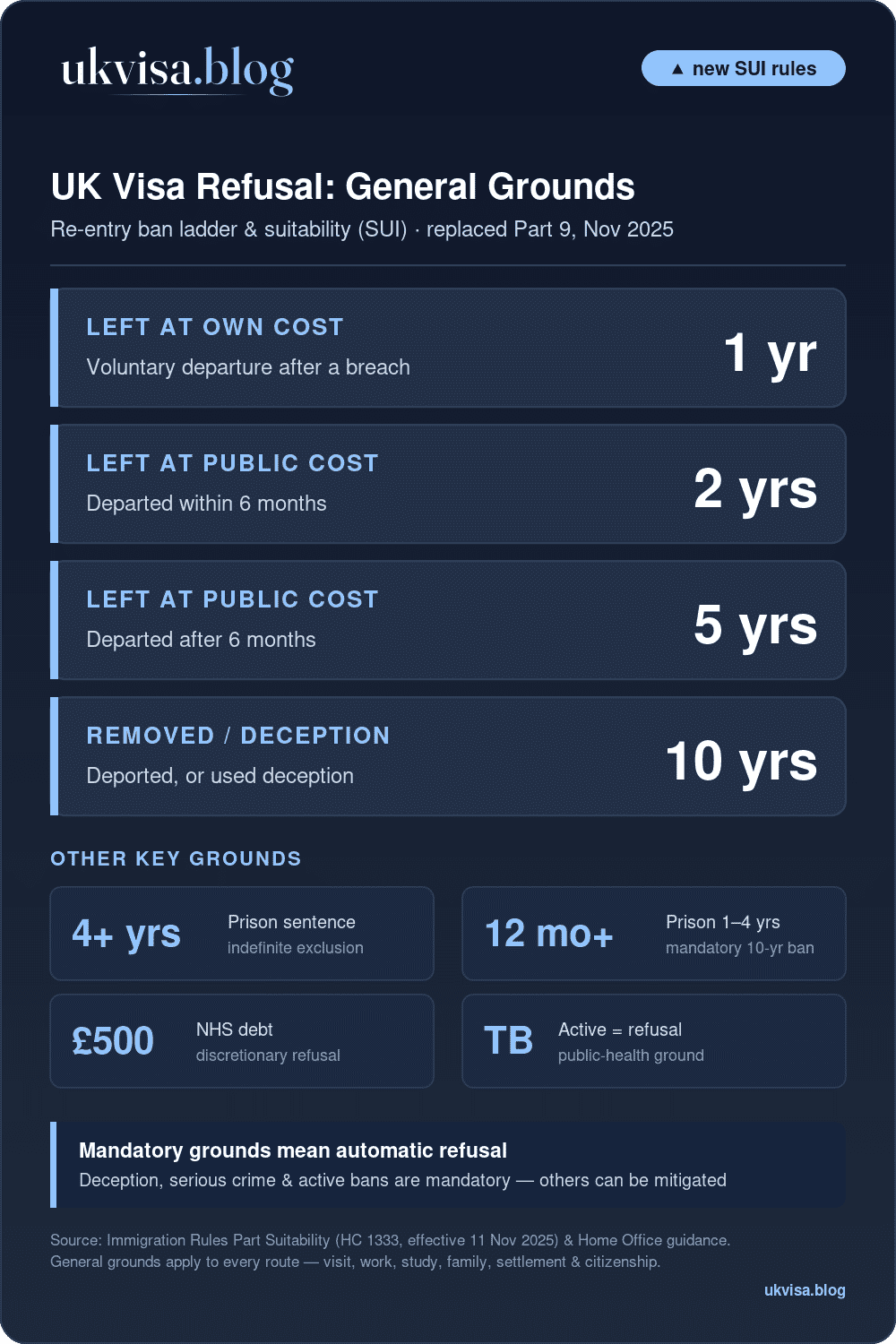
The re-entry ban structure under SUI 12.1 sets graduated time bars based on how you left the UK. 12 months: overstayed 30+ days (or breached conditions / entered illegally) and left at own expense. 2 years: left at public expense within 6 months of a removal notice. 5 years: left at public expense after 6 months. 10 years: enforced removal or deportation, or deception. A short overstay of 30 days or less with voluntary departure usually triggers no ban. See our UK re-entry ban guide for detail.
UK Re-Entry Ban Period by Breach Type
| Breach Type | Ban Period | Part Suitability Reference |
|---|---|---|
| Overstayed 30+ days / breached conditions / illegal entry, left at own expense | 12 months | SUI 12.1(a) |
| Left at public expense, within 6 months of removal notice | 2 years | SUI 12.1(b) |
| Left at public expense, more than 6 months after removal notice | 5 years | SUI 12.1(c) |
| Enforced removal or deportation | 10 years | SUI 12.1(d) |
| Deception used in any UK immigration application | 10 years | SUI 12.1(e) / SUI 9.1 |
UK Visa Refusal on Medical Grounds
UK visa applications can be refused on medical grounds in two scenarios. Public health: applicants from TB-endemic countries applying for a visa over 6 months must provide a TB certificate from an approved clinic; active pulmonary TB means mandatory refusal. NHS burden: refusal where a condition would impose significant NHS costs beyond the IHS — this is discretionary and can be mitigated with private insurance, private treatment arrangements, or sufficient funds.
Tuberculosis (TB) Screening Requirements
Applicants from countries with high TB incidence applying for any UK visa of more than 6 months must provide a TB clearance certificate from a Home Office-approved clinic. The list of TB-endemic countries and approved clinics is maintained by gov.uk and covers most of South Asia, sub-Saharan Africa, and parts of Southeast Asia and the Middle East. Testing positive for active pulmonary TB results in mandatory refusal on public health grounds. Latent TB does not trigger refusal. Children under 11 and short-term applicants (under 6 months) are generally exempt.
Medical Conditions and NHS Resource Demands
Where an applicant's medical condition would impose costs on the NHS beyond what the Immigration Health Surcharge covers, refusal under Part Suitability is discretionary. Applicants can mitigate by providing evidence of comprehensive private medical insurance covering the condition during their UK stay, evidence of arrangements with private healthcare providers, sufficient personal funds to cover anticipated medical costs privately, and a healthcare management plan from treating medical professionals. For applicants travelling specifically for medical treatment, a UK Medical Visitor visa provides a dedicated route with appropriate medical-evidence requirements.
Deception and False Representations — 10-Year Mandatory Ban
Using false representations, false documents, or dishonest non-disclosure in any UK immigration application triggers mandatory refusal under SUI 9.1 and a 10-year re-entry ban (SUI 12.1(e)), running from the refusal decision. You are responsible for all information in your application — an agent preparing it does not transfer that responsibility. False representations without proven dishonesty fall under the discretionary SUI 10.1 instead. See our 10-year deception ban guide for the full framework.
What Constitutes Deception Under Part Suitability?
- False representations: Providing incorrect or misleading information about employment, qualifications, finances, relationships, travel history, criminal convictions, or any other material fact
- False documents: Submitting forged, altered, or fraudulent documents — including bank statements, employment letters, qualification certificates, marriage certificates, sponsorship letters, or any other supporting evidence
- Non-disclosure of material facts: Deliberately omitting relevant information such as previous visa refusals, criminal convictions (including spent convictions), prior immigration history, or other facts the application explicitly asks for
- Substitution: Having someone else attend an immigration interview, provide biometrics, sit a SELT English test, or complete other application components on your behalf
- Material misrepresentation by agent or representative: Even if an agent or third-party representative submitted the false information, the applicant remains responsible — the 10-year ban still applies
Innocent Errors vs Deliberate Deception
The Home Office distinguishes innocent errors from deliberate deception. For the mandatory deception ground (SUI 9.1), the conduct must be dishonest, not a mistake — confirmed in AA (Nigeria) v SSHD [2010] EWCA Civ 773. R (Balajigari) v SSHD [2019] EWCA Civ 673 also requires the Home Office to put any dishonesty allegation to the applicant before refusing. Caseworkers weigh the nature of the error, its materiality, any pattern, and the credibility of the explanation. Honest mistakes lacking dishonesty fall under the discretionary SUI 10.1 ground, not the mandatory ban.
Criminal Convictions — Sentence Length Thresholds
Criminal convictions are assessed by sentence length and pattern. 4 years or more custodial: indefinite exclusion (SUI 5.1(a)). 12 months to 4 years: mandatory 10-year ban (SUI 5.1(a)). Serious-harm offences: mandatory regardless of length (SUI 5.1(c)). Persistent offending: now mandatory (SUI 5.1(b)). Under 12 months: discretionary (SUI 5.3(a)). Non-custodial: discretionary (SUI 5.3(b)). Disclose all convictions, including spent ones where asked — non-disclosure can trigger the deception ground (SUI 9.1).
UK Visa Refusal Thresholds by Sentence Length
| Sentence / Pattern | Consequence | Type | SUI Reference |
|---|---|---|---|
| 4 years or more custodial | Indefinite exclusion | Mandatory | SUI 5.1(a) |
| 12 months to 4 years custodial | 10-year ban | Mandatory | SUI 5.1(a) |
| Persistent offender (pattern) | Refusal regardless of individual sentences | Mandatory | SUI 5.1(b) |
| Offence causing serious harm | Refusal regardless of sentence length | Mandatory | SUI 5.1(c) |
| Under 12 months custodial | May be refused | Discretionary | SUI 5.3(a) |
| Non-custodial / out-of-court disposal | May be refused | Discretionary | SUI 5.3(b) |
Can You Get a UK Visa with a Criminal Record?
Yes, applicants with criminal records can obtain UK visas — the outcome depends on sentence length, the offence, time elapsed, and conduct since. For mandatory grounds (12 months or more custodial, serious-harm offences, persistent offending), you must wait for the ban to expire (10 years for 12 months to 4 years; indefinite for 4 years or more). For discretionary grounds (custodial under 12 months, non-custodial convictions), strengthen the case with rehabilitation evidence, character references, and mitigation. A police clearance certificate may be required for some routes.
Demonstrating Rehabilitation for Discretionary Cases
- Time since conviction: Evidence that significant time has passed since the offence — the longer, the better
- No subsequent offending: Police clearance certificates from all countries of residence showing no further convictions
- Character references: Letters from current employers, community leaders, religious figures, or professionals who know you well
- Rehabilitation evidence: Completion of court-ordered courses, therapy, community service, addiction recovery programmes, or similar
- Circumstances of the offence: Honest explanation of context, mitigating factors, and acceptance of responsibility
- Ties and reason to comply: Strong family, employment, or business ties to your home country that demonstrate intent to comply with UK immigration laws
How to Check Your UK Ban Status
There is no public "UK ban list" or online checker. To verify whether you are subject to a re-entry ban or exclusion order, submit a Subject Access Request (SAR) to the Home Office under UK GDPR — it is free and reveals all the personal data the Home Office holds, including active bans, deportation orders, and exclusion orders. The response takes about 1 month (up to 3 for complex cases). You can also calculate ban expiry from the dates on your refusal letter, removal direction, or deportation order.
How to Submit a Subject Access Request to the Home Office
- Step 1 — Use the gov.uk SAR form: Submit the request through the official Home Office Subject Access Request route on gov.uk — no fee required
- Step 2 — Provide identity evidence: Include a copy of your passport biographical page and any UK visa or BRP/eVisa details to confirm your identity
- Step 3 — Specify what you need: Request all data held on you, including immigration records, refusals, removal directions, deportation orders, and any active bans
- Step 4 — Wait for response: The Home Office should respond within 1 month — extendable to 3 months for complex cases
- Step 5 — Review and calculate ban expiry: Use the SAR response to confirm whether you are subject to any ban and when it expires
Suitability and the UK ETA Scheme — Can an ETA Be Rejected?
Yes — UK ETA authorisations can be refused on suitability grounds, but the ETA scheme is exempt from Part Suitability and uses its own rules in Appendix Electronic Travel Authorisation. The substance is similar — prior violations, unspent convictions, active bans, deception, and public-good concerns all apply. The application asks about convictions; non-disclosure can be treated as deception. There is no administrative review or appeal against an ETA refusal — apply for a Standard Visitor visa instead, submit a fresh ETA, or pursue judicial review.
Complete List of Part Suitability Refusal Grounds
Part Suitability organises grounds under SUI numbering. Mandatory: exclusion/deportation (SUI 2.1), non-conducive (SUI 3.1), custodial 12 months+ (SUI 5.1(a)), persistent offender (SUI 5.1(b)), serious-harm (SUI 5.1(c)), proven deception (SUI 9.1), active re-entry ban (SUI 12.1). Discretionary: custodial under 12 months (SUI 5.3(a)), non-custodial (SUI 5.3(b)), sham marriage (SUI 8.1), false representations without intent (SUI 10.1), failure to provide information (SUI 14.1), NHS debt £500+ (SUI 16.1), unpaid litigation costs (SUI 17.1).
Mandatory Refusal Grounds (Must Refuse)
| Ground | SUI Reference | Consequence |
|---|---|---|
| Exclusion or deportation order in force | SUI 2.1 | Until order lifted / revoked |
| Non-conducive to the public good | SUI 3.1 | Conduct, character, associations |
| Custodial sentence 12 months or more | SUI 5.1(a) | 10-year ban (indefinite if 4 years+) |
| Persistent offender | SUI 5.1(b) | Refusal regardless of individual sentences |
| Offence causing serious harm | SUI 5.1(c) | Refusal regardless of sentence length |
| Proven deception | SUI 9.1 | Mandatory refusal + 10-year ban |
| Active re-entry ban | SUI 12.1 | 1, 2, 5, or 10 years |
Discretionary Refusal Grounds (May Refuse)
| Ground | SUI Reference | Notes |
|---|---|---|
| Custodial sentence under 12 months | SUI 5.3(a) | Assessed on circumstances and time elapsed |
| Non-custodial conviction / out-of-court disposal | SUI 5.3(b) | Discretionary; mitigation possible |
| Sham marriage or civil partnership | SUI 8.1 | Where involvement more likely than not |
| False representations (no proven dishonesty) | SUI 10.1 | Distinct from the mandatory deception ground |
| Breach of immigration laws within ban period | SUI 11.1 | Overstaying, breach of conditions short of removal |
| Failure to provide information | SUI 14.1 | Including failing to attend a UKVI credibility interview |
| NHS debt £500+ | SUI 16.1 | Outstanding charges to UK NHS providers |
| Unpaid Home Office litigation costs | SUI 17.1 | Litigation costs awarded to the Home Office |
| No sponsor undertaking | Route-specific | Sponsor's invitation letter refused |
| Child without parental consent | Route-specific | Under-18 visitor without parental consent |
Remedies After General Grounds Refusal
Options after a Part Suitability refusal: (1) Administrative review for eligible Points-Based System refusals where caseworker error is shown (14-28 days; £80 fee refunded only if it succeeds). (2) First-tier Tribunal appeal where Article 8 family/private life rights or a protection claim are engaged (14-28 days). (3) Judicial review for procedurally unfair or unlawful decisions (3 months). (4) Fresh application addressing the refusal reasons — no time limit unless a re-entry ban applies. Visitor refusals usually have no appeal or review right.
Remedy Options After General Grounds Refusal
| Remedy | When Available | Deadline |
|---|---|---|
| Administrative review | Eligible Points-Based System decisions only | 14-28 days |
| First-tier Tribunal appeal | Article 8 ECHR family / private life rights or protection claims | 14-28 days |
| Judicial review | Procedural unfairness, unlawful decision-making | Usually 3 months |
| Fresh application | Most refusals — address refusal reasons with new evidence | No deadline (unless subject to active ban) |
- Read the refusal notice carefully to identify the specific SUI paragraph cited
- Check if you have administrative review, appeal, or fresh application rights
- Note any deadline dates for challenging the decision (typically 14-28 days)
- Determine whether refusal was mandatory (wait for the ban to expire) or discretionary (challenge or strengthen)
- Gather evidence specifically addressing the cited refusal reason
- Consider whether any re-entry ban period applies and calculate its expiry
- Submit a Subject Access Request to the Home Office if ban status is unclear
- Seek professional immigration advice for complex cases involving deception findings, criminality, or human rights claims
- Part Suitability (which replaced Part 9 on 11 November 2025, HC 1333) applies to ALL UK visa, leave-to-remain, settlement, and naturalisation applications — and now to Appendix FM family routes
- Mandatory grounds require automatic refusal; discretionary grounds allow caseworker judgment
- Deception in any UK immigration application triggers mandatory refusal under SUI 9.1 and a 10-year ban
- Adverse immigration history (overstaying, breach of conditions, illegal entry, removal) triggers re-entry bans of 1, 2, 5, or 10 years under SUI 12.1
- Criminality: 4+ years custodial = indefinite exclusion; 12mo–4 years = 10-year ban; persistent offending and serious-harm offences are now mandatory; under 12mo = discretionary
- Medical grounds: active TB triggers mandatory refusal; NHS burden is discretionary and can be mitigated
- NHS debt of £500 or more is a discretionary ground under SUI 16.1
- The UK ETA scheme is exempt from Part Suitability — it has its own suitability rules in Appendix ETA
- To check UK ban status: submit a free Subject Access Request to the Home Office under UK GDPR
- Remedies: administrative review (PBS), tribunal appeal (human rights / protection), judicial review (procedural unfairness), or fresh application
- The numbering changed twice: the 2021 simplification (320/321/322 → 9.x.x), then HC 1333 (Part Suitability → Part Suitability, SUI numbering) in 2025
Frequently Asked Questions about General Grounds for Refusal
Part 9 (Grounds for Refusal) was replaced by Part Suitability from 11 November 2025 through the HC 1333 Statement of Changes. Part Suitability uses SUI paragraph numbering (SUI 1.1 through SUI 39.1) and consolidates character, conduct, and immigration-history grounds into one framework. The biggest practical change is that suitability grounds now apply in full to Appendix FM family routes (spouse, partner, parent, child), which previously had more generous provisions. The underlying logic — mandatory grounds requiring automatic refusal and discretionary grounds allowing caseworker judgment — carried over, but several thresholds were tightened, including persistent offending becoming a mandatory ground.
Adverse immigration history refers to previous breaches of UK immigration law that negatively affect future visa applications. It includes overstaying a visa (remaining beyond the expiry of leave), working without permission, breach of visa conditions, illegal entry by deception or without entry clearance, previous removal or deportation, and previous port refusals. Depending on severity, adverse immigration history can trigger mandatory re-entry bans of 1, 2, 5, or 10 years under SUI 12.1, or result in discretionary refusal. The longer ago the breach occurred and the more compliant the applicant has been since, the less weight it carries in discretionary cases.
Yes, UK visa applications can be refused on medical grounds under Part Suitability. The primary concerns are public health risks — particularly active pulmonary tuberculosis — and medical conditions requiring significant NHS resources beyond what the Immigration Health Surcharge covers. Applicants from TB-endemic countries must provide TB clearance certificates from Home Office-approved clinics for visas of more than 6 months; testing positive for active TB triggers mandatory refusal on public health grounds. NHS burden refusals are discretionary and can be mitigated by providing evidence of private medical insurance, private treatment arrangements, sufficient personal funds, and a healthcare management plan from treating medical professionals.
Mandatory refusal grounds require the caseworker to refuse the application if the criteria are met — there is no discretion to weigh circumstances or accept mitigating evidence. Examples: active exclusion or deportation orders (SUI 2.1), non-conducive to the public good (SUI 3.1), custodial sentences of 12 months or more (SUI 5.1(a)), persistent offending (SUI 5.1(b)), the 10-year deception ground (SUI 9.1), and active re-entry bans (SUI 12.1). Discretionary grounds allow the caseworker to consider all circumstances and decide whether refusal is appropriate. This means you can submit evidence and explanations to argue against discretionary refusal — including evidence of rehabilitation, time elapsed since the breach, and any exceptional circumstances.
The 10-year deception ban (SUI 9.1, with the re-entry bar under SUI 12.1(e)) runs from the refusal decision. During this period, every UK immigration application — entry clearance, leave to enter, permission to stay, settlement, and naturalisation — must be refused. The ban applies globally, regardless of where the application is submitted. There is no discretion to shorten it; only the passage of time can resolve it. Applicants are responsible for all information in their applications, even if submitted via an agent or representative. Note that false representations made without proven dishonest intent fall under the discretionary ground (SUI 10.1) rather than the mandatory deception ground.
Most refusals on Part Suitability grounds do not carry First-tier Tribunal appeal rights. Statutory appeals are generally only available where the refusal engages Article 8 ECHR family or private life rights (typically family route refusals) or a protection / asylum claim. Visitor visa refusals, for example, have no statutory appeal right. Your refusal letter will confirm whether you have any appeal or administrative review rights. If neither is available, the practical options are administrative review (for eligible Points-Based System refusals), judicial review (where procedural unfairness or unlawful decision-making can be demonstrated), or a fresh application addressing the refusal reasons with strengthened evidence.
Criminal conviction consequences under Part Suitability are tiered by sentence length and pattern. Custodial sentences of 4 years or more result in indefinite exclusion, and sentences of 12 months to 4 years trigger a 10-year mandatory ban — both under SUI 5.1(a). Persistent offending (SUI 5.1(b)) and offences causing serious harm (SUI 5.1(c)) are now mandatory grounds regardless of individual sentence length. Sentences under 12 months are discretionary (SUI 5.3(a)), as are non-custodial sentences such as cautions, fines, or community orders (SUI 5.3(b)). Applicants must disclose all convictions including spent UK convictions when the application asks broadly — non-disclosure can trigger the deception ground.
There is no public UK ban list or online checker. To verify whether you are subject to a re-entry ban, exclusion order, or deportation order, submit a Subject Access Request (SAR) to the Home Office under UK GDPR / Data Protection Act 2018. SARs are free and give you access to all personal data the Home Office holds on you, including refusal records, removal directions, deportation orders, and any active bans. The Home Office should respond within 1 month — extendable to 3 months for complex cases. Submit the SAR through the official gov.uk Home Office Subject Access Request route with a copy of your passport biographical page for identity verification.
Yes, you can return to the UK after an overstay — but the timing depends on how long you overstayed and how you departed. A short overstay of 30 days or less, followed by voluntary departure at your own expense, generally triggers no ban. An overstay of more than 30 days followed by departure at your own expense triggers a 12-month re-entry ban (SUI 12.1(a)). Departure at public expense triggers a 2-year ban (within 6 months of a removal notice) or 5-year ban (after 6 months). Removal or deportation triggers a 10-year ban. After the relevant ban period expires, you can apply for a new UK visa — but be prepared to address the historical adverse immigration history with a detailed cover letter and evidence of compliance since.
Yes — UK ETA applications can be refused on suitability grounds, including unspent criminal convictions, active re-entry bans, deception in any previous UK immigration application, and not-conducive-to-public-good concerns. However, the ETA scheme is exempt from Part Suitability and operates its own suitability rules under Appendix Electronic Travel Authorisation, although the practical effect is broadly comparable. The ETA application asks about criminal convictions; non-disclosure of a relevant conviction can be treated as deception. The overall ETA approval rate is high, so refusals are rare — but they do occur. There is no formal administrative review or appeal against an ETA refusal. The options are: apply for a Standard Visitor visa instead, submit a fresh ETA application addressing the refusal reasons, or pursue judicial review.
To overcome a Part Suitability refusal, first identify whether it was mandatory or discretionary. Mandatory refusals — deception bans, criminality of 12 months custodial or more, persistent offending, serious-harm offences, active re-entry bans, deportation orders — generally require waiting for the time bar to expire; no amount of evidence will overcome a mandatory ban until it ends. For discretionary refusals, you can strengthen your next application by providing detailed explanations of the circumstances, evidence of changed behaviour or rehabilitation, character references, time elapsed since any breach, and documentation showing compliance with immigration laws since. Professional immigration advice is recommended for complex cases involving deception findings, criminality, or human rights claims.
For the formal framework, see the Immigration Rules grounds for refusal / Part Suitability. For Home Office caseworker guidance on applying the suitability grounds, see general grounds for refusal caseworker guidance. To submit a Subject Access Request and check your ban status, see Home Office Subject Access Request guidance. For the underlying primary legislation, see the Immigration Act 1971 and subsequent immigration statutes.