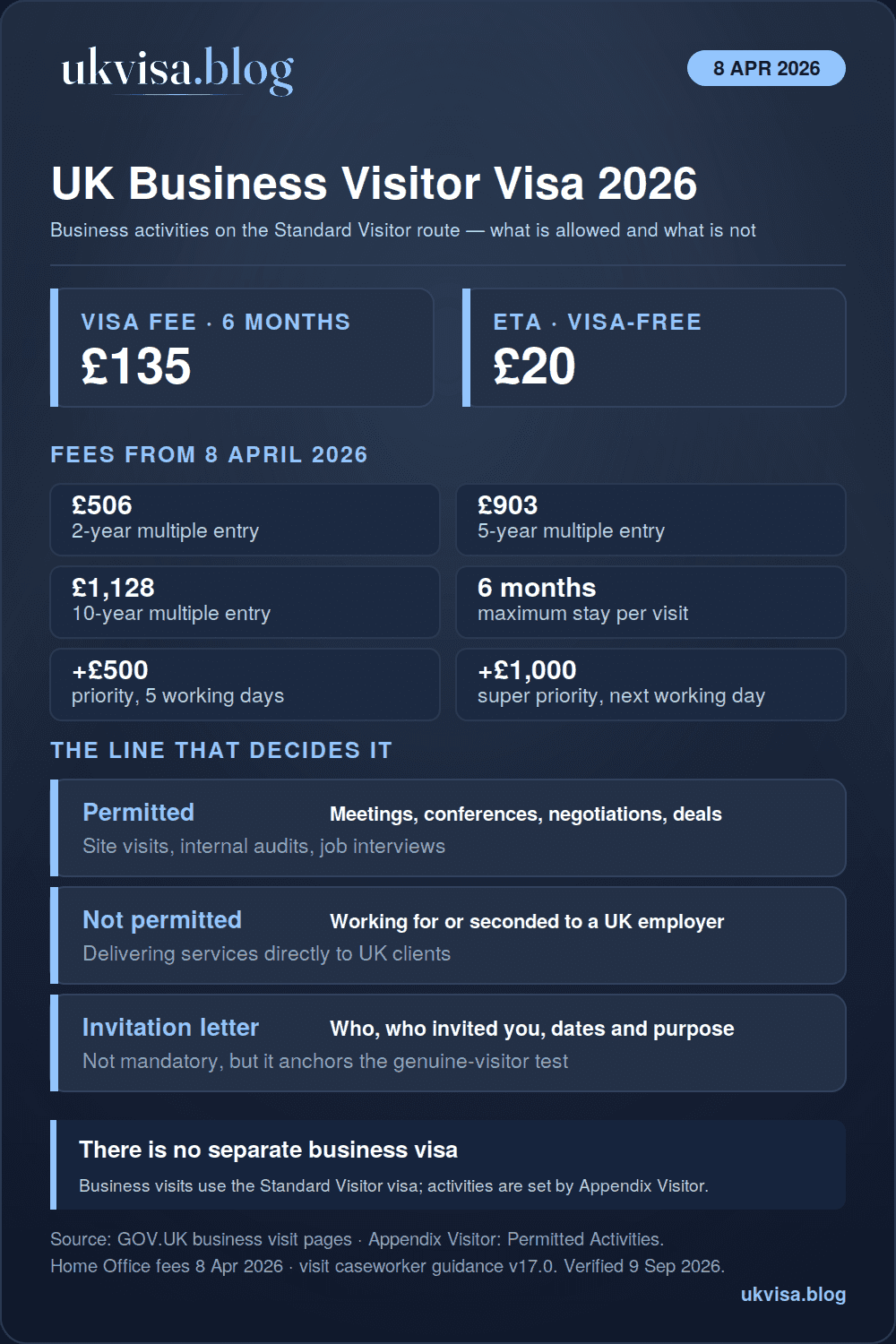
There is no separate business visitor visa. Business travellers apply on the Standard Visitor route and are judged against a defined list of permitted activities. The line that matters is not what your job title is — it is whether the work you do here is incidental to employment abroad or is, in substance, work in the UK.
Business Travel
Business Visits to the UK: What Is Permitted in 2026
What You May Do on a Business Visit
The permitted activities are set out in a dedicated appendix to the Immigration Rules. Anything not on the list is prohibited, whoever pays for it. You apply through the Standard Visitor route, selecting business as the purpose; the visa issued is identical to a tourist’s.
Business visitors pay £135 for a visa of up to six months from 8 April 2026 and may attend meetings, conferences, interviews and negotiations, sign contracts, undertake site visits and carry out internal audits. They may not work for a UK employer, be seconded to a UK branch, provide services directly to UK clients, or fill a role that requires a work visa.
- Meetings and negotiations: attending, negotiating and signing deals and contracts.
- Conferences and seminars: attending, and speaking where the engagement is not paid by a UK source.
- Fact-finding and site visits: including familiarisation programmes on UK practice.
- Job interviews: permitted, on the footing that you leave and apply properly before starting work.
- Funding discussions: general discussions to secure investment for a project.
- Internal audits: regulatory or quality audits within your own corporate group.
- After-sales servicing: installing, repairing or servicing equipment your overseas company supplied, where the contract provides for it.
Remote Working Is Secondary, Not the Point of the Trip
You may answer emails, take calls and join remote meetings for your overseas employer. Guidance is precise about the limit: where a caseworker believes the viability of a long stay substantially depends on you supporting yourself through remote work, that work is treated as the primary purpose of the visit and the application is refused.
The expectation is that remote work is secondary and stays are typically under a month, because you are employed overseas. Stays beyond ninety days are not an automatic refusal but invite questions about the nature of the work. Working remotely alongside meetings is fine; being seconded to a UK company, or to the UK branch of your own employer, is not.
Working With Clients: The Distinction That Decides It
Intra-corporate visits should be short and tied to a specific project. Where you come to support UK colleagues on a project led from the UK branch, and that naturally puts you in front of clients, the client contact is acceptable. Where you come to do client-facing work independently of a UK-led project, guidance directs a refusal, because the work is not incidental to your overseas job.
The Business Invitation Letter
No rule requires one, but for a business visit it does the heaviest lifting of any document: it names the activity, ties it to dates, and confirms who is paying. It should come from the UK host on headed paper and be signed by someone identifiable.
Sample Business Invitation Letter
[UK company name and registered address]
[Company number]
[Date]
To the Entry Clearance Officer
Re: Business visit by [Applicant name], [job title] at [overseas company], passport number [number]
[Applicant] is invited to visit our offices at [address] from [date] to [date]. [Company] is [describe the business] and has an existing commercial relationship with [overseas company] concerning [contract, project or product].
The purpose of the visit is to [attend contract negotiations / conduct an internal quality audit of the production line / attend the named conference / carry out installation and commissioning of equipment supplied under the contract dated DD Month YYYY].
[Applicant] remains employed and paid by [overseas company] throughout. [He/She] will not undertake employment with us, will not be seconded into a role at this company, and will not provide services directly to our clients.
[Overseas company / our company] will meet the cost of [travel / accommodation / subsistence]. No payment will be made to [Applicant] from a UK source.
Please contact me on [direct telephone] or [company email] if you require confirmation.
Yours faithfully,
[Signature]
[Name, job title]
What Makes the Letter Work
A verifiable sender — company email, direct line, registered number — because a caseworker with doubts about a supply contract is expected to contact the UK company. Specific dates matching the application. A named activity that appears on the permitted list. And an explicit statement that the applicant stays on the overseas payroll.
What You Must Show
- Genuine visit: you will leave at the end and are not making the UK your main place of work.
- Listed activity: the purpose must appear in the permitted activities appendix.
- Overseas employment: a letter from your employer confirming role, salary and the reason for the trip.
- Funds: enough to maintain and accommodate yourself, whether personally or through your employer.
- No UK payment: no salary or fee from a UK source, beyond reasonable expenses.
Caseworkers assess whether the length of stay is credible for the activities described. A fortnight of meetings supports a fortnight’s stay; the same meetings paired with a request for five months does not. An employer letter is the evidence usually relied on to bridge that gap. Our supporting documents guide covers the wider bundle, and our application form walkthrough the questions that follow.
Check Whether You Need a Visa at All
Many nationalities travel for business on an Electronic Travel Authorisation at £20 rather than a visa. Whether a visa is required depends on nationality, set out in the visa national list on GOV UK. The permitted activities are the same either way.
Fees and Processing
Visit Visa Fees from 8 April 2026
| Option | Fee | Best for |
|---|---|---|
| Up to 6 months | £135 | A single trip or occasional travel |
| 2 years | £506 | Two or more trips a year |
| 5 years | £903 | Regular travel, stable passport |
| 10 years | £1,128 | Long-running client relationships |
| Priority service | £500 extra | Five working day target |
| Super priority service | £1,000 extra | Next working day target |
Source: Home Office visa fees table, checked 22 August 2026.
Standard decisions target around three weeks from biometrics. For frequent travellers the long-term options work out considerably cheaper per trip — see our pages on two, five and ten-year visas and multiple-entry endorsements, and our full fee breakdown.
Where a decision is running late, our guides to priority services, processing after biometrics and chasing delays set out the realistic options. Paying for priority does not improve the decision itself.
Conferences, Seminars and Training
Attending a conference or seminar is permitted, and there is no fixed limit on its length. Guidance says it is reasonable to expect the event to run no more than a couple of weeks, and where it is longer the caseworker should check the attendance does not amount to work. Familiarisation programmes on UK legal or financial practice count as conferences.
Where a Conference Stops Being a Conference
Two limits. It must not amount to recreational study running beyond thirty days, and it must not become work experience. A programme that puts you inside a UK organisation doing its work, however it is labelled, is not a conference. Speaking is permitted, but payment from a UK source is only allowed under the narrow permitted paid engagement provisions.
Training sits differently again. Receiving training from a UK company is permitted in defined circumstances; delivering training to a UK company’s staff generally is not. The distinctions are listed on our page covering activities permitted to visitors.
Where Business Applications Fail
The Recurring Reasons
- Length that does not match the activity: months requested for days of meetings.
- Remote working as the real purpose: a stay only affordable because you keep earning while here.
- Secondment in substance: filling a role at the UK branch, which requires a work route.
- Direct client work: services delivered to UK clients outside a UK-led project.
- Payment from a UK source: anything beyond reasonable expenses.
- An unverifiable invitation: no company number, no direct contact, no traceable sender.
Coming to hold general discussions to secure funding for a project is permitted. But a visitor cannot switch into the Innovator Founder visa from inside the UK — the switching principles of the points-based system do not allow it. Raise the money as a visitor, then apply from abroad.
Job Interviews and What Follows
Attending interviews is permitted. The caseworker must be satisfied that if you are offered the job you will leave and obtain the correct entry clearance before starting work, and will consider whether a route actually exists for the kind of employment you are pursuing. Interviewing for a role with no available visa route undermines the claim that you intend to leave.
If You Are Refused
There is no right of appeal against a visit refusal and no administrative review. A fresh application answering the refusal notice point by point is the practical route — see our pages on reading the refusal letter, the common grounds and reapplying successfully.
Sources: the GOV UK business visit pages, Appendix Visitor: Permitted Activities, and the Home Office visit caseworker guidance version 17.0 published 25 February 2026. Figures verified 22 August 2026.
Frequently Asked
Business Visit Questions
How much does a UK business visit visa cost?
£135 for up to six months from 8 April 2026. There is no separate business fee. Long-term options cost £506, £903 and £1,128 for two, five and ten years.
Can I work remotely for my overseas employer while in the UK?
Yes, as a secondary activity. If the length of your stay is only affordable because you are working remotely throughout, that work is treated as the primary purpose and the application is refused.
How long can I stay on a business visit?
Up to six months per entry, but the stay must be credible for the activities described. Remote-working visitors are expected to stay under a month; beyond ninety days invites questions.
Can I be seconded to my company’s UK office as a visitor?
No. Filling a role at a UK company or the UK branch of your employer requires a work route, usually Global Business Mobility. A visit application that amounts to secondment must be refused.
Can I do work for UK clients while visiting?
Only where it is incidental to a project led from your group’s UK branch. Client-facing work carried out independently of such a project is not permitted and is a refusal ground.
Can I install or repair equipment my company sold to a UK business?
Yes, where your overseas company manufactured or supplied it and the after-sales arrangement was in place when the contract was concluded. Bring the contract; caseworkers may verify it with the UK company.
Can I be paid for speaking at a UK conference?
Only under the permitted paid engagement provisions, which are narrow and time-limited. Ordinary business visitors may attend and speak but must not receive payment from a UK source beyond reasonable expenses.
Can I attend job interviews on a visit visa?
Yes. You must satisfy the caseworker that if offered the role you will leave the UK and obtain the correct entry clearance before starting work.
Can I carry out an audit of a UK company?
Internal audits within your own corporate group, including branches and subsidiaries, carry no restriction on their nature. Auditing an unrelated UK company as a service is not a permitted visitor activity.
Can I extend a business visit from inside the UK?
Only to complete six months in total, and the application must be made before your current permission expires. See our page on visit extensions for the fee and conditions.