
Home Office fees rose on 8 April 2026. This page covers what you pay from inside the UK — extending, settling, naturalising and the costs that sit alongside them. Fees are per person, not per family, and the health surcharge is usually the larger number.

In-Country Fees
Home Office Fees From Inside the UK in 2026
What This Covers
In-country fees apply when you are already in the UK and applying to extend, switch, settle or naturalise. They are generally higher than the equivalent fee from abroad, and each applicant pays separately — a family of four extending pays four fees, four health surcharges and, at settlement, four settlement fees.
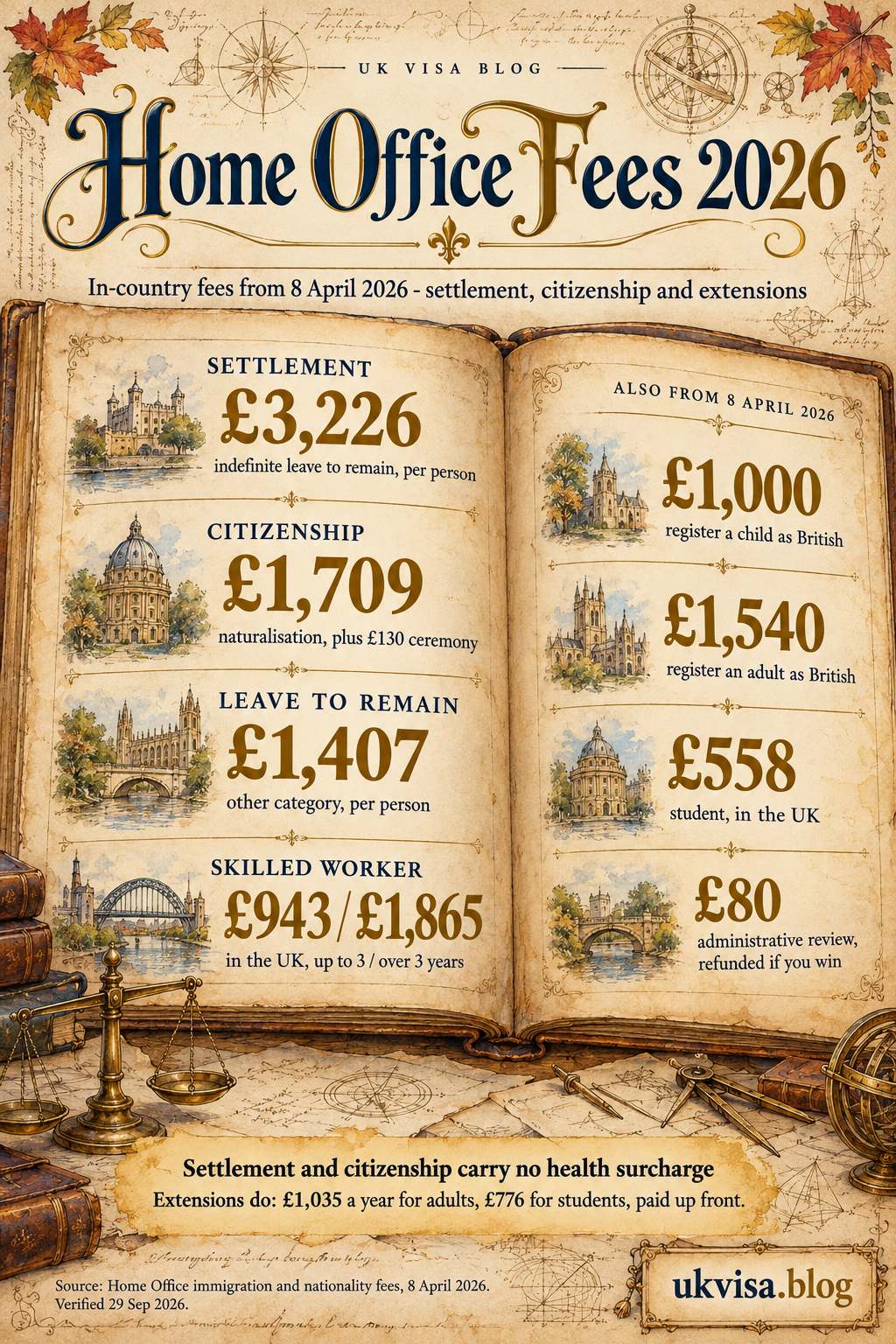
From 8 April 2026: indefinite leave to remain costs £3,226 per person; naturalisation £1,709 plus a £130 ceremony fee; registering a child as British £1,000; leave to remain on the other category £1,407; Skilled Worker in country £943 up to three years and £1,865 beyond; Student in country £558. The Life in the UK test is £50 and administrative review £80.
Extension and Leave to Remain Fees
Leave to Remain From 8 April 2026
| Application | Previous fee | From 8 April 2026 |
|---|---|---|
| Leave to remain, other | £1,321 | £1,407 |
| Route to settlement, from outside the UK | £1,938 | £2,064 |
| Other dependent relative, route to settlement | £3,413 | £3,635 |
| Refugee dependent relative | £424 | £452 |
| Visitor extension in the UK | £1,100 | £1,172 |
Source: Home Office immigration and nationality fees, 8 April 2026. Checked 22 August 2026.
Which form you use depends on the route and the basis of the application — our guide to the FLR forms works through the options. Partner extensions are covered on our spouse extension page, and the income rules on our page on the financial requirement.
Settlement
Indefinite leave to remain costs £3,226 per applicant from 8 April 2026, up from £3,029. The same figure applies to indefinite leave to enter as an Armed Forces service leaver or their dependant, and as a victim of domestic abuse with dependent children.
ILR Fees in 2026 at a Glance
The ILR fee in 2026 is £3,226 per person, and each dependant on the application pays the same again. Priority (£500) or super priority (£1,000) sits on top when offered. There is no routine ILR “renewal” fee: settlement has no expiry date to renew, though the status itself can lapse after long absences abroad.
Choosing the Right Route and Form
Settlement applications are made on the form for your qualifying route — five-year partner, long residence, work, or one of the specific categories. Applying on the wrong form can invalidate the application, and the fee is not refunded. See our page on ILR and our ILR forms guide.
Why the Figure Keeps Rising
Settlement is charged well above the administrative cost of processing it, and successive fee orders have widened that gap. The practical consequence for families is that settlement is now the single largest immigration cost most will meet, and it arrives for every family member at once.
What Settlement Costs on Top
- Life in the UK test: £50 per attempt — see our page on the Life in the UK test.
- English language test: where required, at the provider’s price.
- Priority processing: £500 outside the UK, £1,000 for super priority in the UK.
- Document translation: certified translations for anything not in English or Welsh.
- Professional fees: optional, but common on long residence and complex histories.
A Family Settling Together
Two adults and two children settling at once pay £3,226 each — £12,904 in fees alone. Add two Life in the UK tests at £50, any English testing, and priority if the timing matters. Our page on settlement decision times covers whether paying for speed is worth it.
BRPs, Replacements and the eVisa
Biometric residence permits have been replaced by the online record most people now access through a UKVI account. Replacing a BRP that was lost, stolen, damaged or destroyed still carries a £19 fee, but for most people the relevant step is creating the account rather than replacing a card.
An expired BRP retains a practical use as the identity document that opens a UKVI account, and remains usable for that purpose for a limited transitional period. Our page on the eVisa and UKVI accounts sets out how to create one and how share codes work.
Citizenship and Naturalisation
Nationality Fees From 8 April 2026
| Application | Fee |
|---|---|
| Naturalisation as a British citizen | £1,709 |
| Registration as a British citizen, adult | £1,540 |
| Registration as a British citizen, child | £1,000 |
| Citizenship ceremony | £130 |
| Certificate of entitlement to the right of abode | £589 |
Source: Home Office immigration and nationality fees, 8 April 2026. Checked 22 August 2026.
The Full Cost of Becoming British
Naturalisation is the last step, not the only one. Someone arriving on a partner route typically pays entry clearance, one or two extensions, the health surcharge throughout, settlement at £3,226, then £1,709 and a £130 ceremony. Our page on naturalisation requirements covers the qualifying conditions.
Child registration at £1,000 sits below the adult figures. The gap matters for families deciding whether children should register separately or wait — a decision that turns on the child’s own entitlement, not on cost alone, so take advice before choosing.
Other Services
Beyond applications, the fee order covers documentary services: a right of abode certificate at £589, a replacement biometric document at £19, and the Life in the UK test at £50. Priority services are charged on top of the application fee rather than instead of it.
Application fees are consumed by the decision, not by its outcome. A refused settlement application does not return £3,226, and a shorter grant than the one applied for does not produce a partial refund. That is why the evidential work matters more than the speed of submission.
Work Routes From Inside the UK
Work Applications From 8 April 2026
| Application | In-country fee |
|---|---|
| Skilled Worker, up to 3 years | £943 |
| Skilled Worker, more than 3 years | £1,865 |
| Certificate of sponsorship | £525 |
| Administrative review | £80 |
Source: Home Office immigration and nationality fees, 8 April 2026. Checked 22 August 2026.
The three-year line is the one that catches people out: a certificate assigned for three years and one day doubles the fee. Where the role and the salary allow either, the cost difference is worth raising with the sponsor before the certificate is assigned. See our pages on the Skilled Worker route and on work visa fees.
Study Routes From Inside the UK
A Student application from inside the UK costs £558, the same as applying from abroad, and covers the main applicant and dependants as separate applications at that rate. Our page on student route requirements covers the conditions, and our page on the post-study work visa what follows a course.
Sponsor Costs
Employers pay £611 for a worker sponsor licence at the small or charitable rate and £1,682 at the large rate. Student and temporary worker sponsor licences are £611. Each certificate of sponsorship assigned costs £525, a figure that has risen sharply and now forms a real part of the cost of hiring.
The immigration skills charge sits on top for most sponsored work routes and is charged per year of sponsorship. Sponsors should budget the licence, the certificate, the skills charge and the applicant’s own fee together rather than treating them as separate decisions.
The Health Surcharge
The immigration health surcharge is £1,035 a year at the standard rate and £776 a year for students, their dependants, Youth Mobility holders and anyone under 18 at the date of application. It is charged for the whole period of permission, upfront, and it is usually larger than the application fee.
No surcharge is payable where you apply from outside the UK for six months or less. Our page on how the health surcharge works covers refunds, exemptions and how the amount is calculated for part years.
How the Surcharge Interacts With the Fee
The two are charged together but calculated differently. The application fee is a flat amount for the application; the surcharge is a rate multiplied by the length of permission granted. A thirty-month grant therefore costs far more in surcharge than in fee, which is why a longer grant is not automatically the cheaper choice.
Where permission is granted for less than you paid for, or the application is refused or withdrawn, the surcharge is refundable even though the fee is not. Refunds are processed automatically in most cases, but they are worth checking for rather than assuming.
Challenging a Decision
Administrative review costs £80. Requested from outside the UK it must be made within 28 days of the decision, and GOV.UK currently warns that a result can take 12 months or more, with an update from the Home Office if nothing is decided within six months.
Where review is not available, the options are a fresh application, an appeal where one exists, or judicial review at the Upper Tribunal. See our pages on administrative review (AR) and refusal grounds before paying for anything.
Where the Costs Fall in a Family’s Timeline
The pattern most families meet on a five-year route is front-loaded and then spikes. Entry clearance at £2,064 with the surcharge for the first grant, an extension partway through with a second surcharge block, then settlement at £3,226 for everyone at once, and naturalisation afterwards for those who want it.
Planning around that shape matters more than shaving any single fee. The settlement bill arrives for every family member in the same month, and it cannot be deferred without the permission lapsing. Building towards it from the first grant is the only approach that works.
Worked Examples
- A single person extending on the other category: £1,407.
- A single person settling: £3,226, plus £50 for the Life in the UK test.
- A couple with two children settling together: £12,904.
- Settlement then naturalisation for one adult: £3,226 plus £1,709 plus £130.
- A Skilled Worker extending for over three years: £1,865, plus £525 for the certificate paid by the sponsor.
Add the health surcharge to each of these at £1,035 or £776 a year for the whole period granted, and add priority where the timing matters — £1,000 for super priority in the UK. Our page on priority services and our general fee page cover applications made from abroad.
Sources: the Home Office immigration and nationality fees table effective 8 April 2026, the GOV UK naturalisation pages and the GOV UK biometric residence permit pages. Figures verified 22 August 2026.
Frequently Asked
In-Country Fee Questions
How much is indefinite leave to remain in 2026?
£3,226 per applicant from 8 April 2026, up from £3,029. Each family member pays separately.
How much does British citizenship cost?
Naturalisation is £1,709, with a £130 citizenship ceremony fee. Registering a child as British is £1,000 and adult registration £1,540.
Do I still need a BRP?
No. Status is held online through a UKVI account. Replacing a lost, stolen or damaged BRP still costs £19, but for most people the step is creating the account instead.
Is the fee refunded if my application is refused?
No. Application fees are not refunded on refusal, and a grant shorter than the one applied for does not produce a partial refund.
Why does a Skilled Worker extension cost £943 or £1,865?
The higher rate applies where the certificate of sponsorship covers more than three years. The line falls at exactly three years, so the certificate’s length decides the fee.
How much is the Life in the UK test?
£50, and it is charged for each attempt. There is no discount for resitting.
What is the health surcharge?
£1,035 a year at the standard rate, £776 a year for students, their dependants, Youth Mobility holders and under-18s, charged upfront for the whole period of permission.
How much does a certificate of sponsorship cost the employer?
£525 per certificate, on top of the sponsor licence at £611 or £1,682 and the immigration skills charge.
How much is administrative review and how long does it take?
£80. From outside the UK it must be requested within 28 days, and GOV.UK warns it can take 12 months or more.
Can I pay in instalments?
No. Fees and the health surcharge are paid in full when the application is submitted. Fee waivers exist in limited human rights cases — see our page on human rights applications.