
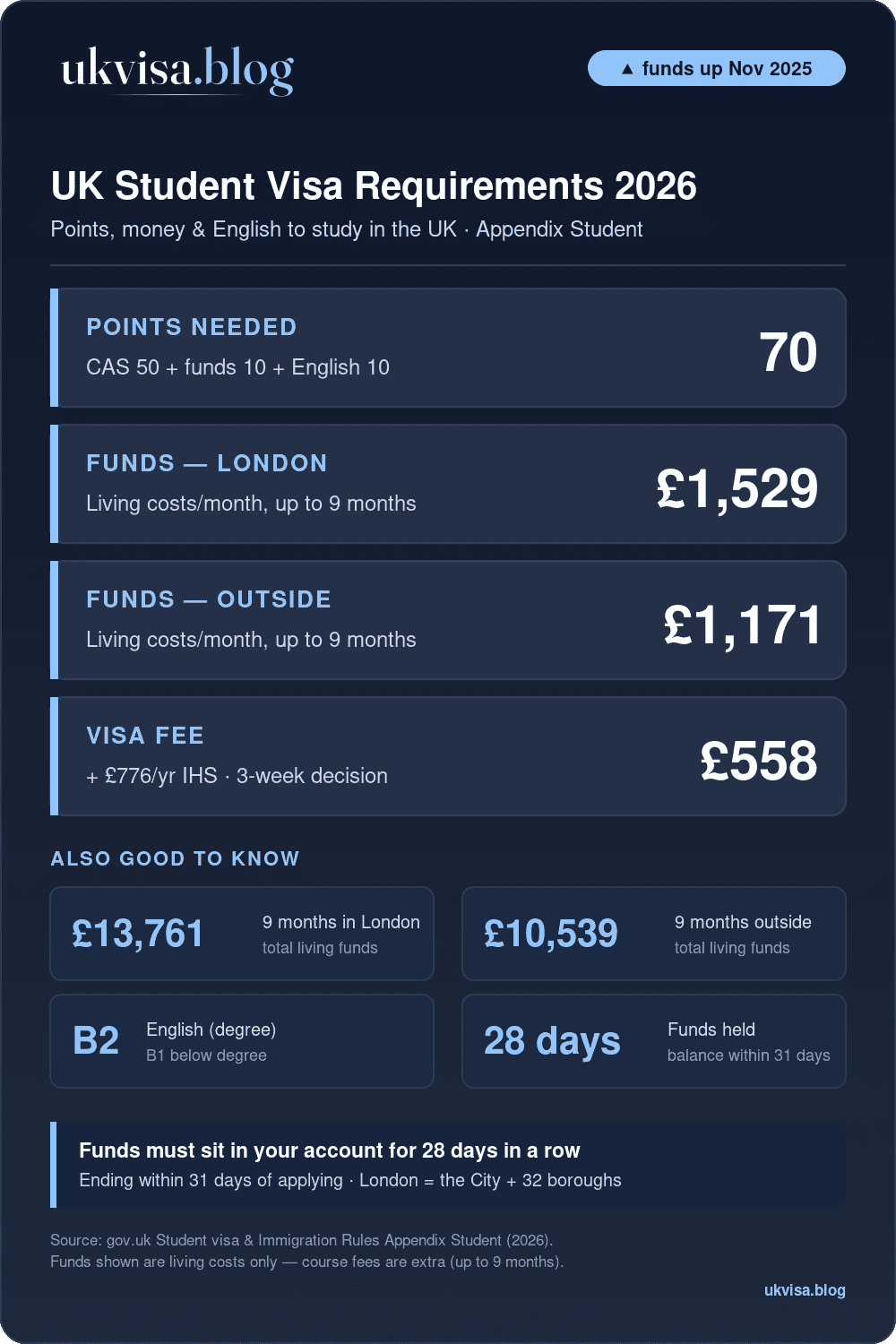
The UK Student visa runs on a 70-point test: 50 for your CAS, 10 for money, 10 for English. The fee is £558 whether you apply from inside or outside the UK, plus £776 a year in health surcharge. Most refusals turn on financial evidence or the genuine student assessment, not on academic ability. Here is what Appendix Student actually demands in 2026.
UK Student Visas
UK Student Visa Requirements 2026: Rules, Points and Eligibility
UK Student Visa Rules and Regulations in 2026
You need 70 points: 50 for a CAS from a licensed sponsor, 10 for money, 10 for English. You must be 16 or over, hold a CAS issued in the last six months, and satisfy the caseworker that you are a genuine student. The fee is £558 in or out of the UK, plus £776 a year surcharge. Decisions take about three weeks abroad, eight in the UK.
The route replaced Tier 4 (General) in October 2020 and is now governed by Appendix Student of the Immigration Rules. Every application passes through three gates in order: validity, suitability, then eligibility. An invalid application is rejected without a refusal decision; an unsuitable applicant is refused whatever their points; only then does the caseworker score the 70.
What the Visa Actually Costs in 2026
The application fee is £558, unchanged whether you apply from overseas or extend and switch inside the UK. It rose from £524 under the 8 April 2026 fee schedule. On top sits the Immigration Health Surcharge at the discounted student rate of £776 for each year of permission, against £1,035 for most other routes — you can check how the charge is calculated in our guide to the health surcharge.
The surcharge is charged on the whole period of permission, which runs a few months longer than the course. Your sponsor pays £55 for the CAS — their cost, not yours, though many recover it. Route-by-route pricing sits in our breakdown of current UK visa charges.
Suitability: The Grounds That End an Application Early
Suitability is assessed under Part Suitability, which replaced the old Part 9 numbering on 11 November 2025. Deception, false documents and relevant criminality sit here and are decided before any points are counted — our guide to the most common refusal grounds explains how.
Two situations bar an application outright rather than merely weighing against it: being in the UK unlawfully, and being on immigration bail. A previous overstay can also attract a re-entry ban, and no Student application succeeds while that ban period is running.
Appendix Student: How the Rules Are Structured
Knowing where a requirement lives is the fastest way to test whether something you have been told is true. These are the paragraph ranges caseworkers cite in refusal notices.
Appendix Student at a Glance
| Paragraphs | Requirement | What it decides |
|---|---|---|
| ST 1.1 – ST 1.6 | Validity | Form, fee, biometrics, passport, CAS age, minimum age 16 |
| ST 5.1 | Genuine student | Whether you intend and are able to study |
| ST 6.1 – ST 11.1 | Points, CAS, course, level and place | The 50 study points |
| ST 12.1 – ST 12.7 | Financial requirement | The 10 financial points |
| ST 13.1 – ST 13.4 | English language | The 10 language points |
| ST 14.1 – ST 14.5 | Academic progress | Whether an extension is allowed |
| ST 19.1 – ST 19.6 | Maximum period of study | The two-year and five-year caps |
| ST 25.1 – ST 27.7 | Period and conditions | Length of permission, work and study limits |
| ST 28.1 – ST 39.3 | Dependants | Who may bring a partner or child |
Source: Immigration Rules Appendix Student, as in force August 2026.
Validity Sits at ST 1.1, Not ST 5.1
A persistent error in student guides is to call ST 5.1 the validity paragraph. It is not. Validity runs from ST 1.1 to ST 1.6: the correct form, the fee and health charge, biometrics, a passport establishing identity and nationality, and a CAS issued no more than six months before the date of application. It also carries the minimum age of 16 and the consent needed where a scholarship agency sponsored you in the past year.
The Genuine Student Requirement Is One Sentence
ST 5.1 says only that the applicant must be a genuine student. Everything else — the questions asked, the weight given to a study plan — comes from the Student and Child Student caseworker guidance, not the Rules. That is why identical paperwork can be treated differently.
Student Route Eligibility Assessment
Beyond the 70 points, four tests decide most borderline cases: course level, academic progress, whether you have used up your permitted study time, and whether the caseworker accepts you as genuine.
Level of Study and Where You Can Study
At 18 or over with a licensed sponsor, the course must normally sit at RQF Level 3 or above in England, Wales and Northern Ireland, or SCQF Level 6 or above in Scotland. A probationary sponsor can offer less. The place of study requirement then ties you to the sponsor's premises or an approved partner, which is why an unannounced change of campus becomes a compliance issue.
Academic Progress Under ST 14
Extending inside the UK requires academic progress: normally a course at a higher level than the last one you were sponsored for. A same-level course qualifies where it is clearly related to the previous study or to your career plans. ST 14 also exempts re-sits, PhD continuation, sponsor changes, intercalated degrees, placements and sabbatical officer posts.
The Maximum Period of Study Trap
Two caps run from your eighteenth birthday. Below degree level you may hold a total of two years' Student permission. At degree level the cap is five years, counted across every grant you have held, not per course. Applicants who took a foundation year, changed subject, or repeated a year are the ones who hit it unexpectedly.
The cap does not apply to a defined list: architecture, medicine, dentistry, veterinary medicine and science, music at a Conservatoires UK member college, and qualifying law conversion, MLaw and accelerated LLB routes. That is an exemption from the cap — not a fixed six or seven-year allowance, which is how it is often mis-stated.
The genuine student test is where the most anxiety sits, and the caseworker guidance contains a protection that few applicants know about:
The Student and Child Student guidance tells caseworkers not to refuse on genuineness grounds without first interviewing the applicant, save in narrow cases such as a repeat refusal on the same grounds. It also tells them not to refuse someone for not knowing the local geography of their study city. Refused as not genuine, never interviewed? Raise it. Our guide to the credibility interview covers what is asked — and failing to attend without good reason means refusal.
The 70-Point System and Your CAS
The points are all-or-nothing: no partial awards, no trading one category against another. Any shortfall is a refusal.
Where the 70 Points Come From
| Category | Points | Evidence |
|---|---|---|
| Study — CAS, course, qualification, level and place | 50 | CAS reference issued within 6 months |
| Financial requirement | 10 | 28 days of qualifying funds, or an exemption |
| English language | 10 | SELT, exempt qualification, or sponsor assessment |
Source: Appendix Student, points requirement ST 6.1.
What Your CAS Must Contain
The CAS is an electronic record, not a certificate. It is used once, expires six months after assignment, and its details must match the application exactly. A mismatch between CAS course dates and application dates is a routine cause of avoidable refusals.
- Course and level: title, RQF or SCQF level, start and end dates matching your offer.
- Fees: total course fees and anything paid, since paid fees reduce what you must show.
- English: the assessment method, plus SELT provider, reference number and component scores.
- Qualifications used: the documents behind your offer, which you may be asked to produce — see the document pack every UK application needs.
- Sponsor details: licence number and the site where you will study.
A CAS Is Not a Decision
A CAS is your institution's judgement that it will teach you. The visa is a separate Home Office judgement on immigration grounds. Universities never see your immigration history, your bank evidence or your interview.
Financial Requirements for a UK Student Visa
You must show outstanding first-year course fees plus living costs, which are set by location and capped at nine months however long the course runs.
Maintenance Funds by Location
| Where you study | Per month | Nine-month maximum |
|---|---|---|
| In London | £1,529 | £13,761 |
| Outside London | £1,171 | £10,539 |
Source: Appendix Student ST 12; Home Office money guidance for the Student route.
London means the City of London and the 32 boroughs, as defined on the Home Office money page for the Student route. A commuter-belt campus does not count, however London the rent feels.
The 28-Day Rule
The money must sit in a qualifying account for 28 consecutive days, with the closing balance dated no more than 31 days before you apply. It must not dip below the required figure on any day in that window — one dip resets the clock. Student loans and official sponsorship are evidenced differently and escape the 28 days.
What You Can Deduct
Course fees already paid to your sponsor come off the total, provided the CAS records the payment. Accommodation paid to the sponsor for its own accommodation is deductible up to £1,529; private landlords and third-party halls are not. Our detailed guide to the money rules covers acceptable accounts and evidence.
Who Does Not Have to Show the Money
Twelve months of lawful UK permission at the date of application removes the need to evidence funds, as does a sabbatical officer post. The differential evidence arrangements at ST 22.1 excuse listed nationalities from filing documents up front — but the funds must still exist and can be demanded at any point.
English Language Requirements
The standard is CEFR B2 in all four components at degree level or above, and B1 below it. Your sponsor records how you met it on the CAS, and that recorded method is what the caseworker checks.
When Your University Assesses You Itself
For degree-level courses, a higher education provider may assess your English itself rather than require a Secure English Language Test, provided the assessment reaches B2. Below degree level that discretion does not exist. Where a SELT is taken, the provider, your unique reference number and each component score must appear on the CAS.
Exemptions That Remove the Test
Nationals of the listed majority English-speaking countries are exempt, as are holders of a UK degree, of a degree taught in English confirmed as equivalent by Ecctis, and of certain UK school qualifications. Having proved English at the required level in an earlier successful application also counts. The wider picture across every route is in our guide to how English is proved for UK visas.
- SELT certificate: from an approved provider, at B2 or B1 as your course level requires.
- UK school qualification: GCSE, A level or Scottish National Qualification in English.
- Degree taught in English: a UK degree, or an overseas one with an Ecctis equivalence assessment.
- Nationality: a passport from a listed majority English-speaking country.
- Sponsor assessment: degree level and above only.
Student Visa Conditions and What Comes Next
Permission is granted with three standing conditions: no access to public funds, no work except as ST 26 allows, and no study except as ST 27 allows. Breaching the work condition is not a technicality — it can end the permission and follow you into later applications.
Work Conditions
Degree-level students sponsored by a compliant provider may work 20 hours a week in term time and full time in vacations. Below degree level the term-time limit is 10 hours. Assessed work placements that form part of the course sit outside those limits. Our guide to Student visa working hours covers how a working week is counted and where students most often go wrong.
Self-employment, freelancing and sole-trader work are prohibited, as are professional sportsperson and entertainer roles and permanent full-time posts. The lawful shape of building something while studying is in our guide to starting a business on a Student visa.
Dependants
For courses starting on or after 1 January 2024, only PhD, doctorate and research-based higher degree students may bring dependants, along with government-sponsored students on courses over six months. Taught master's and undergraduate students may not. Each dependant pays £558 and shows £845 a month in London or £680 outside, capped at nine months — see our Student dependant guide.
How Long Permission Runs
Permission covers the course plus a wrapper: one month before and four after for courses of 12 months or more, one and two for six to 12 months, a month either side for short pre-sessional courses, seven days for other short ones. The surcharge is calculated on that whole period.
Short-Term Study and the Visitor Route
The Short-term study visa covers English language courses of more than six and up to 11 months, at £228 since April 2026. Other short courses are done as a Standard Visitor. Neither leads to settlement or the Graduate route — see our Short-term study guide.
After the Course: Graduate Route or Skilled Worker
The Graduate route page on GOV.UK gives two years for applications made on or before 31 December 2026 and 18 months from 1 January 2027, with three years for a doctorate throughout. The fee is £937 and the surcharge reverts to £1,035 a year — our Graduate route guide has the detail.
With a sponsored job offer you can switch straight to the Skilled Worker route instead, which is the pathway that leads to indefinite leave to remain. Student permission itself never leads to settlement directly, though it counts as lawful residence for long residence purposes.
With the CAS and evidence in order, next come the online application form and the wait after biometrics. If it goes against you, read the refusal notice closely, consider the review route for caseworker errors, and weigh your prospects on a fresh application.
Sources: Immigration Rules Appendix Student; Student and Child Student caseworker guidance, version 14.0, published for Home Office staff on 3 August 2026; the Student route pages on GOV.UK, including the money and family members pages; Home Office immigration and nationality fees, 8 April 2026. Figures verified 22 August 2026.
Frequently Asked
Questions about UK Student Visa Requirements
You must be 16 or over, hold a CAS issued within the last six months by a licensed sponsor, and score 70 points: 50 study, 10 money, 10 English. Money means outstanding course fees plus £1,529 a month in London or £1,171 outside, for up to nine months. English is CEFR B2 at degree level, B1 below. The fee is £558 plus £776 a year surcharge.
£558, the same whether you apply from outside the UK or extend and switch from inside it. It rose from £524 under the 8 April 2026 fee schedule. The Immigration Health Surcharge is charged separately at the student rate of £776 for each year of permission granted, which is normally a few months longer than the course. Your sponsor pays £55 for the CAS itself.
Twenty hours a week in term time at degree level with a compliant sponsor, and full time in vacations. Below degree level the limit is 10 hours. Assessed placements sit outside the limits. Self-employment, freelancing, professional sport and entertainment work and permanent full-time posts are prohibited.
Only if your course started on or after 1 January 2024 and is a PhD, another doctorate or a research-based higher degree — or if you are government-sponsored on a course longer than six months. Taught master's and undergraduate students cannot. Eligible dependants each pay £558 plus the health surcharge and must show £845 a month in London or £680 outside, capped at nine months.
About three weeks from outside the UK and up to eight weeks from inside it. You can apply six months before the course starts from overseas, or three months before if you are already here. Priority services exist at some locations only, and they shorten the decision, not the biometric appointment wait.
You receive a written refusal setting out the paragraph relied on. Where the error is the caseworker's — a document overlooked, a figure miscalculated — administrative review is the remedy. Where the refusal reflects a genuine gap, a fresh application that fixes it is usually faster. If you were refused as not a genuine student without ever being interviewed, say so; the guidance requires an interview first in most cases.
Yes, if you meet the academic progress requirement at ST 14. Normally the new course must be at a higher level than the last one you were sponsored for, though a same-level course can qualify where it is clearly related to the previous study or to your career plans. Re-sits, PhD continuation, sponsor changes, intercalated degrees and placements have their own exceptions. Apply before your current permission expires.
Yes. Applicants aged 16 or 17 need written consent to the application, the travel, and the living and care arrangements in the UK, from both parents, from one parent with sole legal responsibility, or from a legal guardian, confirming the relationship to you. At an independent school, the Child Student route may be correct instead.