
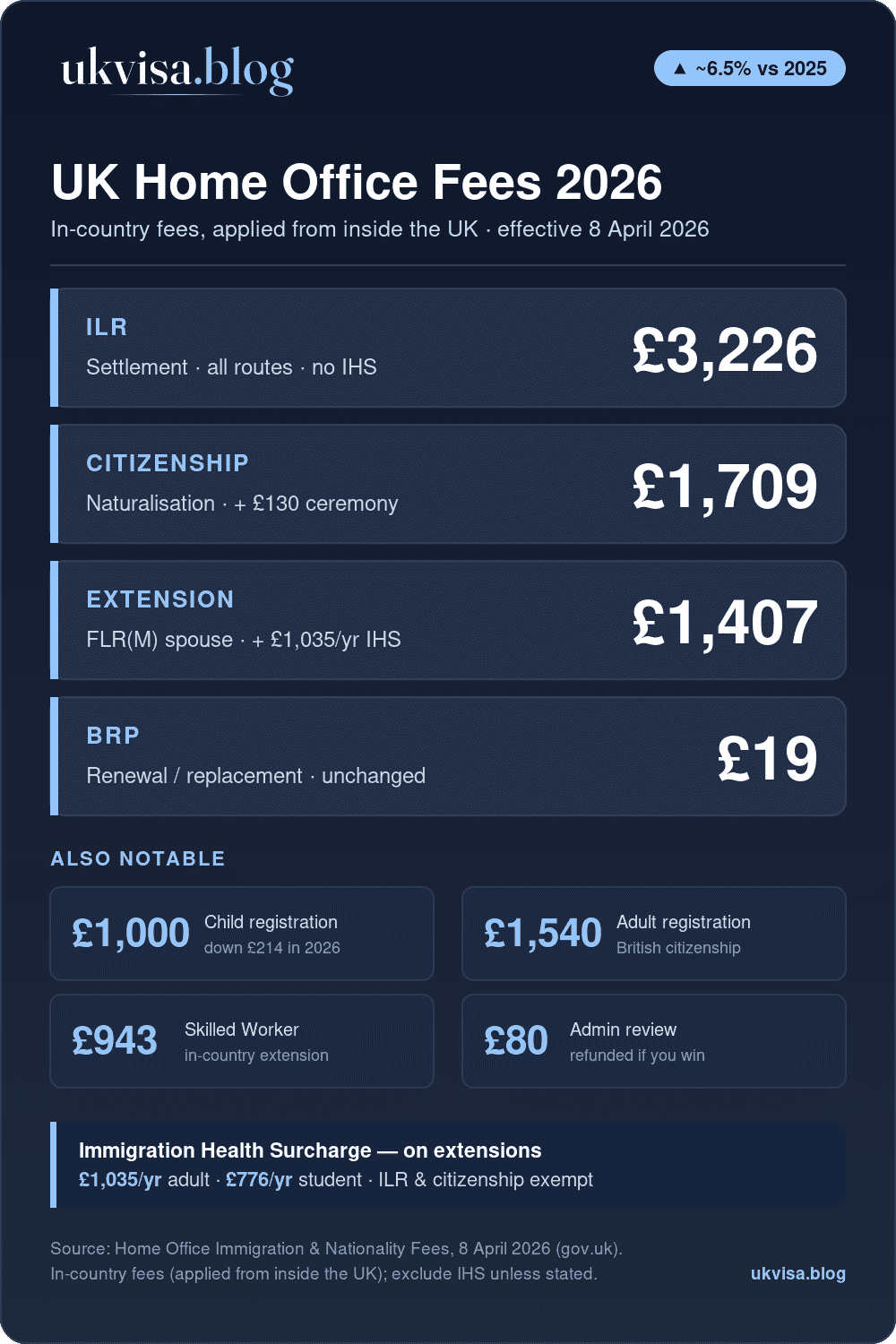
UK in-country Home Office fees rose on 8 April 2026, the largest single increase being the ILR fee from £3,029 to £3,226 (+£197). Naturalisation rose £104 to £1,709 (plus £130 ceremony — total £1,839). In a rare reduction, the child citizenship registration fee dropped £214 to £1,000. FLR(M) and other in-country leave-to-remain extensions rose around 6.5% to £1,407; BRP renewal stayed at £19. This guide covers every in-country fee for 2026 — FLR extensions, ILR and settlement, citizenship and nationality services, BRP renewal, work and student extensions, sponsor licence and CoS, and IHS. For out-of-country fees, see our companion UK entry clearance fees 2026 guide.
Source: Home Office Immigration and Nationality Fees, 8 April 2026
ILR rose £197 to £3,226 per person; FLR extensions rose 6.5% to £1,407; in-country Skilled Worker extension £943 (≤3 years) or £1,865 (>3 years); naturalisation £1,709 plus £130 ceremony (£1,839 total). Notably, the child citizenship registration fee fell £214 to £1,000 — the first significant fee reduction in recent years. BRP renewal/replacement (£19), Administrative Review (£80), Life in the UK Test (£50), priority service charges (£500 / £1,000), and the Immigration Health Surcharge (£1,035 adult / £776 student-YMS-under-18 per year) all remained unchanged.

- In-Country vs Out-of-Country Fees
- FLR Extension Fees 2026
- ILR (Settlement) Fees 2026
- ILR Additional Costs and Family Examples
- BRP Renewal and Replacement Fees
- British Citizenship and Naturalisation Fees
- Other Nationality and Status Services
- In-Country Work Visa Extension Fees
- In-Country Student Visa Extension Fees
- Sponsor Licence and CoS Fees
- Immigration Health Surcharge — In-Country Applications
- Administrative Review and Redress Fees
- Total Cost Worked Examples
- Frequently Asked Questions
Understanding UK In-Country Home Office Fees 2026
In-country Home Office fees apply to applications submitted from within the UK — extensions of leave to remain, ILR settlement applications, BRP renewals, British citizenship applications, and in-country work and student visa applications. In-country fees are generally higher than the equivalent out-of-country entry clearance fee, reflecting the additional UKVCAS biometric appointment infrastructure and the closer Home Office processing. The 8 April 2026 increases applied to most in-country categories at roughly 6.5% — broadly matching the out-of-country uplift. The full statutory schedule is published in the Home Office Immigration and Nationality Fees table.
In-Country vs Out-of-Country Fees — Scope of This Guide
This guide covers every Home Office fee for applications submitted from inside the UK: FLR extensions, ILR/settlement, BRP renewal and replacement, British citizenship and registration, in-country work and student visa extensions, sponsor licence and CoS, IHS on in-country applications, and administrative review fees. For applications submitted from outside the UK (entry clearance for visit, student, work, and family visas), see the companion out-of-country entry clearance fees guide linked at the top of this article.
| Route | Out-of-Country Fee | In-Country Fee |
|---|---|---|
| Skilled Worker (≤3 years) | £819 | £943 |
| Skilled Worker (>3 years) | £1,618 | £1,865 |
| Student route | £558 | £558 |
| Spouse / Partner | £2,064 (33-month entry clearance) | £1,407 (FLR(M) 30-month extension) |
| ILR / SET(M) / SET(O) | Not applicable | £3,226 |
| British citizenship / Naturalisation | Not applicable | £1,709 + £130 ceremony |
FLR Extension Fees 2026 — All In-Country Leave-to-Remain Routes
From 8 April 2026, in-country Further Leave to Remain (FLR) extensions cost £1,407 per applicant across the standard family and human rights routes (FLR(M), FLR(FP), FLR(IR), FLR(HRO)). The FLR(O) "Other" form covers various extension types at the same £1,407 rate. Most extensions require the Immigration Health Surcharge in addition to the application fee. For full FLR form selection guidance, see our FLR application forms guide.
| FLR Application | Fee 2026 | Standard Visa Length Granted |
|---|---|---|
| FLR(M) — Spouse / Civil Partner extension | £1,407 | 30 months |
| FLR(FP) — Family / Private Life | £1,407 | 30 months |
| FLR(IR) — In Receipt of Public Funds | £1,407 | 30 months |
| FLR(HRO) — Human rights and other routes | £1,407 | 30 months |
| FLR(O) — Other routes (Ancestry extension, parent, dependant) | £1,407 | Varies by route |
| FLR with Priority service | £1,907 (£1,407 + £500) | Decision within 5 working days |
| FLR with Super Priority service | £2,407 (£1,407 + £1,000) | Decision by next working day |
FLR extensions on the five-year family route require the Immigration Health Surcharge at £1,035 per adult per year, charged on the 30-month visa length — totalling £2,587.50 per applicant for the extension period. Full spouse-route guidance on the extension stage, including spouse visa financial requirements and continuous-residence rules, is covered in our dedicated UK Spouse visa renewal guide.
ILR (Indefinite Leave to Remain) Fees 2026
The ILR application fee from 8 April 2026 is £3,226 per applicant (up from £3,029, +£197). It applies uniformly across all settlement routes — SET(M) spouse, SET(O) work and ancestry, SET(LR) long residence, and Innovator Founder. Adult and child dependants each pay the full £3,226 — no reduced rate. Priority adds £500 (5 working days), Super Priority £1,000 (next working day, UKVCAS only). ILR does not require the Immigration Health Surcharge — settlement grants permanent NHS access.
| ILR Application Type | Fee 2026 | Decision Target |
|---|---|---|
| Standard ILR application — all routes | £3,226 | Up to 6 months |
| ILR with Priority service (where available) | £3,726 | 5 working days |
| ILR with Super Priority service | £4,226 | Next working day (UKVCAS only) |
| Dependant ILR applications | £3,226 each | Same as main applicant |
ILR Routes and Form Selection
The £3,226 ILR fee applies whether you apply on SET(M), SET(O), SET(LR), Innovator Founder settlement, BN(O), or any other settlement route. Form selection differs by route — see our UK long-term settlement guide for the complete framework and our ILR processing time targets guide for current decision timelines. Priority processing availability depends on route — see the UK Priority and Super Priority guide for which ILR forms qualify for which expedited service.
Why the ILR Fee Rose So Sharply
The £197 increase from £3,029 to £3,226 in the 8 April 2026 update is the largest single in-country fee increase in 2026 — both in absolute terms (£197) and in revenue contribution. With approximately 95,000 ILR grants annually, the increase delivers around £18.7 million in additional Home Office revenue in its first year. ILR has risen from £1,377 in 2015 to £3,226 in 2026 — a 134% increase over 11 years, comfortably above CPI inflation.
ILR Additional Costs and Family Application Examples
The £3,226 application fee is the largest single Home Office cost, but several additional charges apply across most ILR applications. Unlike visa extensions, the Immigration Health Surcharge is not required for ILR — settlement grants permanent NHS access on the same basis as British citizens.
| ILR Cost Component | Fee 2026 | Required For |
|---|---|---|
| ILR application fee | £3,226 | All settlement applicants |
| Life in the UK Test | £50 | Most adult applicants 18–65 |
| English language test (B1) | £150 typical | Where prior visa did not establish B1 |
| Document translation | ~£40–£60 per document | Non-English supporting documents |
| Priority service (optional) | +£500 | Where available for the route |
| Super Priority service (optional) | +£1,000 | UKVCAS appointments only |
| Immigration Health Surcharge | £0 | Not required for ILR — settlement exempt |
ILR Family Application Cost Examples
Single applicant: £3,226 application fee + £50 Life in the UK Test + £150 English test (if required) = ~£3,426 total.
Family of three (two adults + one child): 3 × £3,226 application fee = £9,678 + £100 Life in the UK Test (two adults) = ~£9,778 total (children under 18 do not take the Life in the UK Test).
Family of four (two adults + two children): 4 × £3,226 = £12,904 application fees + £100 Life in the UK Test = ~£13,004 total.
Family of four with Super Priority: £12,904 + 4 × £1,000 Super Priority + £100 Life in UK Test = £17,004 total.
BRP Renewal and Replacement Fees 2026
The BRP renewal, replacement, or update fee in 2026 is £19 per application — unchanged in the 8 April 2026 update. This applies to lost, stolen, or damaged Biometric Residence Permits, to name changes, and to status updates. A BRP Replacement Visa (for applicants who lost their BRP while outside the UK and need to return) costs £154. From January 2025, BRPs have been progressively replaced by digital eVisa status — physical card replacement may not be available for visas issued under the new digital system.
| BRP Service | Fee 2026 |
|---|---|
| BRP renewal (existing valid leave) | £19 |
| BRP replacement (lost, stolen, damaged) | £19 |
| BRP replacement (name change after marriage) | £19 |
| EU Settlement Scheme biometric residence card | £19 |
| BRP Replacement Visa — from overseas after loss abroad | £154 |
British Citizenship and Naturalisation Fees 2026
Naturalisation as a British citizen costs £1,709 per adult from 8 April 2026 (up from £1,605, +£104), plus the mandatory £130 ceremony fee — total £1,839 per adult. In a rare reduction, the child citizenship registration fee dropped £214 to £1,000 — the first significant cut in recent years. Adult registration costs £1,540 (up from £1,446); British Overseas Territories citizen naturalisation remains £1,070. There is no priority processing; standard processing is up to 6 months.
| Citizenship Route | Fee 2026 | Change from 2025 |
|---|---|---|
| Naturalisation — adult | £1,709 | +£104 (was £1,605) |
| Naturalisation + ceremony total | £1,839 | +£104 (ceremony fee unchanged) |
| Adult registration as British citizen | £1,540 | +£94 (was £1,446) |
| Child registration (£214 reduction) | £1,000 | −£214 (was £1,214) |
| British Overseas Territories citizen — naturalisation | £1,070 | Unchanged |
| Citizenship ceremony fee | £130 | Unchanged |
| Life in the UK Test | £50 | Unchanged |
Why Child Registration Fees Were Reduced
The £214 reduction in the child registration fee from £1,214 to £1,000 responds to R (PRCBC) v Secretary of State for the Home Department and related litigation challenging the profit margin on children's citizenship applications. Courts found the fee disproportionate to administrative cost, and the reduction aligns it closer to the cost-recovery test set by case law. It applies to all qualifying child registration routes under the British Nationality Act 1981, including section 1(3), 3(1) and 1(4) applications — the first significant Home Office fee cut in over a decade.
Total Cost to Become a British Citizen 2026
Single adult applicant: £1,709 application + £130 ceremony + £50 Life in the UK Test (if not already passed) = ~£1,889 total.
Couple naturalising together: 2 × £1,709 + 2 × £130 ceremony = £3,678 total (Life in UK Test passes typically reused from earlier ILR application).
Family of four (two adults + two children registering): 2 × £1,839 (adults including ceremony) + 2 × £1,000 (child registration) = £5,678 total. The 2026 child registration reduction saves the family £428 versus the 2025 schedule.
For the full naturalisation process from application through ceremony, see our UK naturalisation requirements guide and the official UKVI naturalisation application guidance. Naturalisation does not offer priority processing — the Home Office targets decisions within 6 months but case complexity, residence checks, and good character verification can extend timelines.
Other Nationality and Status Services 2026
Beyond the main naturalisation and registration fees, several specialist nationality services have specific 2026 charges. These cover situations including renunciation of British nationality, right of abode certification, status confirmation letters, and corrections to nationality certificates.
| Nationality Service | Fee 2026 | Use Case |
|---|---|---|
| Renunciation of British nationality | £513 | Giving up British citizenship (e.g. for foreign nationality acquisition) |
| Certificate of Entitlement to Right of Abode | £627 | Confirming right of abode in UK passport |
| Status confirmation letter | £488 | Written confirmation of British nationality status |
| Non-acquisition letter | £488 | Confirmation a person is not a British citizen |
| Nationality certificate correction | £455 | Amendment or reissue of a nationality certificate |
| Invalid application administration charge | £30 | Deducted from refund where application rejected as invalid |
In-Country Work Visa Extension Fees 2026
In-country Skilled Worker visa extension fees from 8 April 2026 are £943 for visas up to 3 years and £1,865 for visas longer than 3 years (up from £885 and £1,751). The Health and Care Worker route remains discounted. Most in-country work visa fees are roughly £100–£250 higher than the equivalent out-of-country entry clearance fee. For the complete work-cluster cost framework including employer-side costs, see our dedicated full work visa fee schedule.
| In-Country Work Visa | Up to 3 Years | Over 3 Years |
|---|---|---|
| Skilled Worker sponsorship route | £943 | £1,865 |
| Temporary Shortage List role | £721 | £1,428 |
| Health and Care Worker route | £419 | £721 |
| Senior or Specialist Worker (GBM) | £943 | £1,865 |
| Temporary Worker T5 (in-country) | £319 | — |
| Innovator Founder extension | £1,486 | |
In-country work visa extension applicants also pay the Immigration Health Surcharge at £1,035 per year of extension granted (or £0 for Health and Care Worker route). Employer-side costs — Certificate of Sponsorship (£525), Immigration Skills Charge (£480 or £1,320 per year by employer size) — apply on each new CoS assignment, including extensions. The complete employer cost framework is in the work-cluster fee schedule linked above.
In-Country Student Visa Extension and Graduate Route Fees 2026
In-country Student visa extension or switch applications from 8 April 2026 cost £558 (up from £524) — the same fee as out-of-country entry clearance. The Graduate (post-study work) route in-country application costs £937 (up from £880), with 2-year permission (or 3 years for PhD graduates). The High Potential Individual (HPI) visa in-country fee is also £937. Students pay the reduced Immigration Health Surcharge at £776 per year for the full visa length.
| Student / Graduate Route | Fee 2026 | Visa Length |
|---|---|---|
| Student visa extension or switch (in-country) | £558 | Matches course length + buffer |
| Graduate (post-study work) visa | £937 | 2 years (3 for PhD holders) |
| High Potential Individual (HPI) — in-country | £937 | 2 years (3 for PhD holders) |
| Confirmation of Acceptance for Studies (CAS) | £55 | Required before Student visa application |
| Student IHS (per year) | £776 | Reduced rate |
Full Student-route framework and CAS rules are covered in our UK Student route applications guide. Students switching to a work route at the end of their course (typically Graduate then Skilled Worker) benefit from the student-to-work transition framework — the Immigration Skills Charge is waived on the initial Skilled Worker assignment for graduates switching from Student route.
Sponsor Licence and Certificate of Sponsorship Fees 2026
The UK Sponsor Licence fee from 8 April 2026 is £611 for small or charitable sponsors and £1,682 for medium or large sponsors (up from £574 and £1,579). The Certificate of Sponsorship for the Skilled Worker route remains £525 per worker; for Temporary Worker routes, CoS is £55. The Confirmation of Acceptance for Studies (CAS) fee for student sponsors is £55. Sponsor Licence priority processing remains £750 for 10-working-day expedition.
| Sponsor / CoS Cost | Small / Charity | Medium / Large |
|---|---|---|
| Sponsor Licence application (Worker route) | £611 | £1,682 |
| Sponsor Licence priority service | £750 | £750 |
| CoS — Skilled Worker | £525 per CoS | £525 per CoS |
| CoS — Temporary Worker | £55 per CoS | £55 per CoS |
| CAS — Student sponsor | £55 per CAS | £55 per CAS |
| Student Sponsor Licence | £611 | £611 |
| Immigration Skills Charge — per year | £480 | £1,320 |
All sponsor-side costs are legally the employer's responsibility under the Sponsor Licence framework — sponsors cannot lawfully recoup the Sponsor Licence fee, CoS fee, or Immigration Skills Charge from sponsored workers. Doing so is a serious compliance breach that can result in licence revocation. The full Immigration Skills Charge framework, refund mechanism, and exemptions are detailed in the dedicated work-cluster pillar.
Immigration Health Surcharge on In-Country Applications
The Immigration Health Surcharge applies to most in-country FLR and work visa extensions at £1,035 per adult per year and £776 per year for Student/YMS/under-18. ILR applications are exempt — settlement does not pay IHS. Standard Visitor extensions inside the UK are also exempt. Health and Care Worker route extensions remain exempt regardless of whether applied from inside or outside the UK. IHS rates were not changed in the 8 April 2026 update.
| In-Country Application | IHS Status | Typical Total IHS |
|---|---|---|
| FLR(M) spouse extension (30 months) | Payable | £2,587.50 per adult |
| FLR(FP) / FLR(HRO) extension (30 months) | Payable | £2,587.50 per adult |
| Skilled Worker extension (3 years) | Payable | £3,105 per adult |
| Health and Care Worker extension | Exempt | £0 |
| Student route extension | Payable | £776 × visa years (reduced rate) |
| Graduate route (2 years) | Payable | £2,070 per applicant |
| ILR / SET(M) / SET(O) / SET(LR) | Exempt | £0 |
| Naturalisation / British citizenship | Not applicable | £0 |
For full IHS calculation rules including rounding, fee waivers for ten-year human rights route applicants, and refund mechanics, see our dedicated Immigration Health Surcharge calculation pillar.
Administrative Review and Redress Fees 2026
Administrative review of a refused in-country UK visa application costs £80 from 8 April 2026 — unchanged from prior years. The review must be requested within 14 days of the refusal date for in-country applications (28 days from outside the UK). If the review overturns the refusal, the £80 fee is refunded; if upheld, the fee is not refunded. Some appeal rights to the First-tier Tribunal apply on human rights and asylum routes — separate tribunal fees apply.
| Redress Mechanism | Fee 2026 | Available For |
|---|---|---|
| Administrative review procedure | £80 | In-country refusals with admin review right |
| Tribunal appeal (FtT Immigration & Asylum) | £80 paper / £140 oral | Human rights / asylum / EU route refusals |
| Judicial review (Upper Tribunal) | £174 application + court costs | Where no in-tribunal appeal exists |
| Reconsideration request | No additional fee | Limited discretionary review |
For complete refusal recovery options including timing, evidence-strengthening strategies, and the difference between administrative review and reapplication, see our UK visa refusal reasons guide. Where no in-tribunal appeal exists, the judicial review pre-action process may be the only challenge route.
Total Cost Worked Examples — In-Country Routes 2026
- Base Home Office application fee for the relevant in-country category
- Immigration Health Surcharge — £1,035 × visa years (£776 for student/under-18)
- Life in the UK Test £50 — for ILR and naturalisation (most adults 18–65)
- English language test — typically £150 if not previously evidenced
- UKVCAS appointment fees — biometric enrolment usually included, premium services optional
- Document translation — £40–£60 per document, certified third-party translator only
- Optional Priority service — £500 (5 working days) or £1,000 (next working day, UKVCAS only)
- Multiply application fee + IHS by each family member applying
Worked Example: 5-Year Spouse Route to ILR (Per Person)
Stage 1 — Entry clearance (33 months from outside UK): £2,064 application fee + £3,105 IHS = £5,169.
Stage 2 — FLR(M) extension (30 months in-country): £1,407 application fee + £2,587.50 IHS = £3,994.50.
Stage 3 — ILR / SET(M): £3,226 application fee + £50 Life in UK Test + £150 English test = £3,426.
Total 5-year route per applicant: approximately £12,589.50 in Home Office fees and IHS.
Worked Example: Skilled Worker to ILR (Per Person)
Stage 1 — Entry clearance (3-year visa from outside UK): £819 application fee + £3,105 IHS = £3,924.
Stage 2 — In-country extension (2-year extension to complete 5 years): £943 application fee + £2,070 IHS = £3,013.
Stage 3 — ILR / SET(O): £3,226 + £50 Life in UK Test = £3,276.
Total 5-year route per applicant: approximately £10,213 in Home Office fees and IHS (excludes employer-side CoS and Immigration Skills Charge — those are paid by the sponsoring employer).
Worked Example: Path to British Citizenship (Per Person)
ILR application: £3,226 + £50 Life in UK Test = £3,276.
12 months later — naturalisation as British citizen: £1,709 application fee + £130 ceremony = £1,839.
First British passport (online standard adult): £102.
Total ILR-to-citizenship completion per applicant: £5,217 in Home Office and HMPO fees (excludes prior visa stages).
- ILR rose £197 to £3,226 per applicant — largest single in-country fee increase in 2026
- Naturalisation rose £104 to £1,709 (plus £130 ceremony = £1,839 total)
- Child citizenship registration DROPPED £214 to £1,000 — rare fee reduction following PRCBC litigation
- FLR extensions rose to £1,407 across all in-country leave-to-remain routes (FLR(M), FP, IR, HRO, O)
- BRP renewal and replacement remained at £19 — unchanged in 8 April 2026 update
- ILR applications do not require the Immigration Health Surcharge — settlement is permanently NHS-eligible
- Immigration Health Surcharge unchanged: £1,035 adult / £776 student-YMS-under-18 per year
- Priority and Super Priority service charges unchanged: £500 / £1,000
- Sponsor Licence rose to £611 (small/charity) and £1,682 (medium/large); CoS Skilled Worker £525
- Administrative review of refusal remains £80 — refunded if review overturns the refusal
- For applications from outside the UK, see our companion out-of-country entry clearance fees pillar
Frequently Asked Questions about In-Country Home Office Fees
The Indefinite Leave to Remain application fee from 8 April 2026 is £3,226 per applicant (up from £3,029, an increase of £197). The fee applies uniformly across all settlement routes — SET(M) spouse, SET(O) work and ancestry, SET(LR) ten-year long residence, and Innovator Founder settlement. Priority processing adds £500 (5 working days, available for limited routes) and Super Priority adds £1,000 (next working day, UKVCAS only). ILR applications do not require the Immigration Health Surcharge as settlement grants permanent NHS access. Most adult applicants also pay the £50 Life in the UK Test fee.
A family of four applying for ILR together pays £12,904 in application fees alone (4 × £3,226). Adding the £50 Life in the UK Test for each adult (typically two parents) and any English language test costs brings the total to approximately £13,004 minimum. With Super Priority processing for all four applicants, the cost rises to £17,004 including the £1,000 Super Priority charge per person. Adult and child dependants each pay the full £3,226 — there is no reduced ILR rate for children. The Immigration Health Surcharge is not payable on ILR applications.
The BRP renewal, replacement, or update fee in 2026 remains £19 — unchanged in the 8 April 2026 fee update. This applies to lost, stolen, or damaged Biometric Residence Permits, to name changes after marriage, and to status updates. A BRP Replacement Visa (for applicants who lost their BRP while outside the UK and need to return) costs £154. Since January 2025, BRPs have been progressively replaced by digital eVisa status — physical card replacement is becoming less common for newly-issued visas.
Naturalisation as a British citizen costs £1,709 per adult from 8 April 2026 (up from £1,605). The mandatory citizenship ceremony fee of £130 brings the total cost to £1,839 per adult. Adult registration of British citizenship is £1,540. The child citizenship registration fee was reduced from £1,214 to £1,000 in the 8 April 2026 update — a rare fee cut following litigation around child registration profit margins. British Overseas Territories citizen naturalisation remains £1,070. There is no priority processing for naturalisation; standard processing is up to 6 months.
The UK naturalisation fee in 2026 is £1,709 per adult (up from £1,605 — a £104 increase from 8 April 2026). Adding the mandatory £130 citizenship ceremony fee, the total cost is £1,839 per adult. Most applicants will also have paid the £50 Life in the UK Test fee during their earlier ILR application, so the marginal cost at the citizenship stage is the £1,839 application+ceremony total plus any optional document costs.
The child citizenship registration fee dropped from £1,214 to £1,000 in the 8 April 2026 update — a £214 reduction. This followed years of litigation challenging the profit margin built into child citizenship fees, culminating in R (PRCBC) v Secretary of State for the Home Department and related cases. Courts found the fee disproportionate to administrative cost. The reduction applies to all qualifying registration routes for children under the British Nationality Act 1981, including section 1(3), section 3(1), and section 1(4) applications. This is the first significant Home Office fee reduction in over a decade.
The FLR(M) spouse visa extension fee from 8 April 2026 is £1,407 per applicant (up from £1,321). Adding the Immigration Health Surcharge of £2,587.50 for the 30-month extension period, the total spouse visa extension cost is £3,994.50 per adult applicant. Children at the reduced £776 per year IHS rate add £1,940 each for the 30-month period. A family of four on the FLR(M) extension stage pays approximately £12,829 in combined application fees and IHS.
In-country Skilled Worker visa extension fees from 8 April 2026 are £943 for visas up to 3 years and £1,865 for visas longer than 3 years (up from £885 and £1,751). The in-country rate is roughly £125–£250 higher than the equivalent out-of-country entry clearance fee (£819/£1,618). The Health and Care Worker route is £419 (≤3 years) or £721 (>3 years) in-country. Applicants also pay the Immigration Health Surcharge of £1,035 per year for the extension period. Employer-side CoS (£525) and Immigration Skills Charge (£480/£1,320 per year) apply on each new CoS assignment.
The most recent Home Office fee increase took effect on 8 April 2026. Most in-country application categories rose by approximately 6.5%, with the largest single increase being the ILR fee at +£197. The previous increase was on 9 April 2025. The Immigration Health Surcharge was last changed on 6 February 2024 (from £624 to £1,035 per adult per year) and has remained unchanged in both 2025 and 2026 schedules. The Priority service fees (£500 / £1,000) were last changed on 4 October 2023 and also remain unchanged.
UK Home Office application fees are non-refundable once a valid application has been accepted for processing, regardless of whether the application is granted or refused. The Immigration Health Surcharge IS refundable in full automatically if the visa application is refused, withdrawn before decision, or successfully overturned at administrative review. Where an application is rejected as invalid (e.g. payment failed or mandatory sections incomplete), the Home Office typically refunds the application fee less a £30 administration charge. The £80 administrative review fee is refunded if the review overturns the refusal.
For the complete out-of-country entry clearance fee schedule covering visit, student, work, and family visa applications from abroad, see the companion entry clearance fees guide linked at the top of this article. For decision timescales across in-country and out-of-country routes, see UK visa processing time after biometrics. For the complete official fee schedule including every UK immigration and nationality fee, verify against the Home Office's published fees table and the official guidance on UKVI healthcare immigration applications for IHS detail.