
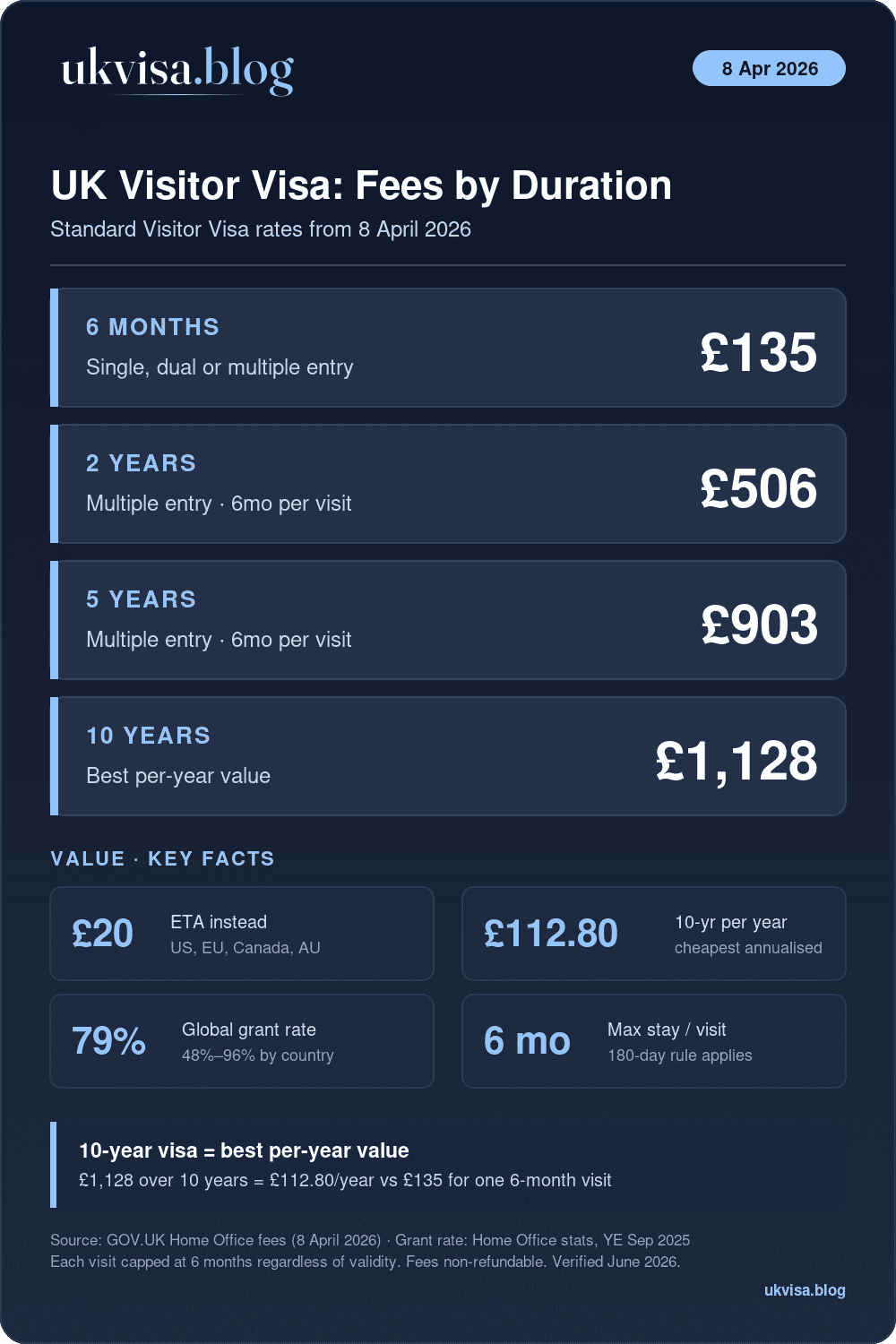
The Standard Visitor visa costs £135 for six months, or £506, £903 and £1,128 for two, five and ten years. Every visit is capped at six months whichever you hold. The famous 180-day rule is not a rule at all, and believing it is has cost people trips.
UK Short Stay Visas
Standard Visitor Visa UK: 2026 Overview
What the Standard Visitor Visa Covers
One consolidated route under Appendix V for tourism, family visits, business activity, private medical treatment and study of up to six months. It costs £135 for six months and is multiple-entry by default. Long-term versions run two, five or ten years, but each individual visit is still capped at six months. Visitors cannot work for a UK employer or claim public funds.
The route replaced the separate tourist, family and business visitor visas. What survives from those older categories is the activity list rather than the visa type — a single permission covering a wide set of permitted activities for visitors, from holidays to business meetings and private medical treatment.
The Numbers Behind the Route
In the year ending March 2026 the UK decided 2,827,533 visitor applications and granted 2,241,997 — a 79 per cent grant rate worldwide. India, China, Turkey, Nigeria and Pakistan lead by volume. The global figure hides an enormous spread by nationality, which is why the same application is routine from one country and difficult from another.
Do You Need a Visa or an ETA?
Check this before paying anything. Fees are not refunded when the wrong product is bought, and the two permissions are not interchangeable. GOV.UK's check if you need a UK visa tool settles it in a minute.
Visa Nationals and Visa-Exempt Nationals
| Group | Permission needed | Fee |
|---|---|---|
| Visa nationals — India, Pakistan, Nigeria, China, Turkey and others | Standard Visitor visa | £135 for six months |
| Visa-exempt — USA, Canada, Australia, EU, Japan, South Korea and others | Electronic Travel Authorisation | £20 |
Source: Home Office immigration and nationality fees, 8 April 2026.
If you hold a US, EU, EEA, Swiss, Canadian or Australian passport you almost certainly need an Electronic Travel Authorisation rather than this visa. Both can be applied for by phone app — the UK ETA app for an ETA, and the UK Immigration: ID Check app for a visa — with no visa application centre appointment.
Standard Visitor Visa Requirements 2026
The test sits at paragraph V 4.2 of Appendix V. You must be a genuine visitor: someone who will leave at the end of the visit, will not live in the UK for extended periods, will do only permitted things, and can pay for all of it without working or claiming public funds.
- Genuine purpose: a real reason to come that matches your circumstances.
- Departure: ties at home — work, property, family, study — that make return credible.
- Funds: enough to maintain and accommodate yourself for the whole stay.
- Return journey: the means to pay for it.
- Permitted activities only: nothing outside the published list.
- Not residence: you must not be making the UK your home through successive visits.
The Home Office's own visit guidance says it plainly: "There is no specified maximum period, which an individual can spend in the UK in any period, such as '6 months in 12 months'." No rule caps your annual total. What caseworkers actually assess is whether the pattern of visits amounts to living here — and someone can fail that test on far less than 180 days, or pass it on more.
What Caseworkers Weigh Instead
The guidance lists the real factors: how often you have visited in the past twelve months and for how long each time, the gaps between visits, whether you spend more time in the UK than at home, and whether you return home between trips or simply move around outside the Common Travel Area.
Then the residence markers. Registering with a GP, children enrolled in UK schools, no tax registration or long-term commitments abroad. Any of these can defeat an application from someone whose day count looked comfortable, because they answer the question the day count only gestures at.
What You Can Actually Do as a Visitor
More than most guides suggest. You may study for up to six months — not thirty days, which is the separate cap on recreational courses and on volunteering with a registered charity. You may work remotely for your overseas employer provided that is not the primary purpose of the trip.
You may also take a permitted paid engagement within 30 days of arriving, as a Standard Visitor — there is no separate visa for it any more. What you cannot do is work for a UK business, be self-employed here, do an internship, or sell directly to the public.
The Travel Itinerary — and What Not to Send
This is where popular advice and official guidance part company. GOV.UK's guide to supporting documents, updated 25 February 2026, carries a list of documents that are less useful as evidence in a visit application. Flight bookings and hotel bookings are both on it — flights count only where you are transiting.
- Travel: flight bookings (unless transiting), hotel bookings and travel insurance.
- Personal: photographs, business cards, driving licences, evidence of car ownership.
- Financial: credit card statements, photocopies of bank cards, and bank statements or letters issued more than a year before the application.
- Sponsor's household papers: their utility bills and council tax bills.
- Miscellaneous: notarial certificates, unrequired educational certificates, sports trophies and similar.
The guidance goes further and warns applicants directly: submitting documents does not guarantee that the application or entry at the border will succeed, and you should bear that in mind when making bookings — particularly where you need the visa before you travel. In other words, do not commit to non-refundable travel to prove you intend to travel.
What the Guidance Does Ask For
Evidence of your circumstances at home and of the activity you will do here. A letter from your employer on headed paper giving your role, salary and length of service; or from your education provider confirming enrolment and leave of absence; or business registration and recent invoices if you are self-employed.
Then previous passports showing travel to other countries, confirmation of legal residence if you are applying outside your country of nationality, and financial documents that show the origin of the funds rather than merely their presence. Where an inviting organisation is involved, their letter setting out what you will do and who is paying.
So Should You Write an Itinerary at All?
A short statement of what you plan to do is worth including, because it explains the visit and lets the caseworker match your purpose against your circumstances. What it should not do is rest on bookings. Describe the plan, evidence the ties and the funds, and leave the reservations until you hold the visa.
Financial Requirements
There is no minimum balance and no published daily figure. The guidance directs caseworkers to calculate the likely cost of the trip against your income and savings, less your ongoing commitments at home — mortgage, dependants, existing obligations. The question is whether the arithmetic works, not whether a threshold is cleared.
- Bank statements: six months from your own account, showing income arriving and normal spending.
- Employment: a letter confirming role, salary, length of service and approved leave, with payslips.
- Self-employment: business registration, tax returns and business account statements.
- Assets and ties: property documents or other commitments that also evidence your return.
- Sponsor's documents: where someone else is paying — see our visitor visa sponsorship guide.
Money That Arrived Last Month
Where funds appear recently, the guidance requires the origin to be verified. A genuine inheritance, bonus or property sale is fine once documented; an unexplained deposit shortly before applying reads as a balance assembled for the application. Funds must also sit with an institution listed in Appendix Finance.
Third-Party Support Has One Hard Condition
Support from family, friends or business contacts is permitted where the relationship is genuine. The condition that catches people is this: a sponsor in the UK must not be in breach of immigration law at the date of decision. The sponsor must also show funds beyond their own needs, and a previous failed sponsorship counts against them.
Visitor Visa Fees from 8 April 2026
Every fee below is non-refundable, including where a shorter visa than the one applied for is issued. Sub-route variants and country comparisons sit in our UK visitor visa fees guide.
What a Visit Costs
| Product | Fee | Notes |
|---|---|---|
| Standard Visitor, up to 6 months | £135 | Multiple entry by default |
| Long-term, 2 years | £506 | 6 months maximum per visit |
| Long-term, 5 years | £903 | 6 months maximum per visit |
| Long-term, 10 years | £1,128 | 6 months maximum per visit |
| Private medical treatment, 6 to 11 months | £234 | Separate product |
| Visitor extension in the UK | £1,172 | Main applicant and dependants |
| Electronic Travel Authorisation | £20 | Visa-exempt nationals |
Source: Home Office immigration and nationality fees, 8 April 2026.
Processing and Priority
Standard decisions run at about three weeks from biometrics. Priority service adds £500 for a target of five working days and super priority £1,000 for the next working day, where either is offered at your centre. Apply four to six weeks ahead — see our guides to processing time after biometrics and chasing a delayed decision, and the application form guide for the form itself.
Multiple Entry and Long-Term Visas
There is no separate multiple-entry application. Every Standard Visitor visa is multiple-entry, and the long-term versions simply extend how long that permission remains valid. Each individual visit is still capped at six months — see our long-term visitor visa guide for choosing between them.
Choosing a Validity Length
| Validity | Fee | Suits |
|---|---|---|
| 6 months | £135 | A single trip, or uncertain plans |
| 2 years | £506 | Two to four visits over the period |
| 5 years | £903 | Regular family visits or ongoing business |
| 10 years | £1,128 | Frequent travel and settled circumstances |
Source: Home Office immigration and nationality fees, 8 April 2026.
Two Traps in the Long-Term Products
An applicant under 18 receives a long-term visa valid only until six months after their eighteenth birthday, however many years they paid for. And where the Home Office issues a shorter visa than the one applied for — which the guidance encourages in borderline cases rather than refusing outright — the difference in fee is not refunded.
Extending from Inside the UK
Extensions exist but are narrow. The total stay generally cannot exceed six months, so an extension only helps someone granted less than that or facing genuinely unforeseen circumstances. Private medical treatment is the main exception, reaching eleven months. At £1,172 it costs nearly nine times the original visa — see our visit visa extension guide.
Grant Rates by Nationality
The 79 per cent global figure is close to meaningless for an individual applicant. What matters is the rate for your nationality, because it tells you how much scrutiny the file will attract before anyone reads it.
Visitor Grant Rates, Year Ending March 2026
| Nationality | Applications | Grant rate |
|---|---|---|
| South Africa | 78,219 | 96% |
| Ukraine | 51,809 | 93% |
| China | 526,905 | 92% |
| Turkey | 263,446 | 90% |
| India | 648,802 | 82% |
| Nigeria | 167,753 | 61% |
| Pakistan | 149,646 | 55% |
| Bangladesh | 37,612 | 46% |
Source: Home Office immigration statistics, year ending March 2026.
India files the most applications of any nationality and still refuses roughly 120,000 a year at an above-average rate. Full figures sit in our UK visa success rate guide.
Why Visitor Applications Are Refused
Almost every refusal comes back to the genuine visitor test, expressed through one of a small number of failures. Our guide to UK visa refusal reasons works through each, and the supporting documents guide covers what prevents them.
- Funds insufficient or unexplained: the arithmetic does not cover the trip, or the balance appeared recently.
- Weak ties at home: nothing that requires your return.
- Inconsistency: the form, the itinerary and the documents disagree.
- Immigration history: earlier overstaying or breaches, in the UK or elsewhere.
- Undeclared refusals: any refusal, from any country, left off the form — treated as deception.
- Pattern of visits: a history that reads as residence rather than visiting.
There Is No Appeal — but the Answer Is Usually Quick
Visitor refusals carry no right of appeal. You can reapply immediately, and a reapplication answering each stated reason is normally faster and cheaper than any challenge. Our guides to your chances after refusal and to exceptionally complex cases cover when advice is worth taking, and cancellation covers what happens at the border.
Sources: Appendix V of the Immigration Rules and the permitted activities appendix; Home Office visit caseworker guidance, version 17.0 of 25 February 2026; the fee table of 8 April 2026; and Home Office immigration statistics to March 2026. Marriage plans need the Marriage Visitor visa; switching inside the UK is covered in our switching guide. Figures verified 22 August 2026.
Frequently Asked
Questions about the Standard Visitor Visa
£135 for up to six months from 8 April 2026, £506 for two years, £903 for five years and £1,128 for ten. Priority adds £500 and super priority £1,000 where offered. Children pay the same as adults. No fee is refunded if the application is refused or if a shorter visa than the one applied for is issued.
No. The Home Office visit guidance states there is no specified maximum period a person can spend in the UK in any period, such as six months in twelve. What is assessed is whether the pattern of visits amounts to living here — frequency, length, gaps, time in the UK against time at home, and residence markers such as GP registration or children in UK schools.
No. US, EU, EEA, Swiss, Canadian, Australian, Japanese and most other visa-exempt nationals need an Electronic Travel Authorisation at £20, applied for through the UK ETA app. Buying a Standard Visitor visa instead wastes £135, because the fee is not refundable and the two permissions are not interchangeable.
Yes, for up to six months at an accredited institution. The thirty-day limit that circulates widely applies to something else — recreational courses, which cannot include English language training, and volunteering with a registered charity. Study for longer than six months needs a student route rather than a visit.
Yes. The permitted activities appendix allows a visitor to carry out activities relating to their overseas employment remotely from the UK, provided this is not the primary purpose of the visit. What remains prohibited is working for a UK business, being self-employed here, taking an internship, or selling directly to the public.
No. Permitted paid engagements are now an activity a Standard Visitor may undertake, listed at PA 19 of the permitted activities appendix, provided the engagement takes place within 30 days of entering the UK. The separate permitted paid engagement visa no longer exists as its own route.
No — GOV.UK’s guide to supporting documents lists hotel bookings and flight bookings among the documents that are less useful as evidence, flights counting only where you are transiting. It also warns applicants to bear in mind that documents do not guarantee success when making bookings. Evidence your circumstances and funds instead, and book once you hold the visa.
There is no minimum balance and no published daily figure. Caseworkers calculate the likely cost of your trip against your income and savings, minus your ongoing commitments at home. Bank statements showing the origin of the funds are what the guidance asks for; statements or letters issued more than a year before the application are treated as less useful.
Only narrowly. The total stay generally cannot exceed six months, so an extension helps mainly where less than six months was granted or something genuinely unforeseen intervenes. Private medical treatment reaches eleven months. The extension fee is £1,172 for the main applicant and dependants — nearly nine times the original visa.
You receive a refusal letter setting out the reasons, and there is no right of appeal against a visitor refusal made outside the UK. You may reapply immediately, and answering each stated reason with better evidence is usually faster than any other route. The refusal stays on your immigration history and must be declared in every future application.