
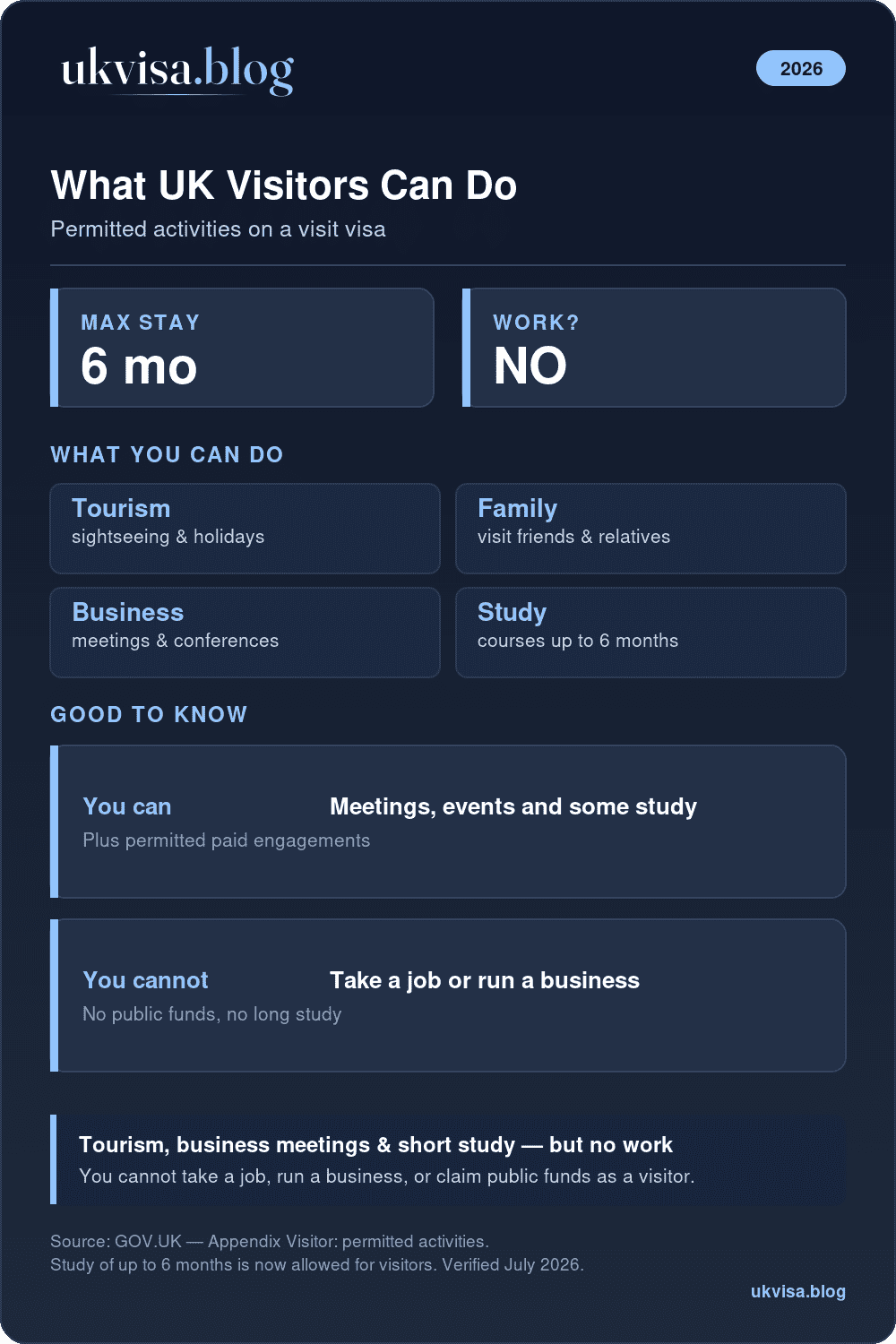
Every visitor visa carries a no-work condition. Appendix Visitor: Permitted Activities carves 19 categories out of it, from meetings to remote working to paid engagements. The test that decides refusals is not whether you worked — it is whether you filled a role.
UK Short Stay Visas
UK Visitor Visa Permitted Activities: Appendix V and PA 1-19
What Permitted Activities Are
The 19 categories at PA 1 to PA 19 of Appendix Visitor: Permitted Activities — the activities a visitor may undertake without breaching the no-work condition that Appendix V attaches to every visit visa. They run from tourism and volunteering through business meetings, intra-corporate work, academic and legal activities, performances, sport, private medical treatment, study of up to six months, transit and paid engagements.
Without the appendix a visitor could not lawfully attend a business meeting, because that would count as work. The carve-out exists to make ordinary visiting possible, and it draws its boundaries tightly: PA 1.4 provides that a permitted activity must not amount to employment or to filling a role, even temporarily.
Which Sub-Route Gets Which Activities
| Sub-route | Available categories | Key restriction |
|---|---|---|
| Standard Visitor | All of PA 1–19 | Genuine visitor test applied at every entry |
| Marriage or civil partnership visitor | Most, plus the marriage activities | No study and no paid engagements |
| Transit visitor | PA 18 only | 48 hours landside, or airside only |
| ADS visitor from China | Tourism only | Must travel with an approved tour group |
| Diplomatic visa arrangement visitor | Most categories | No clinical attachments, medical treatment, organ donation or study |
Source: Appendix V and Appendix Visitor: Permitted Activities of the Immigration Rules.
Two Appendices, One Test
Appendix V is the route: who may come as a visitor, the genuine visitor test at V 4.2, the prohibited activities at V 4.4 to V 4.5, and the no-work condition at V 17.1. Appendix Visitor: Permitted Activities is the schedule of what is allowed. The Visit caseworker guidance tells decision-makers how to apply both.
People searching for "Appendix V permitted activities" often expect the list to be inside Appendix V. It is not — Appendix V cites the PA paragraphs and the substance sits in the separate appendix. Knowing which document answers which question saves a great deal of time.
Where Each Question Is Answered
- Am I a genuine visitor? Appendix V, paragraph V 4.2.
- What is banned outright? Appendix V, V 4.4 to V 4.5.
- Why is work barred at all? The no-work condition at V 17.1.
- What may I actually do? Appendix Visitor: Permitted Activities, PA 1 to PA 19.
- Can I perform at this festival? The separately maintained Permit Free Festival List.
- How will this be decided? The Visit caseworker guidance, version 17.0 of 25 February 2026.
Tourism, Leisure and Volunteering
PA 2 covers the classic visit: holidays, seeing friends and family, weddings, graduations and funerals, and educational exchanges with UK schools. Repeated tourism over years is better served by a long-term visit visa than by reapplying, and where a UK host is involved our visitor visa sponsorship guide covers their documents.
The Two 30-Day Caps People Miss
Recreational courses under PA 2 — pottery, photography, cookery, yoga — are capped at 30 days and expressly exclude English language training. Volunteering under PA 3 is capped at 30 days in total and only with a charity registered with the Charity Commission, OSCR in Scotland or CCNI in Northern Ireland.
The Caps Are Hard Limits, and They Are Not the Study Rule
Enrolling on an eight-week recreational course breaches PA 2 even though study of up to six months is permitted elsewhere, because recreational courses carry their own shorter cap. English language classes belong under the six-month study allowance, not the 30-day recreational one. Volunteering beyond 30 days needs the Charity Worker route, and longer study a short-term study or Student route.
Volunteering also carries the role-filling constraint. Two days helping at a charity shop is unproblematic. A full-time volunteer schedule in a post the charity would otherwise pay someone to do is not, however genuine the motive.
Business Activities
PA 4 to PA 12 carry the largest practical caseload. Our business visitor guide covers what the invitation letter must say and what evidence of overseas employment is expected; this section sets out the underlying rules.
- Meetings and events: conferences, seminars and interviews.
- Speaking: one-off talks or a short series, not for profit and not a commercial event.
- Deals: negotiating and signing contracts.
- Trade fairs: promotional attendance only — no direct selling.
- Site visits: inspections and fact-finding for the overseas employer.
- Customer briefings: being briefed on UK requirements where the substantive work happens abroad.
- Remote work: activities relating to overseas employment, where that is not the primary purpose.
Intra-Corporate Work, and the Client-Facing Change
Employees of overseas companies may advise, consult, troubleshoot, train and share knowledge with UK colleagues in the same corporate group. Client-facing activity is permitted where it is incidental to the overseas employment — a narrow opening that lets an intra-corporate visitor join client meetings and support a UK project team. Internal auditors may audit UK branches of the same group.
Supply, Training and Professional Categories
PA 7 lets employees of overseas manufacturers and suppliers install, dismantle, repair, service or advise on machinery, equipment or software supplied to the UK under contract — the provision engineers rely on when commissioning equipment. PA 8 covers clients of UK export companies overseeing delivery.
PA 10 covers work-related training, including unpaid clinical attachments and PLAB or OSCE examinations for overseas medical, dental and nursing graduates. PA 11 covers academic exchange, collaboration and research, with senior doctors and dentists permitted teaching or clinical practice short of a permanent post. PA 12 covers overseas lawyers advising, arbitrating, mediating and drafting.
Remote Working and the Primary Purpose Test
The appendix permits a visitor to undertake activities relating to their employment overseas remotely from within the UK, "providing this is not the primary purpose of their visit". That last clause carries the whole rule.
A software engineer on holiday who answers urgent messages and joins a call is within PA 4. A software engineer who travels to the UK in order to work from here is not, whatever their itinerary says. The distinction is the reason for the journey, not the volume of work done during it.
What Remote Working Does Not Cover
The permission attaches to overseas employment. It does not extend to running an overseas business from the UK as a self-employed person, to freelancers whose UK time is itself the engagement, or to anyone whose primary intent is UK-based work. Where income is being generated through activity carried out here, a work route is the honest answer.
Religion, Performance, Sport, Medicine and Study
The specialised categories sit at PA 13 to PA 17 and usually carry extra requirements in Appendix V itself — medical visitors must satisfy V 7, organ donors V 8, and study visitors V 9.
The Specialised Categories at a Glance
| Category | What it permits |
|---|---|
| PA 13 — religion | Preaching and pastoral work while employed by an overseas religious organisation |
| PA 14 — creative | Performances, competitions, auditions, personal appearances, permit-free festivals; overseas film crews |
| PA 15 — sport | Competing, appearances, trials without a paying audience, unpaid training, amateur teams, officials |
| PA 16 — medical | Private medical treatment and organ donation |
| PA 17 — study | Study of up to six months at an accredited institution |
Source: Appendix Visitor: Permitted Activities; Appendix V paragraphs V 7 to V 9.
Two practical points. Anyone taking up a post in a UK religious organisation needs a Temporary Work or Minister of Religion route rather than PA 13. And the permit-free festival list changes, so a performer should confirm their festival is currently on it before treating the engagement as covered.
Medical Visitors and the NHS
PA 16 covers private treatment only, and Appendix V requires evidence that it is arranged, payable and completable within the visit. Visitors have no access to NHS care beyond emergencies — which is precisely why no Immigration Health Surcharge is charged on a visit visa. Longer courses of private treatment use the dedicated medical visitor product.
Permitted Paid Engagements
PA 19 is the only category that lets a visitor take payment from a UK source. Every other category bars UK-source income. The engagement must be completed within 30 days of entering the UK — counted from entry, not from the date of the engagement.
The separate PPE route closed. A paid engagement is now something a Standard Visitor may do, so a visa national applies for an ordinary Standard Visitor visa at £135 and undertakes the engagement within 30 days of arrival. Anyone still being told to apply for a "PPE visa" is working from withdrawn guidance — our paid engagements guide sets out the current position.
- Age: 18 or over on entry to the UK.
- Arranged in advance: invited before travel, with the invitation in writing.
- Within the listed categories: academic examining, expert lecturing at a higher education institution, designated aviation examining, examining for a professional body, a performing arts or entertainment engagement, or a sports engagement.
- Relevant: matching your expertise, qualifications and main overseas occupation.
- Completed within 30 days of arriving in the UK.
Prohibited Activities
Paragraphs V 4.4 and V 4.5 bar employment, work for a UK organisation outside the PA categories, self-employment, establishing or running a business, providing goods or services during the visit, and any activity amounting to filling a role even temporarily.
Most refusals on this ground are not cases where the declared activity sat wholly outside the list. They are cases where a listed activity was pushed until it looked like a job.
"Filling a Role" Is the Test, Not "Working"
One keynote at a conference is within PA 4. Daily talks across a four-week speaking tour starts to look like occupying a UK speaking post. Advising UK colleagues on an overseas project is within PA 5. Advising UK clients on UK-delivered work is not. The line is qualitative, and it decides the outcome.
Because of that, the declared purpose matters as much as the activity. Vague or inconsistent purpose statements drive refusals — see our guides to the application form, the supporting documents and the usual refusal reasons.
Border Decisions and Consequences
The genuine visitor test is applied at every entry, including on a ten-year multiple-entry visa with years left to run. Border Force will probe where the arriving picture does not match the declared purpose — a "tourism" visit arriving with branded materials and a full week of meetings invites exactly that.
When a Case Is Sent for Interview
Caseworkers can require a credibility interview where activities sit close to the prohibited boundary. Triggers include vague invitation letters, activities that do not match the applicant's overseas role, and previous refusals. Interviewed cases fall outside the ordinary three-week decision window — see our guides to processing time, delays and priority services.
- Refusal at the border: entry denied, return at your own expense, recorded on your immigration history — the reasons appear in your refusal notice.
- Cancellation in-country: a valid visa can be cancelled where prohibited activity is found — see cancelled visitor visas.
- Re-entry bans: from 12 months to 10 years depending on the conduct — our re-entry ban guide sets out the tiers.
- Future applications: the record must be declared on every subsequent application, in the UK and elsewhere.
- Prosecution: possible in serious cases of sustained illegal working.
Sources: Appendix V of the Immigration Rules; Appendix Visitor: Permitted Activities; Home Office visit caseworker guidance, version 17.0 of 25 February 2026; and the fee table of 8 April 2026 — current visit fees sit in our visitor visa fees guide, and nationality outcomes in our UK visa success rate data. Figures verified 22 August 2026.
Frequently Asked
Questions about Permitted Activities
The 19 categories at PA 1 to PA 19 of Appendix Visitor: Permitted Activities: tourism and leisure, volunteering up to 30 days, general business, intra-corporate work, manufacture and supply, clients of UK exporters, overseas employment activities, work-related training, science and academia, legal services, religion, creative work, sport, medical treatment and organ donation, study up to six months, transit, and permitted paid engagements.
Yes, for your overseas employer, provided that is not the primary purpose of the visit. Answering messages and joining calls while here on holiday or for meetings is within the rules. Travelling to the UK in order to work from a UK base is not, and the permission does not extend to running an overseas business as a self-employed person or to freelancers whose UK time is the engagement itself.
Attend meetings, conferences, seminars and interviews; give one-off talks that are not commercial; negotiate and sign contracts; attend trade fairs promotionally without selling; carry out site visits; gather information for your overseas employer; and be briefed on UK customer requirements where the substantive work happens abroad. Intra-corporate visitors may also advise, train and troubleshoot within their own corporate group.
Yes, for up to six months at an accredited institution, including English language courses. That is a different allowance from recreational courses, which are capped at 30 days and expressly exclude English language training. Marriage visitors and diplomatic visa arrangement visitors cannot use the study category at all, and courses over six months need a study route.
No — that separate route no longer exists. A paid engagement is now an activity a Standard Visitor may undertake, so a visa national applies for an ordinary Standard Visitor visa at £135. The engagement must be arranged before travel, fall within the listed professional categories, match your overseas occupation, and be completed within 30 days of entering the UK.
Yes, for up to 30 days in total, and only with an organisation registered with the Charity Commission for England and Wales, OSCR in Scotland or CCNI in Northern Ireland. The volunteering must not amount to filling a role, so short-term help at an event is fine while a full-time volunteer post the charity would otherwise pay for is not. Beyond 30 days the Charity Worker route applies.
The rule that a permitted activity must not amount to employment or to occupying a post, even temporarily. It is what decides most refusals in this area: the declared activity usually is on the list, but has been extended until it resembles a job. One keynote is a permitted activity; a four-week speaking tour delivered daily begins to look like filling a UK role.
Employment, work for a UK organisation outside the permitted categories, self-employment, establishing or running a business, providing goods or services during the visit, and anything amounting to filling a role. Taking payment from a UK source is also barred except for a permitted paid engagement, and prize money and reimbursed expenses within the specified exceptions.
Border Force can refuse entry on arrival, with return at your own expense and the refusal recorded. A visa can be cancelled in-country where prohibited activity is found. Re-entry bans run from 12 months to 10 years depending on the conduct, the record must be declared in every future application worldwide, and sustained illegal working can bring prosecution.