
The Standard Visitor Visa UK is the main route for tourists, family visitors, and business travellers entering the United Kingdom. From 8 April 2026, the visa fee is £135 for a 6-month visa (up from £127), with long-term options at £506 (2 years), £903 (5 years), or £1,128 (10 years). This 2026 guide covers every requirement, the document checklist, sample travel itineraries, success rates by nationality, and the visa-vs-ETA decision for visa-exempt nationals.
Source: Home Office Immigration System Statistics, year ending March 2026
Globally, the UK granted 2,241,997 visitor visas from 2,827,533 decisions in the year ending March 2026 — a 79% approval rate. But that average masks dramatic variation: South African applicants achieve 96% approval; Bangladeshi applicants only 46%. The same evidence and itinerary that easily wins approval from one country may face heavy scrutiny from another. Understanding your country-specific approval rate is the single most useful piece of intelligence for your application strategy.
- Standard Visitor Visa UK: Overview
- Do I Need a Visa or an ETA?
- Standard Visitor Visa Requirements 2026
- Travel Itinerary for UK Visa
- Financial Requirements
- UK Visitor Visa Fees 2026 (8 April 2026 Rates)
- Multiple Entry & Long-Term Visitor Visas
- Visitor Visa Success Rate by Nationality
- Common Refusal Reasons and How to Avoid Them
- Frequently Asked Questions
Standard Visitor Visa UK: 2026 Overview
The Standard Visitor Visa UK is the consolidated entry route covering tourism, family visits, business meetings, private medical treatment, and short courses of study up to 6 months. It replaced the previous separate tourist, family, and business visitor visas under the Immigration Rules Appendix V. The visa allows stays of up to 6 months per visit and can be issued for 6 months, 2 years, 5 years, or 10 years — though each individual visit remains capped at 6 months regardless of validity length.
Year ending March 2026 statistics show the UK decided 2,827,533 visitor visa applications and granted 2,241,997 — a 79% global grant rate. India, China, Turkey, Nigeria, and Pakistan are the top five source countries by application volume. Understanding requirements and presenting a strong application is essential, particularly for nationalities with lower approval rates.
Do I Need a Visa or an ETA?
Visa-exempt nationals (USA, Canada, Australia, EU countries, and most developed economies) require an Electronic Travel Authorisation (ETA — £20 from 8 April 2026), NOT a Standard Visitor Visa. Visa nationals (most non-European nationals) need this Standard Visitor Visa (£135 from 8 April 2026). Check the gov.uk visa national list to confirm which applies to you. Booking the wrong type wastes the fee — it is non-refundable.
Before applying for a Standard Visitor Visa, confirm that you actually need one. The UK distinguishes between two groups — you can verify your own status using the official check if you need a UK visa tool:
| Group | Permission Type | Fee | Examples |
|---|---|---|---|
| Visa Nationals | Standard Visitor Visa (this guide) | £135 (6 months) | India, Pakistan, Nigeria, China, Turkey |
| Visa-Exempt Nationals | Electronic Travel Authorisation | £20 | USA, Canada, Australia, EU, Japan, South Korea |
If you are a US citizen, EU/EEA/Swiss national, or from another visa-exempt country and search arrives here, you almost certainly need an ETA rather than a visitor visa. EU/EEA/Swiss nationals can use two smartphone apps for UK applications: the UK ETA App for ETA applications and the UK Immigration: ID Check App for visa applications — neither requires an appointment at a visa application centre.
Standard Visitor Visa UK Requirements 2026
You must be a genuine visitor who intends to leave the UK at the end of your visit, can support yourself financially without working or accessing public funds, can pay for your return journey, and will only undertake permitted activities. You must not intend to live in the UK through frequent or successive visits — known informally as the 180-day rule.
To qualify for a Standard Visitor Visa, you must demonstrate that you meet the eligibility criteria set out in Appendix V paragraphs V4.2(a)-(e). The Home Office assesses whether you are a genuine visitor with legitimate reasons to enter and sufficient ties to your home country to ensure your return — the full Appendix V genuine-visitor rules set out the statutory test caseworkers apply.
Eligibility Requirements at a Glance
- Genuine intention: You must genuinely intend to visit the UK for a permitted purpose
- Will leave the UK: You must demonstrate strong ties to your home country ensuring your return at the end of the visit
- Sufficient funds: You can financially support yourself and any dependents during the trip without working or accessing public funds
- Return travel: You can pay for your return or onward journey
- Permitted activities: Your planned activities fall within the scope of what visitors are allowed to do, such as tourism, business meetings, family visits, or private medical treatment
- 180-day rule: You must not live in the UK through frequent or successive visits — the Home Office monitors whether visitors spend more than 180 days in any 12-month period
What is the 180-Day Rule for UK Visitors?
Although each Standard Visitor Visa allows stays of up to 6 months per visit, the Home Office expects visitors not to spend more than 180 days in the UK within any rolling 12-month period. Spending close to 6 months on every visit may lead to questioning at the border or future visa refusals, as it suggests you are effectively living in the UK rather than visiting.
The 180-day rule is a practical guideline used by UK Border Force officers rather than a formal legal limit. If you hold a long-term visitor visa (2, 5, or 10 years), you can make multiple entries, but each visit should be proportionate and you should spend the majority of your time outside the UK. Visitors who repeatedly stay for 5-6 months may face refusal of entry or cancellation of their visa — see visitor visa cancelled, revoked or curtailed for the consequences.
Document Checklist for Standard Visitor Visa
The document requirements you submit play a crucial role in demonstrating your eligibility. While the Home Office does not provide a mandatory checklist, the following documents are strongly recommended:
| Document Type | Details Required |
|---|---|
| Valid Passport | Must be valid for the duration of your stay with at least one blank page |
| Bank Statements | Last 6 months showing regular income and sufficient funds |
| Employment Evidence | Employment letter confirming role, salary, and approved leave; payslips; or business registration if self-employed |
| Travel Itinerary | Flight bookings, hotel reservations, and day-by-day planned activities |
| Accommodation Proof | Hotel bookings or sponsor's invitation letter with proof of their address and status |
| Ties to Home Country | Property ownership, family commitments, ongoing employment, or enrolled education |
| Previous Travel History | Old passports showing compliance with previous visa conditions |
Travel Itinerary for UK Visa
A travel itinerary is strongly recommended for UK visa applications although not technically mandatory. Day-by-day plans showing where you will go, what you will do, and where you will stay significantly strengthen applications by demonstrating genuine tourist intentions. The itinerary should align with your accommodation bookings and flight tickets.
How to Write a Flight Itinerary for UK Visa
A flight itinerary should show your planned arrival and departure dates, departure city, arrival airport in the UK, and return flight details. You can provide a confirmed booking or a flexible/refundable reservation. Many applicants use airline "hold" bookings to avoid financial loss if the visa is refused.
Your flight itinerary must show both entry to and exit from the UK. Some visa application centres accept flight itineraries (showing intended dates) rather than confirmed paid bookings, which is particularly useful for applicants who want to avoid the financial risk of purchasing non-refundable tickets before receiving their visa.
Sample UK Visa Travel Itinerary (10 Days)
Below is a sample itinerary for a 10-day UK tourist visa application. Adapt this template to your own specific plans, ensuring your itinerary matches your accommodation bookings and stated purpose of visit:
- Day 1: Arrive London Heathrow, transfer to hotel in Westminster, evening walk along South Bank
- Day 2: Tower of London, Tower Bridge, Borough Market, dinner in Covent Garden
- Day 3: Westminster Abbey, Houses of Parliament, Buckingham Palace, West End theatre show
- Day 4: British Museum, National Gallery, afternoon tea in Mayfair
- Day 5: Day trip to Oxford by train — university colleges, Ashmolean Museum, Bodleian Library
- Day 6: Visit family or friends in [City] — staying overnight at their home
- Day 7: Return to London, Camden Market, Natural History Museum, evening in Soho
- Day 8: Day trip to Bath — Roman Baths, Bath Abbey, Royal Crescent
- Day 9: Shopping at Oxford Street and Harrods, Hyde Park walk, farewell dinner
- Day 10: Check out of hotel, last-minute sightseeing, depart from London Heathrow
If your visit includes purposes beyond tourism — such as attending a business conference, receiving private medical treatment, getting married under the Marriage Visitor visa, or speaking under the Permitted Paid Engagement visa — include those activities in your itinerary with relevant supporting evidence such as conference invitations, hospital appointment letters, or wedding venue bookings.
Financial Requirements for Standard Visitor Visa
You need bank statements for the last 6 months showing your name, account number, regular income deposits, and a healthy balance covering your trip costs (typically £100-£150 per day excluding flights/accommodation). Statements should demonstrate consistent financial activity over the full period, not just a sudden large deposit before the application. If someone else is funding your trip, include their financial documents and a sponsorship letter.
Demonstrating sufficient funds is one of the most critical aspects of your Standard Visitor Visa application. The Home Office does not specify a fixed minimum bank balance, but you must show you can cover all trip costs — including flights, accommodation, food, transport, and activities — without working or accessing public funds.
- Bank statements: 6 months of statements showing regular income and transactions from your personal account
- Employment letter: Confirming your position, salary, length of service, and approved leave dates
- Payslips: Recent payslips (3-6 months) showing consistent salary payments
- Self-employed: Business registration, recent tax returns, and company bank statements
- Property ownership: Title deeds or mortgage statements demonstrating assets and ties to your home country
- Sponsor support: If a UK-based sponsor is funding your visit, include their bank statements, employment letter, and a signed undertaking — see the visitor visa sponsorship guide referenced in the document checklist above for full details
UK Visitor Visa Fees 2026 (8 April 2026 Rates)
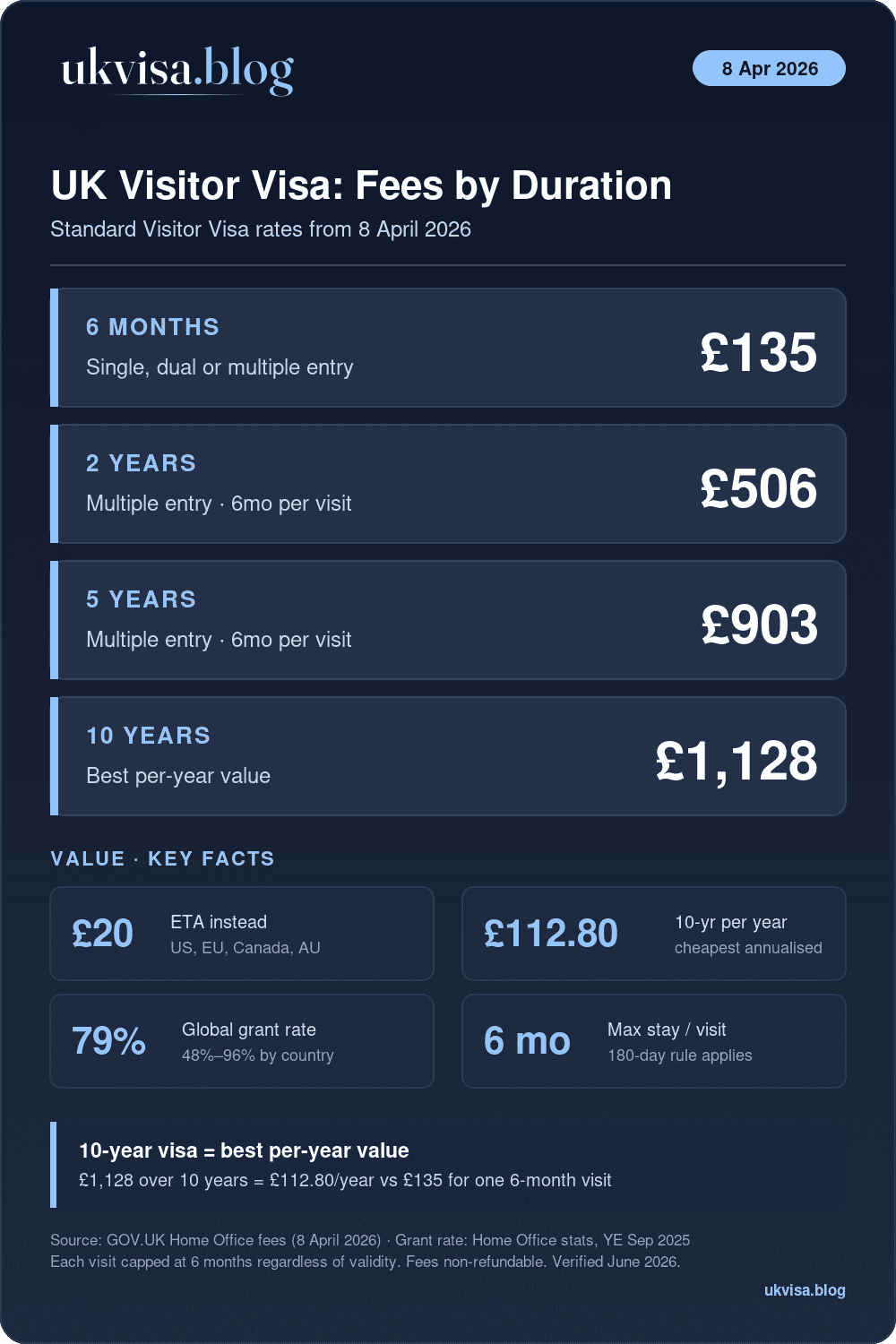
From 8 April 2026, UK visitor visa fees are: £135 for 6 months, £506 for 2 years, £903 for 5 years, and £1,128 for 10 years. All visitor visa fees are non-refundable, even if your application is refused. Optional priority service costs £500 extra (5 working days); super priority £1,000 extra (next working day).
UK visitor visa fees increased on 8 April 2026 across all categories. For the complete fee breakdown including sub-route variants (Marriage, PPE, Medical, Transit) and country-specific cost contexts, see our dedicated UK visitor visa fees guide.
| Visa Duration | Fee (8 Apr 2026) | Notes |
|---|---|---|
| Up to 6 months | £135 | Standard visitor visa — single, dual, or multiple entry |
| 2-year long-term | £506 | Multiple entry, 6 months maximum per visit |
| 5-year long-term | £903 | Multiple entry, 6 months maximum per visit |
| 10-year long-term | £1,128 | Multiple entry, 6 months maximum per visit |
| Priority Service | +£500 | Decision within 5 working days (subject to availability) |
| Super Priority | +£1,000 | Decision by next working day (subject to availability) |
How Long Does UK Visitor Visa Processing Take?
Standard UK visa processing takes approximately 3 weeks from your biometrics appointment. Priority service (additional £500) targets a decision within 5 working days, and Super Priority (additional £1,000) the next working day. Processing times may be longer during peak seasons or if additional security checks are required — around 10–20% of visitor applications experience UK visa delays beyond the standard window, particularly for cases flagged as Non-Straightforward.
Apply at least 4-6 weeks before departure to allow for standard processing plus any unexpected delays. Use the UK visa application form guide for help completing the form questions, and refer back to the document checklist section above for what to upload.
Multiple Entry & Long-Term Visitor Visas
The Standard Visitor Visa is automatically multiple-entry as standard — you do not need a separate "multiple entry visa" application. Long-term variants (2, 5, and 10 years) all permit unlimited entries during their validity, with each visit capped at 6 months. The 10-year visa offers the best per-year value at £112.80/year, but is non-refundable if circumstances change.
A common source of confusion: the Standard Visitor Visa includes multiple-entry as default. There is no separate "BIVS" (British Irish Visa Scheme) or "multiple entry visa" — these are sometimes searched but refer to either the Standard Visitor Visa itself or specific bilateral arrangements with Ireland. For a detailed guide on which validity duration suits your travel pattern, see the multi-year visa duration guide.
When to Choose Each Validity Length
- 6-month visa (£135): Best for one-time visits or uncertain travel plans
- 2-year visa (£506): Ideal if you'll visit 2-4 times over two years
- 5-year visa (£903): Good for regular family visits or ongoing business relationships
- 10-year visa (£1,128): Best per-year value (£112.80) for frequent travellers with stable circumstances
Applicants under 18 will only receive a long-term visa valid until 6 months after their 18th birthday, and the higher fee is not refundable if a shorter visa is issued. Chinese nationals applying in mainland China may receive a 2-year visa for the standard £135 fee under the UK-China visa scheme.
Can I Extend My Standard Visitor Visa?
Visitor visa extensions are only granted in exceptional circumstances, such as ongoing private medical treatment or being unable to travel due to unforeseen events. You cannot extend simply because you want to stay longer. Applications must be made before your current leave expires, and even when granted, your total stay typically cannot exceed 6 months (or 11 months for medical visitors receiving private treatment).
Visitor Visa Success Rate by Nationality
The overall UK visitor visa grant rate is 79%, with 2,241,997 visas granted from 2,827,533 decisions in the year ending March 2026. Approval rates vary significantly by nationality — from 96% for South African applicants to 46% for Bangladeshi applicants. India processes the most applications (648,802) at an above-average 82% approval rate.
Understanding your country's specific approval rate helps identify areas to strengthen in your application. The Home Office publishes detailed statistics by nationality:
| Nationality | Applications (YE Mar 2026) | Grant Rate (YE Mar 2026) |
|---|---|---|
| South Africa | 78,219 | 96% |
| Ukraine | 51,809 | 93% |
| Russia | 50,147 | 93% |
| China | 526,905 | 92% |
| Indonesia | 42,461 | 90% |
| Turkey | 263,446 | 89% |
| Thailand | 53,346 | 89% |
| India | 648,802 | 82% |
| Nigeria | 167,753 | 61% |
| Ghana | 45,811 | 57% |
| Pakistan | 149,646 | 55% |
| Bangladesh | 37,612 | 46% |
India alone accounts for 648,802 applications — the highest of any nationality — with around 120,000 refusals despite an above-average 82% approval rate. For applicants from countries with lower grant rates, presenting thorough financial evidence, strong ties to your home country, and a detailed travel itinerary is particularly important. For a full breakdown across all nationalities and country-specific application guidance, see our UK visa success rate guide.
Common Refusal Reasons and How to Avoid Them
Understanding why applications are refused helps avoid common pitfalls. The most common UK visa refusal reasons for visitor visa applications relate to financial evidence, ties to home country, and inconsistencies in the application.
- Insufficient funds: Unable to demonstrate adequate finances to cover the entire trip including flights, accommodation, and daily expenses
- Weak ties to home country: No compelling evidence of employment, property, or family obligations requiring your return
- Incomplete application: Missing documents, unanswered questions, or gaps in your supporting evidence
- Inconsistent information: Discrepancies between your application form answers and supporting documents
- Previous immigration violations: History of overstaying or breaching visa conditions in the UK or other countries
- Undisclosed refusals: Failing to declare previous visa refusals from any country — this is treated as deception
If your visitor visa application is refused, you cannot appeal but you can reapply immediately after addressing the specific reasons given in your visitor visa refusal letter. For detailed guidance on reapplying, see our guide on your chances of getting a visa after refusal. For particularly complex cases involving previous refusals or immigration history, consider seeking professional advice from immigration solicitors who specialise in complex visitor visa applications.
- Standard Visitor Visa fee: £135 from 8 April 2026 (was £127)
- Long-term variants: £506 (2yr) / £903 (5yr) / £1,128 (10yr)
- Visa-exempt nationals (US, EU, Canada, Australia) need an ETA (£20), not this visa
- Global grant rate is 79%, but varies dramatically by nationality (46-96%)
- Always provide a detailed travel itinerary with flight bookings and day-by-day plans
- Six months of bank statements showing consistent finances are essential — avoid large unexplained deposits
- Standard processing takes approximately 3 weeks; apply at least 4-6 weeks before travel
- Each visit limited to 6 months maximum, with the 180-day rule applying to frequent visitors
- Multiple-entry is automatic — long-term visas all permit unlimited entries during validity
For complete official guidance on the application process, eligibility criteria, and permitted activities, visit the gov.uk visas and immigration pages.
Frequently Asked Questions about Standard Visitor Visa UK
From 8 April 2026, the UK Standard Visitor Visa costs £135 for 6 months (up from £127), £506 for 2 years, £903 for 5 years, or £1,128 for 10 years. Optional priority service costs £500 extra; super priority £1,000 extra. Children pay the same fee as adults — no reduced rate for under-18s.
You can stay for a maximum of 6 months per visit on a Standard Visitor Visa. This limit applies regardless of whether you have a 6-month, 2-year, 5-year, or 10-year visa. Long-term visas allow multiple entries, but each individual visit must not exceed 6 months. The UK Border Force officer at your port of entry determines your actual permitted stay duration.
US citizens are visa-exempt and need an Electronic Travel Authorisation (ETA), NOT a Standard Visitor Visa. The ETA costs £20 from 8 April 2026 and is applied for via the UK ETA app. The same applies to EU/EEA/Swiss nationals, Canadians, Australians, Japanese, and most other developed-economy nationals. Visa-required nationals (India, Pakistan, Nigeria, China, etc.) need this Standard Visitor Visa instead.
While not technically mandatory, a travel itinerary is strongly recommended and significantly strengthens your Standard Visitor Visa application. Include day-by-day plans, accommodation bookings, and flight details that align with your stated purpose of visit. Applications without itineraries may face additional scrutiny.
No, you cannot undertake paid or unpaid work on a Standard Visitor Visa. You also cannot study for more than 30 days unless the study is not the main purpose of your visit. Permitted activities include tourism, family visits, attending business meetings and conferences, receiving private medical treatment, and participating in certain sporting or creative events. For permitted paid engagements, you need a separate PPE visa endorsement.
There is no fixed minimum bank balance requirement. You must demonstrate sufficient funds to cover your entire trip costs including accommodation, food, transport, and planned activities without accessing public funds. As a general guideline, budgeting £100-£150 per day plus accommodation and flights is typical. Your bank statements should show consistent income and spending patterns over 6 months, not just a recent large deposit.
The overall UK visitor visa grant rate is 79% according to Home Office Immigration System Statistics (year ending March 2026). However, approval rates vary significantly by nationality — South Africa enjoys a 96% grant rate, while Bangladesh has the lowest at 46%. India processes the most applications (648,802) with an 82% approval rate.
Visitor visa extensions are only granted in exceptional circumstances, such as ongoing private medical treatment or being unable to travel due to unforeseen events. You cannot extend simply because you want to stay longer. Applications must be made before your current leave expires. If granted, your total stay still cannot exceed 6 months (or 11 months for medical visitors receiving private treatment).
If your Standard Visitor Visa is refused, you will receive a refusal letter explaining the specific reasons. There is no right of appeal for visitor visa refusals made outside the UK. However, you can reapply immediately after addressing the issues raised in the refusal notice. Your refusal will be recorded on your immigration history and must be declared honestly in all future applications.
Yes — the Standard Visitor Visa is automatically multiple-entry as standard, regardless of validity length. There is no separate "multiple entry visa" application. The 6-month, 2-year, 5-year, and 10-year variants all permit unlimited entries during their validity, with each individual visit capped at 6 months and the 180-day rule monitoring overall presence.